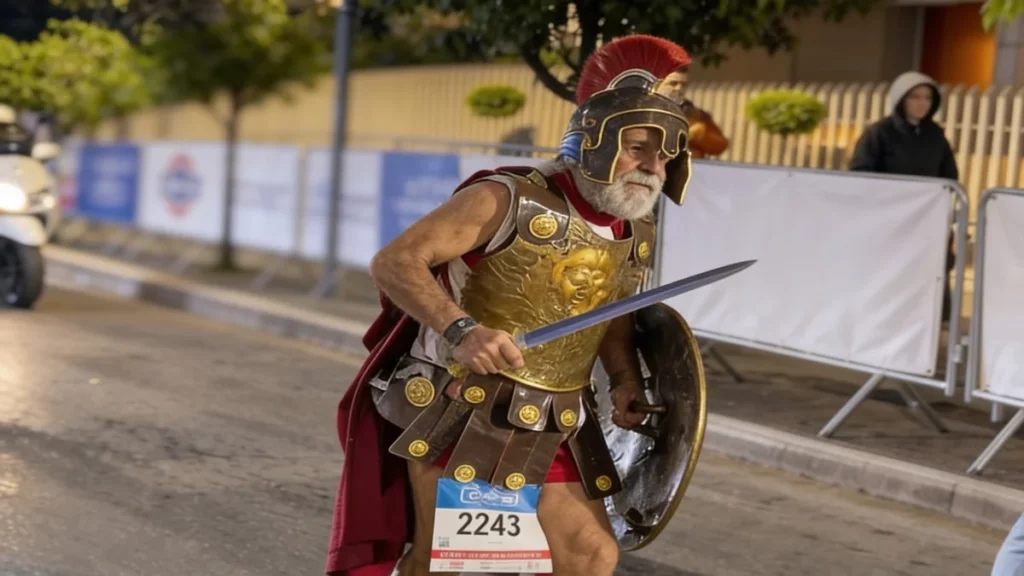
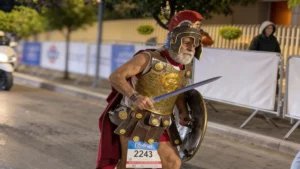

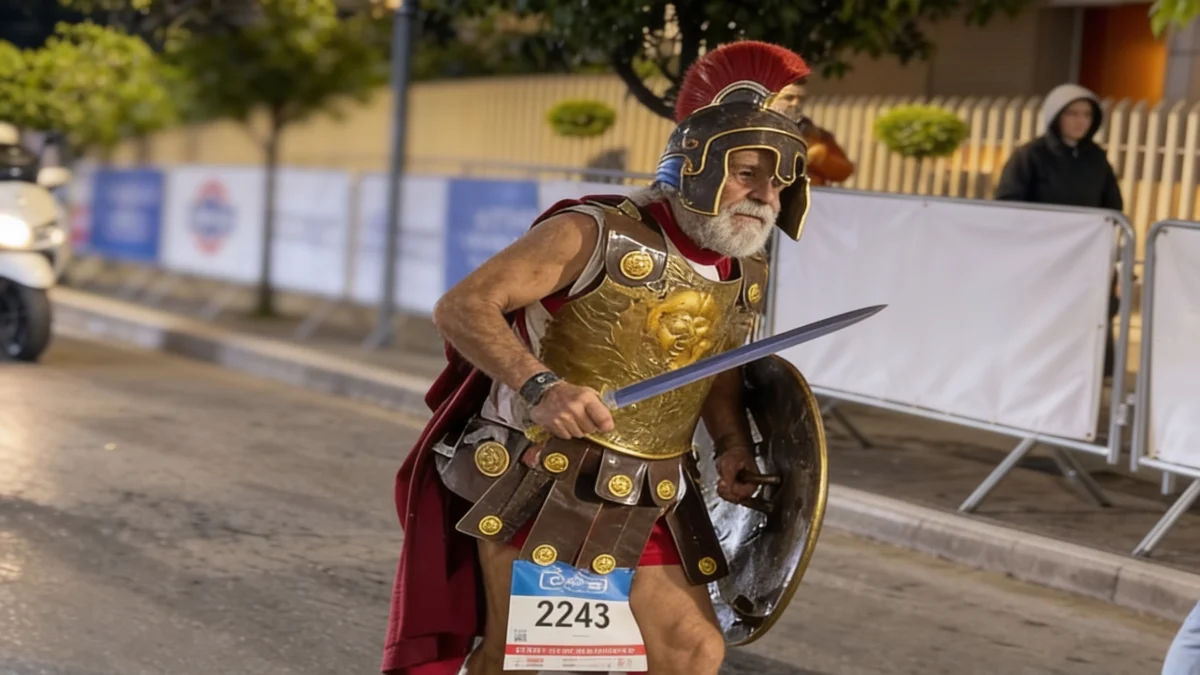
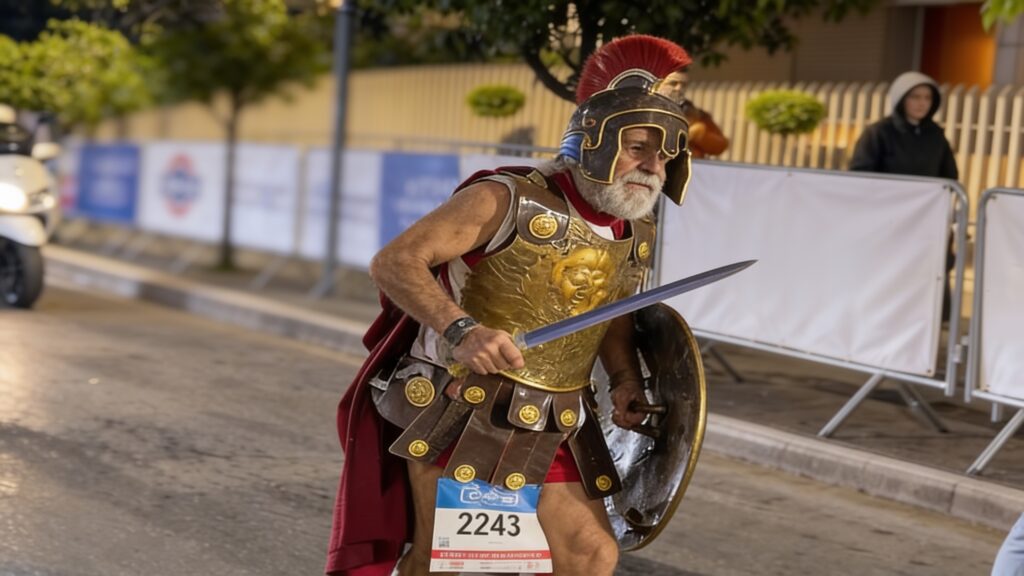
ATHENS — In a feat that bridges ancient legend and modern endurance, a 75-year-old Greek man named Idomeneas Avramakis reportedly crossed the finish line of the Athens Authentic Marathon completely barefoot while dressed in the traditional armor of an ancient Greek warrior.
The achievement, which has quickly captured the imagination of runners and sports enthusiasts worldwide, is made even more astonishing by Avramakis’s personal backstory. According to reports circulating across social media platforms, including a widely shared post by The Running Week, Avramakis is a survivor of intensive care who carries a metal rod in his leg. Transitioning from a hospital bed and orthopedic recovery to conquering one of the most grueling marathons on Earth without footwear or modern athletic gear represents a narrative of human resilience that borders on the mythic.
While the story carries elements that sound more akin to classical mythology than modern sports reporting, it has sparked widespread fascination regarding the limits of human endurance, aging, and the psychological drive required to overcome profound physical setbacks.
The Athens Authentic Marathon is widely regarded as one of the most demanding road races in the world. The course faithfully traces the historic and legendary route run by the messenger Pheidippides in
490 BC, who, according to ancient accounts, ran from the coastal town of Marathon to Athens to announce the Greek victory over the Persians before collapsing and dying from exhaustion. Modern runners face a punishing, uphill climb from roughly the 10-kilometer mark to the 31-kilometer mark, making the course significantly tougher than flat, modern city marathons like those held in Berlin or Chicago.
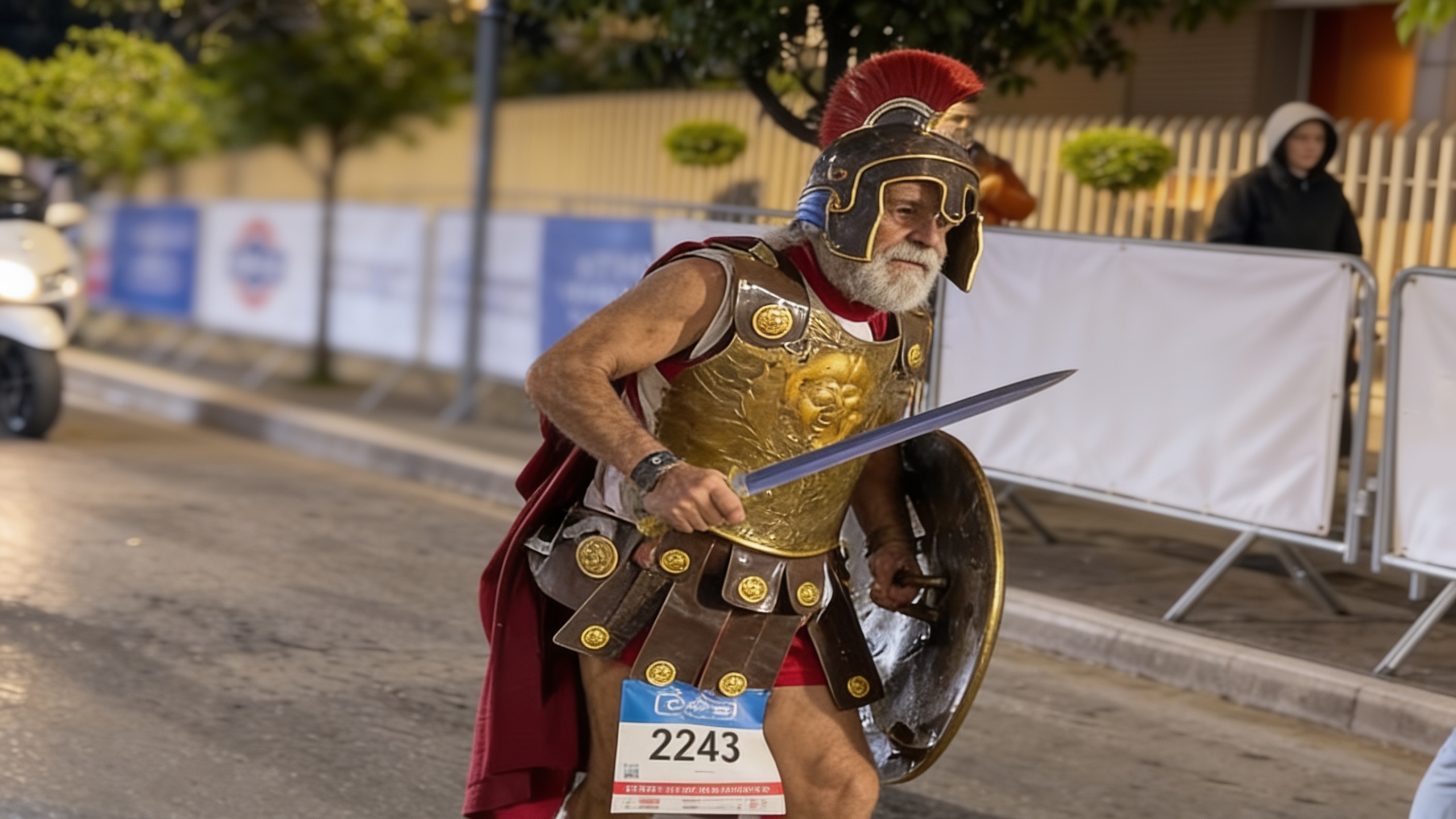
To tackle this punishing route while dressed as an ancient Greek hoplite adds an extraordinary layer of physical strain. Historically, a fully equipped hoplite carried a heavy bronze-and-leather panoply, which included a breastplate, helmet, greaves for the shins, a large round shield known as an aspis, and a heavy wooden spear. A complete kit typically weighed anywhere from 15 to 30 kilograms, translating to roughly 33 to 66 pounds of extra weight. Even if Avramakis wore a partial or lightweight replica of the ancient gear, carrying any load of armor over a distance of 42.195 kilometers places immense pressure on the cardiovascular system, spine, and lower extremities.
Compounding the difficulty of the armor is Avramakis’s decision to run the entire distance barefoot. The practice of barefoot running remains a subject of ongoing debate among sports scientists, podiatrists, and running coaches. Supporters of barefoot running argue that shedding modern, cushioned shoes encourages a natural forefoot strike rather than a heavy heel strike, which can potentially reduce certain impact-related injuries and strengthen the intrinsic muscles of the foot.
Conversely, skeptics and sports medicine specialists point out that running 26.2 miles barefoot on hard, abrasive asphalt surfaces introduces severe risks, including friction burns, deep bruising, lacerations, and overuse injuries in the tendons and bones of the lower leg. For an older athlete, the lack of shock absorption makes the choice particularly risky, requiring meticulous conditioning and an exceptional degree of physiological adaptation.
Perhaps the most remarkable aspect of Avramakis’s reported feat is his medical history. The presence of a metal rod in his leg indicates that he previously underwent orthopedic surgery involving an intramedullary nail, a medical device surgically inserted inside the bone shaft to stabilize and heal severe fractures of the femur or tibia. While modern orthopedics successfully returns many patients to active lifestyles after thorough rehabilitation and physical therapy, pushing an augmented limb through the extreme repetitive stress of a marathon while bearing additional weight and lacking footwear crosses into uncharted territory.
Sports medicine professionals generally advise extreme caution for individuals with significant orthopedic hardware who wish to engage in high-impact, ultra-endurance sports. Long-distance running places thousands of pounds of cumulative force on the lower limbs, and structural modifications within the bone can alter biomechanics, affect load distribution, and increase stress concentrations around the surgical site. The fact that Avramakis managed to complete the historic route under such conditions has left medical observers both astounded and urging everyday athletes not to attempt similar exploits without comprehensive medical supervision and training.
Despite the extraordinary nature of the account, independent journalistic verification of Avramakis’s age, medical records, and the exact specifications of his armor remains limited, with the narrative originating primarily from social media documentation. Observers note that while the specific details await broader corroboration, the symbolic weight of the narrative resonates deeply within the running community.
Stories of aging athletes defying physical limitations serve as a powerful counter-narrative to the conventional view that growing older necessitates a steady retreat from physical vigor. Whether viewed as an inspiring testament to human determination or an extreme athletic anomaly, Avramakis’s journey along the historic road from Marathon to Athens highlights the enduring capacity of the human spirit to overcome profound physical adversity long after traditional retirement age.