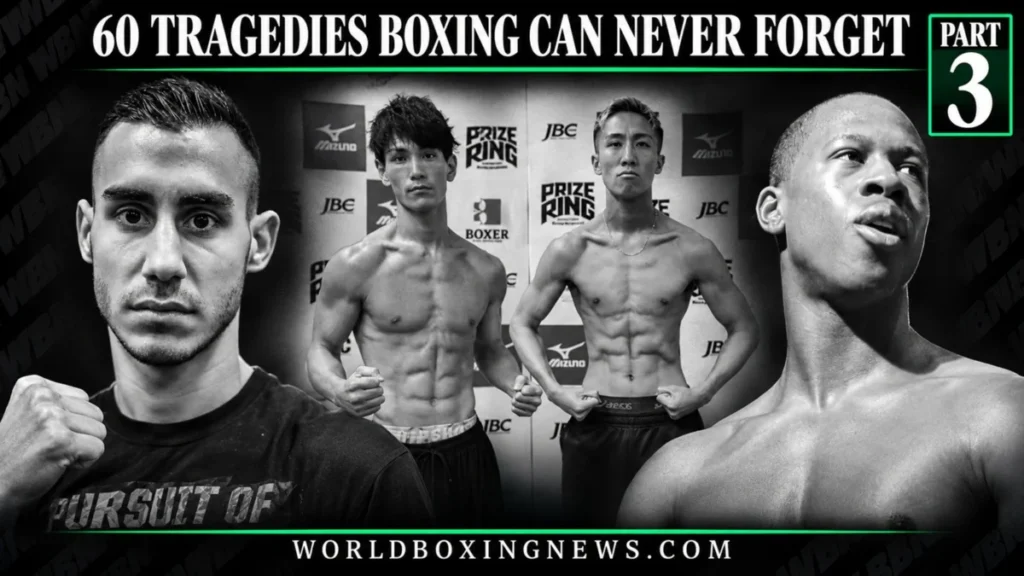
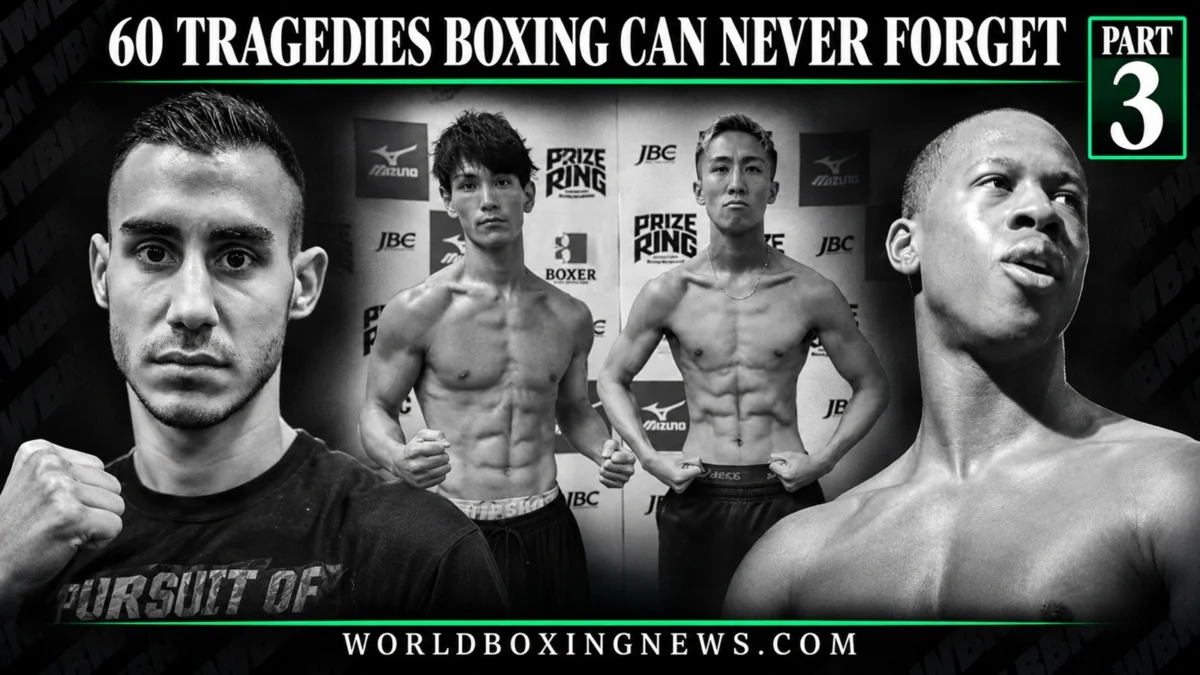
World Boxing News is continuing its landmark series, 60 Tragedies Boxing Can Never Forget, reaching the halfway mark with its third installment. The retrospective honors the memory of 11 fighters across 10 deeply tragic events that left an indelible mark on the sport of boxing.
From catastrophic in-ring brain injuries suffered by world champions to shocking personal tragedies away from the squared circle, Part 3 reflects on the inherent dangers, physical costs, and emotional tolls associated with professional fighting. The series serves as a sobering reminder of the ultimate sacrifices made by athletes who stepped inside the ropes, as well as the heartbreaking events that have followed former fighters long after their competitive careers ended.
Here are the 10 stories highlighted in the latest chapter of the series.
Shigetoshi Kotari and Hiromasa Urakawa
Japanese boxing suffered a rare and devastating double tragedy in August 2025 following an event at Tokyo’s famous Korakuen Hall, where two fighters lost their lives after competing on the exact same fight card.
On August 2, 28-year-old Shigetoshi Kotari faced Yamato Hata in a grueling 12-round contest for the OPBF super featherweight championship. The hard-fought bout ended in a draw, but Kotari was rushed to the hospital shortly after leaving the ring after suffering a severe brain injury. On the very same bill, 28-year-old Hiromasa Urakawa competed in a separate contest against Yoji Saito, which ended when Urakawa was stopped in the eighth round.
Both Kotari and Urakawa required immediate emergency surgery to treat bleeding on the brain. Tragically, medical interventions could not save either fighter. Kotari passed away on August 8, and Urakawa died just one day later on August 9.
The double loss shook the Japanese combat sports community to its core. In direct response to the tragedy, Japanese boxing authorities enacted emergency safety measures. Among the primary reforms was a decision to reduce OPBF championship contests from 12 rounds down to ten in an effort to minimize prolonged physical damage to competing athletes.
Darren Sutherland
Irish middleweight Darren Sutherland captured national acclaim at the 2008 Beijing Olympic Games, winning a bronze medal and displaying the technical skill and power that signaled a bright future in the sport.
Following his Olympic success, the Dublin-born fighter transitioned into the professional ranks later in 2008. Sutherland made an impressive, unbeaten start to his professional career, quickly establishing himself as one of Ireland’s most promising young talents. However, his life was tragically cut short in September 2009.
Sutherland was found dead in his London apartment on September 14, 2009, at just 27 years of age. A subsequent inquest into his passing heard evidence that Sutherland had experienced severe bouts of anxiety and depression while attempting to navigate the difficult transition from amateur boxing into the high-pressure professional arena.
In 2012, the presiding coroner recorded an open verdict, citing insufficient evidence to conclusively determine that Sutherland had intended to take his own life. Following the inquest, Sutherland’s family advocated publicly for comprehensive mental health and psychological support systems for young fighters transitioning from the amateur ranks into professional boxing.
Shaun Cummins
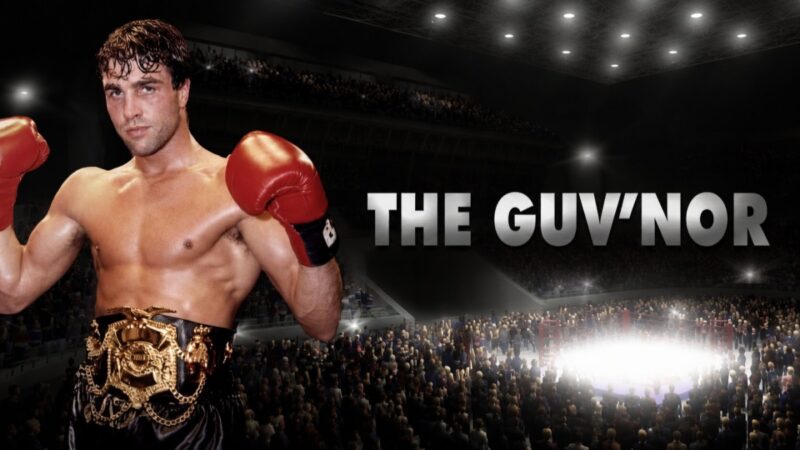
While many boxing tragedies unfold beneath the arena lights, former British fighter Shaun Cummins survived a tough career in the ring only to suffer an appalling fate years after retiring from combat.
Cummins fought professionally throughout the 1980s and 1990s, earning a reputation as a relentless competitor known as "The Guv’nor." Years after hanging up his gloves, Cummins was involved in a severe road traffic accident in 2004 that left him paralyzed and reliant on full-time daily care.
To assist with his complex daily needs, Cummins hired Thomas Dunkley as a personal carer. However, that arrangement ended in horrific circumstances. In September 2012, police investigating Cummins’ disappearance made a gruesome discovery at his Leicester home, finding his dismembered remains stored inside freezers on the property.
Dunkley was arrested and subsequently tried for murder. In May 2013, a jury found Dunkley guilty of murdering the 45-year-old former boxer. Although medical examiners were unable to determine the precise underlying cause of death due to the condition of the remains, the evidence presented led to Dunkley receiving a life sentence with a minimum term of 34 years. The tragic murder of Shaun Cummins remains one of the most shocking and horrific incidents involving a former professional boxer.
Patrick Day
On October 12, 2019, American super welterweight contender Patrick Day stepped into the ring at Wintrust Arena in Chicago to face undefeated prospect Charles Conwell in a televised contest.
The bout proved physically demanding, culminating in the tenth round when Conwell delivered a devastating knockout blow. Day was knocked unconscious and had to be removed from the ring on a stretcher before being rushed to Northwestern Memorial Hospital.
Day underwent emergency brain surgery to address a severe traumatic brain injury. Despite the efforts of medical staff, Day fell into a coma and never regained consciousness. Four days later, on October 16, 2019, promoter Lou DiBella officially confirmed Day’s death at the age of 27. Day concluded his professional boxing career with a record of 17 wins, four losses, and one draw.
The tragedy deeply impacted his opponent. Conwell penned an emotional open letter expressing profound grief and difficulty processing the fatal outcome of their contest. In a poignant display of compassion amidst tragedy, Day’s head trainer, Joe Higgins, personally reached out to Conwell to assure the young fighter that no one held him responsible for the outcome, emphasizing that Day chose to compete in the sport he loved. Day was widely remembered throughout the boxing community for his warmth, intellect, and exceptional character.
Leavander Johnson
For 16 years, Atlantic City native Leavander Johnson relentlessly pursued a world championship title. That lifelong ambition was finally realized in June 2005 when Johnson traveled to Italy and stopped Stefano Zoff to claim the vacant IBF lightweight championship.
Just three months after achieving his career-defining victory, Johnson made his first title defense on September 17, 2005, facing challenger Jesus Chavez at the MGM Grand in Las Vegas.
The contest proved brutal for the champion. By the eleventh round, Johnson was absorbing sustained, unanswered punishment, prompting referee Tony Weeks to step in and stop the fight to protect the champion. Johnson initially walked out of the ring under his own power, but his condition rapidly deteriorated near his dressing room, where he collapsed.
Emergency medical technicians rushed Johnson to University Medical Center, where surgeons performed emergency surgery to relieve pressure caused by bleeding on the brain. Johnson was placed in a medically induced coma but succumbed to his injuries on September 22, 2005, five days after the bout, at age 35. Johnson, who had realized his dream of becoming a world champion just months earlier, left behind his four children.
Frankie Campbell and Max Baer
One of the earliest ring deaths to draw widespread public scrutiny and prompt calls for regulatory reform occurred on August 25, 1930, in San Francisco, when heavyweight Frankie Campbell faced future world champion Max Baer.
During the contest, Campbell took heavy punishment. In the fifth round, trapped against the ropes, Campbell absorbed a series of unanswered power punches to the head before the bout was halted. Campbell collapsed in the ring and never regained consciousness, passing away the following day, August 26, at the age of 26.
The death triggered immense public outcry, with heavy criticism directed at the referee for failing to stop the unequal contest sooner. An autopsy revealed that the impact of the blows had caused severe structural trauma to Campbell’s brain.
The incident deeply traumatized Baer, who contemplated quitting the sport entirely. Though Baer returned to fighting and ultimately captured the World Heavyweight Championship in 1934 by defeating Primo Carnera, the memory of Campbell’s death haunted Baer throughout his life, leading him to offer financial support to Campbell’s surviving family.
Jimmy Doyle and Sugar Ray Robinson
On June 24, 1947, world welterweight champion Sugar Ray Robinson was scheduled to defend his title against challenger Jimmy Doyle in Cleveland, Ohio. However, the night before the bout, Robinson experienced a horrifying premonition.
Robinson dreamt that he knocked Doyle out in the ring and watched the young challenger die from the blows. Shaken by the vivid nightmare, Robinson expressed his desire to pull out of the fight. Matchmakers and local athletic commission officials brought in a minister to talk to Robinson, who reassured the champion that his dream was simply a reaction to pre-fight stress. Reluctantly, Robinson agreed to proceed with the defense.
During the fight, Robinson dominated the action, knocking Doyle out cold in the eighth round with a left hook. Doyle hit the canvas hard and failed to regain consciousness. He was rushed to Charity Hospital, where he died the following day, June 25, 1947, at just 22 years old.
The horrific realization of Robinson’s nightmare remains one of the most surreal and haunting chapters in combat sports history. Robinson would go on to build what many consider the greatest career in boxing history, winning world titles in multiple weight divisions, but the tragedy of Jimmy Doyle remained an enduring shadow over his legacy.
Davey Moore and Sugar Ramos
On March 21, 1963, World Featherweight Champion Davey Moore defended his title against Cuban contender Sugar Ramos before a crowd at Dodger Stadium in Los Angeles.
The fight was intense and high-paced. In the tenth round, Ramos battered Moore, sending him crashing to the canvas. As Moore fell, the back of his head and neck struck the bottom rope of the ring with tremendous force. The referee stopped the fight after the tenth round, awarding the victory and championship to Ramos.
Following the fight, Moore gave brief interviews in his dressing room and gave no immediate indication of critical distress. However, forty-five minutes after the bout ended, Moore complained of severe headaches before falling unconscious.
He was rushed to the hospital, where doctors diagnosed massive brain swelling attributed to the traumatic impact of his head hitting the ring rope during the knockdown. Moore lingered in a coma for three days before passing away on March 25, 1963, at the age of 29. He left behind his wife and five children.
Moore’s tragic death sparked intense international debate regarding the safety of professional boxing, famously inspiring musician Bob Dylan to write the protest song "Who Killed Davey Moore?"
Johnny Owen
Known affectionately as the "Merthyr Matchstick" due to his frail-looking frame and iron determination, Welsh bantamweight Johnny Owen emerged as one of Great Britain’s most cherished sporting figures during the late 1970s.
After capturing British, Commonwealth, and European bantamweight titles, Owen traveled to Los Angeles to challenge WBC World Champion Lupe Pintor on September 19, 1980, at the Olympic Auditorium.
Despite stepping into a hostile environment against a puncher in Pintor, Owen fought valiantly across 11 grueling rounds. However, in the 12th round, Pintor delivered a powerful right hand that knocked Owen unconscious. Owen hit the canvas and did not wake up.
Emergency surgery revealed that Owen possessed an unusually thin skull, and the blows absorbed during the contest had caused severe, irreversible brain injury. Owen remained in a comatose state for 46 days before dying on November 4, 1980, at the age of 24.
Owen’s death devastated his home nation of Wales, where he remains immortalized with a statue in his hometown of Merthyr Tydfil, commemorating his courage and sportsmanship.
Maxim Dadashev
Russian junior welterweight prospect Maxim Dadashev possessed an impressive 13-0 record when he took on Puerto Rican contender Subriel Matias in an IBF world title eliminator on July 19, 2019, at MGM National Harbor in Oxon Hill, Maryland.
Throughout the grueling contest, Dadashev sustained a heavy volume of power shots from Matias. Recognizing that his fighter was taking severe damage and unable to defend himself effectively, legendary trainer Buddy McGirt pleaded with Dadashev in the corner after the 11th round to let him stop the fight. When Dadashev gave no response, McGirt officially stopped the bout to protect his fighter.
As Dadashev was assisted out of the arena, he collapsed and began vomiting before losing consciousness. He was rushed to UM Prince George’s Hospital Center, where doctors performed an emergency craniotomy to relieve severe brain swelling.
Despite medical efforts, Dadashev’s heart gave out, and he passed away on July 23, 2019, at the age of 28. He left behind his wife, Elizabeth, and their young son. McGirt’s desperate attempts to save his fighter in the corner were widely praised by safety advocates, highlighting the immense responsibility corner crews bear in protecting fighters from catastrophic harm.
About the Author
Phil Jay is the Editor-in-Chief of World Boxing News (WBN), a BWAA-acknowledged boxing news platform founded in 2010. A veteran boxing reporter with 16 years of experience, he has interviewed world champions, broken international exclusives, and reported ringside from major events. His work is published worldwide through WBN and distributed on major platforms including Apple News.