


From the manicured lawns of multi-million-dollar estates to towering urban skyscrapers, a distinct class of careers demands far more than technical skill or basic competency—they require a relentless level of physical endurance that most people never witness. Modern society often takes for granted the infrastructure, maintenance, and public safety systems that keep daily life functioning, rarely pausing to consider the human toll behind them.
What happens, then, when an individual attempts to tackle some of America’s most grueling professions in rapid succession?
For fitness content creator Jesse James West, the answer involved torn hands, burning lungs, and a profound, humbling respect for the everyday workers who make these punishing tasks look routine. Embarking on an eye-opening journey through the nation’s most physically demanding jobs, West quickly discovered that conventional gym strength does not always translate to real-world toughness. More importantly, he learned that the hardest jobs often belong to the people we see every day but rarely truly notice.
The Landscaping Gauntlet: Where Trees Fight Back
Landscaping a sprawling $10 million property sounds glamorous on paper, but the reality sets in immediately when a worker is shoulder-deep in dirt, wrestling a 300-pound tree from its root system. West’s first challenge involved exactly that: excavating mature trees from a backyard and replanting them in the front. It was a task that immediately humbled his gym-trained physique.
"I feel like I’m not doing anything. I’m like trying really hard, but nothing’s really happening. I feel like they’re doing a lot more than me," West admitted while laboring alongside seasoned professionals.
The crew, led by experienced landscapers, made the heavy lifting look effortless while West struggled with the fundamentals. The physical demands extended well beyond tree removal, encompassing hours of hauling heavy river rock by wheelbarrow, placing each stone individually by hand, and maintaining flawless precision to satisfy the rigorous standards of a luxury property.
"Doing a different job than usual requires such different muscles in the body where my forearms and like fingers, like the hand muscles are really tired," West noted. Among the crew, a landscaper named Arnulfo stood out for an unrelenting work ethic that caught West’s attention early in the experiment, planting the seed for a recognition award that West would ponder throughout his journey.
Roofing: Fighting Gravity and Fear Simultaneously
Heights and steep architectural slopes introduce a fierce psychological battle that compounds the raw physical strain of roofing. West’s second assignment took him dozens of feet into the air, forcing him to balance on a pitched roof while tearing away old, weathered shingles—a task that burns approximately 590 calories per hour while simultaneously triggering primal survival instincts.
"It doesn’t look that high when you’re on the ground, but then when you’re up here, it’s way more scary," West said. "It is actually very tiring. It’s like digging holes, but you are fighting adrenaline cuz you feel like you’re going to die."
The job comprised three primary phases: stripping old materials, repairing compromised roof structures, and installing fresh components. Each stage demanded distinct proficiencies, shifting rapidly from the brute force required to rip away decaying materials to the precise carpentry needed to cut replacement plywood to exact specifications. Brian, the roofing company owner who supervised West, demonstrated the massive chasm separating an amateur from a professional. What took West agonizing minutes to accomplish, experienced roofers completed in mere seconds.
Farming: Where Every Muscle Gets Its Turn
Despite the advent of modern agricultural machinery, traditional farming remains rooted in intense physical labor, a reality West experienced firsthand at Braglio Farms. Guided by Roman, the daily itinerary included clearing heavy hay feeders, mucking pig pens, chopping firewood, and working alongside cattle. Every single task engaged entirely different muscle groups in unexpected ways.
"Farmers probably burn so many calories a day," West observed. Research confirms this impression, indicating that agricultural workers burn an average of approximately 600 calories every hour, cementing farming as one of the most calorically expensive professions in the country.
Cleaning the pig pens proved uniquely difficult, challenging West not through muscular fatigue, but via an overwhelming sensory assault. "I’m fighting every urge to gag. Oh, it makes me light-headed," he admitted. The experience highlighted how mental toughness is often just as critical as physical strength on a farm, requiring workers to push past deeply unpleasant conditions while maintaining strict standards for safety and animal care.
Timber Sports: Where Lumberjacks Become Athletes
Competitive timber sports bridge the gap between historical forestry practices and high-intensity modern athletics. Stepping into this world with virtually no prior background, West received a crash course from Matt Cogar, a world-class timber sports competitor, just hours before entering a live competition.
The sport features five distinct disciplines: the springboard chop, stock saw, standing block chop, single buck saw, and underhand chop. Each event demands specialized techniques that competitors spend years refining. "Everything you’re learning here is exactly the same thing that they were learning in the timber industry in the forest in the 1900s," West noted, acknowledging the lineage of a sport dating back to 1880, when loggers used competitive downtime to measure their skills against one another.
Despite his minimal preparation, West managed a surprising fourth-place finish in one event. However, the experience also underscored the inherent dangers of the sport; during the final underhand chop, an axe swung dangerously close to his head, serving as a stark reminder of why extensive safety protocols and rigorous training are mandatory.
Construction: Demolition as Full-Body Workout
Construction work merges strength, cardiovascular endurance, and spatial problem-solving in ways that traditional gym environments rarely replicate. Rejoining Brian for a series of heavy construction tasks, West tackled demolition work capable of burning up to 700 calories per hour. The work involved tearing down plaster walls, ripping out ceilings from overhead angles, and maneuvering a massive, cast-iron bathtub down a narrow flight of stairs.
"It’s like a bunch of overhead presses, a bunch of Russian twists with a medicine ball. All those things in the gym apply in here," West said.
The complexity of the labor often belied its appearance. Stripping ceiling plaster required workers to balance precariously on exposed joists while attacking the material from above, demanding acute balance and spatial awareness alongside sheer muscular output. The removal of the cast-iron bathtub—weighing an estimated 400 pounds—proved to be the definitive logistical hurdle of the day, requiring slow, coordinated maneuvering through tight residential corridors to prevent property damage or severe injury.
Firefighting: The Crown of Physical Careers
If any single profession sits at the apex of physical demand, firefighting consistently claims that title. Training alongside Miami-Dade firefighters, West confronted the realities of a career that routinely ranks as America’s most physically challenging occupation.
Firefighters can burn up to 840 calories per hour while actively responding to emergencies. Yet, raw caloric expenditure only tells part of the story, as these professionals must maintain absolute readiness around the clock, never knowing when an alarm will require maximum physical and mental output.
The rigorous physical abilities test utilized in fire academy training established an immediate baseline. West was tasked with running six stories of stairs while carrying heavy fire hose bundles, completing a total of twelve laps—equivalent to 1.6 miles—while encumbered by full protective gear weighing approximately 120 pounds.
"The one thing we didn’t mention when we started was tank, gear, boots, helmet plus the pack, you’re probably 120 lbs heavier than you normally are," West observed. Subsequent simulated fire rescues pushed him further, requiring him to crawl through dense, smoke-filled corridors, drag a heavy rescue dummy to safety, and immediately pivot to a "firefighter down" rescue scenario that tested decision-making under acute physiological stress.
Olympic Athletes: When Fitness Becomes Art
Beyond manual labor and public safety roles, West tested his physical limits against elite Olympic and Paralympic athletes across various sports, including diving, track and field, wrestling, and rugby. These encounters starkly illustrated the vast chasm separating general fitness from sport-specific mastery.
Training with four-time Olympic gold medalist Allison Schmitt in the pool, West learned quickly that athletic prowess does not automatically translate to clean execution. Despite his best efforts, his diving form drew gentle amusement from judges who awarded generous scores primarily out of politeness. Track and field proved similarly humbling; while pole vault coaches effortlessly cleared bars set near 18 feet, West celebrated successfully clearing a height of just six feet.
The sole exception during his athletic crossovers occurred within the women’s rugby program, where West participated in the "Bronco" fitness test—a grueling conditioning drill requiring repeated sprints to progressively distant markers. Completing the course in 4:36, West narrowly beat the team’s top recorded time of 4:46, marking his only victory against Olympic-caliber competition throughout the entire endeavor.
SWAT Academy: The Ultimate Test of Relentlessness
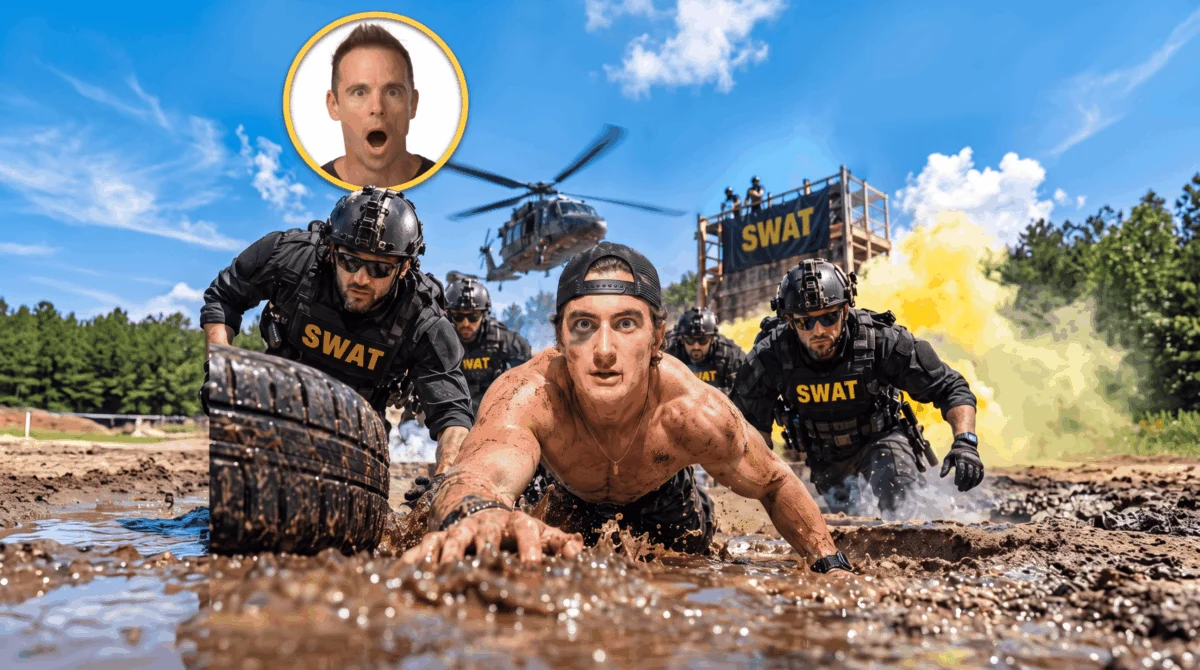
The culmination of West’s journey took him into a 50-hour SWAT academy selection course led by Cadre Dennis Medina. Designed to test both physical limits and psychological fortitude, the academy immediately initiated psychological screening disguised as hospitality, offering donuts with a hidden caveat: would candidates exercise restraint, or push past instructions to demonstrate unchecked effort?
"If I tell you it’s 50 push-ups in 2 minutes, when you get to 50 push-ups, you’re going to stop or you going to keep going until the 2 minutes are over? What type of person are you?" Medina challenged.
The ensuing physical challenges arrived in relentless waves, featuring unannounced distance runs, 15-minute water treading intervals, continuous swimming laps, and over 100 repetitions of pulling himself out of a pool while reciting Theodore Roosevelt’s famous "Man in the Arena" speech. When West reached a physical breaking point amidst nausea and exhaustion during the aquatic drills, Officer Orlando intervened to keep him moving forward, emphasizing the unique psychological value of pushing boundaries within a controlled training environment.
The second day escalated further with helicopter water rescue drills, boat casting exercises, building rappelling, and a culminating exercise involving controlled exposure to tear gas. Experiencing the chemical agent first with a mask, then with a partially opened seal, and finally with zero protection while reciting his memorized speech, West gained a visceral understanding of why chemical agents remain effective tactical tools and why law enforcement personnel must build complete tolerance to operate effectively in contaminated zones.
Lessons from the Hardest Jobs in America
Reflecting on more than a dozen physically punishing careers, distinct patterns emerged regarding what separates standard difficulty from truly grueling labor. Sustained duration consistently proved more taxing than short bursts of maximum athletic intensity. Landscapers, construction workers, and farmers cannot rest between sets; they must maintain steady productivity across eight-to-twelve-hour shifts.
Environmental hazards further multiplied the difficulty, whether roofers battling height-induced vertigo, farmers enduring oppressive heat, or firefighters navigating life-threatening conditions. Furthermore, the unpredictability inherent in emergency services imposes a permanent psychological vigilance that scheduled physical training cannot replicate.
Ultimately, West’s experiences underscored the deep expertise embedded within skilled trades and public service sectors. Concluding his project, West presented his "most relentless employee" plaque to Brian, the roofing company owner and construction supervisor who continues to lead his businesses by working alongside his crews every day.
Through blisters, exhaustion, and moments of genuine fear, West’s journey highlighted an essential truth: the individuals who build, maintain, and protect society’s infrastructure perform work demanding a rare combination of physical endurance, specialized skill, and mental resilience that goes far beyond the public eye.