

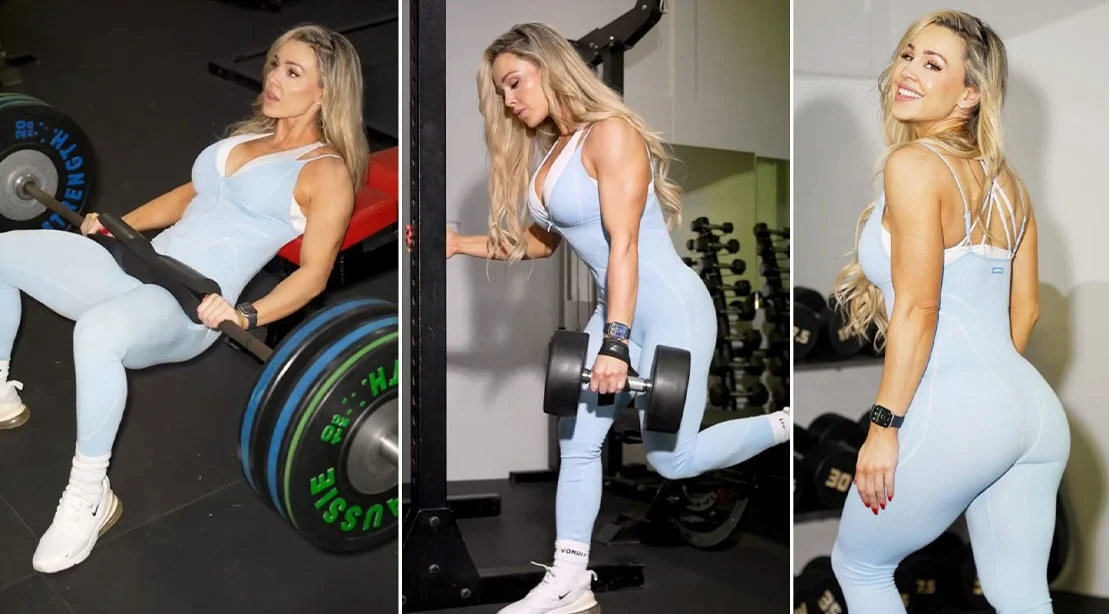
Australian weightlifter, personal trainer, and fitness influencer Stephanie Sanzo has continued to cement her reputation in the strength and conditioning community by demonstrating how high-level physical conditioning can coexist with a demanding family life. Known across the fitness industry for balancing intense training regimens with the responsibilities of motherhood, Sanzo has built a massive following centered on straightforward, high-effort strength training. Rather than relying on complicated or trendy fitness fads, the Australian trainer consistently advocates for fundamental movements executed with maximal effort, precision, and consistency.
In a recent demonstration shared across her digital channels, Sanzo showcased an intensive glute-focused training routine designed to stimulate muscular hypertrophy through progressive overload and deliberate fatigue management. The program, distributed directly to her audience of more than 3.3 million followers on Instagram, quickly drew substantial attention from fitness enthusiasts and lifters seeking an efficient, evidence-informed lower-body session.
The online response highlighted Sanzo’s long-standing influence within the strength community, where she regularly challenges conventional notions regarding female aesthetics and resistance training. Enthusiastic viewers praised both the physical rigor of the routine and its broader cultural representation. Among the thousands of reactions, one follower noted that Sanzo continues to demonstrate that building significant muscle mass does not detract from femininity, while others characterized the training session as essential viewing, quickly bookmarking the workout breakdown to integrate into their own lower-body splits.
Stephanie Sanzo’s Glute-Focused Workout
At the core of Sanzo’s training philosophy is the physiological principle of progressive overload—the gradual increase of stress placed upon the musculoskeletal system to encourage muscle growth and strength adaptations. Hypertrophy, the enlargement of skeletal muscle fibers, requires a combination of mechanical tension, muscle damage, and metabolic stress. Sanzo’s routine is organized to systematically induce these stimuli by pairing heavy resistance exercises with high-density rep schemes and controlled rest periods.
Rather than overcomplicating exercise selection, the personal trainer prioritizes foundational movement patterns: hip hinging, horizontal hip extension, unilateral knee-dominant pressing, targeted hip abduction, and posterior chain loading. This direct, compound-oriented structure reflects her broader approach as a busy professional and parent, proving that meaningful athletic gains can be accomplished within a streamlined timeframe provided the work rate remains exceptionally demanding.
The structure of the session demands disciplined pacing. Sanzo utilizes structured drop tri-sets and escalating cumulative repetitions, beginning with explosive pre-exhaustion movements before transitioning into compound bilateral lifts, stability-assisted unilateral work, isolated machine tension, and an exhaustive posterior-chain finisher. With rest periods kept deliberately brief between sets, the program maintains elevated cardiovascular output and muscular fatigue from the opening repetition to the final set.
Stephanie Sanzo’s Glute-Focused Workout Breakdown
1. Standing Hip Thrust (Drop Tri-Set)
Sanzo initiates the workout with a high-intensity drop tri-set on the standing hip thrust machine, designed to target the glutes and hamstrings while driving immediate blood flow into the posterior chain. The movement serves as an aggressive pre-exhaustion mechanism, demanding 35 repetitions distributed across three relentless sets.
By employing a standing hip thrust variation early in the session, Sanzo places the gluteal complex under direct tension through an upright hip hinge and lockout. In the drop tri-set framework, the lifter moves through descending resistance levels with minimal to no pause, sustaining continuous muscular tension while challenging endurance thresholds. For gym-goers who train in facilities lacking a specialized standing hip thrust apparatus, Sanzo provides a practical modification, advising that standing cable pull-throughs offer a biomechanically comparable alternative. Cable pull-throughs mirror the horizontal resistance vector and hip-hinge mechanics of the machine variation, ensuring lifters can effectively activate the gluteal muscles and hamstrings before advancing to heavier barbell work.
2. Traditional Barbell Hip Thrust
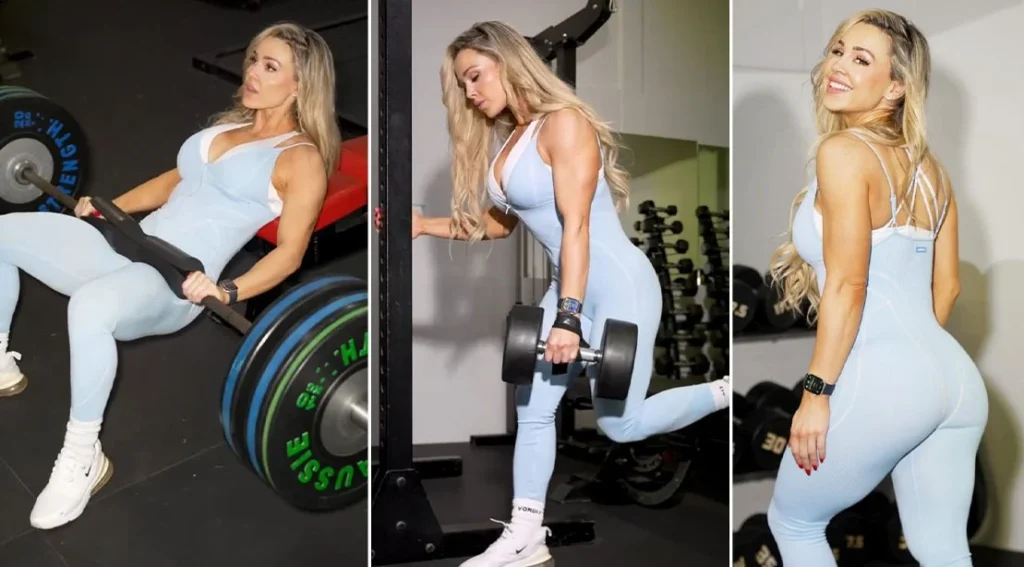
Following the initial pre-exhaustion phase, the routine shifts to the cornerstone of modern glute programming: the traditional barbell hip thrust. Widely recognized in strength training for its ability to deliver peak mechanical tension at full hip extension, the barbell hip thrust allows for substantial progressive loading without placing excessive axial compression on the spine.
Sanzo executes the movement with her upper back anchored firmly against a stable gym bench, positioning her feet flat on the floor to generate force directly upward through her heels. Driving the barbell toward full extension, she emphasizes achieving a rigid, neutral, straight alignment from the shoulders through the hips and knees at the peak of each repetition. The protocol calls for three heavy sets, separated only by short rest intervals. This restricted recovery period limits intra-set recovery, forcing the recruitment of higher-threshold motor units and compounding metabolic fatigue in the gluteus maximus.
3. Rack-Supported Dumbbell Bulgarian Split Squat
For the third exercise of the session, Sanzo transitions from bilateral loading to unilateral lower-body development with the rack-supported dumbbell Bulgarian split squat. Unilateral movements are essential for rectifying muscular imbalances, strengthening stabilizing structures around the pelvis, and ensuring balanced force production between limbs.
Recognizing that the standard Bulgarian split squat often forces lifters to balance balance constraints over raw muscular output, Sanzo deliberately modifies the movement by using a power rack or adjacent vertical upright for external support. Holding a heavy dumbbell in one hand while steadying her torso with the other eliminates the neurological burden of balance. This simple adjustment isolates the working lower-body musculature, minimizing extraneous upper-body stabilizing recruitment and allowing the lifter to channel maximum mechanical tension directly into the glute, hamstring, and pelvic stabilizers of the working leg. Sanzo pushes through three demanding sets per leg, maintaining strict depth and controlled tempos to ensure that the gluteal complex handles the brunt of the load.
4. Seated Hip Abduction Machine
After exhausting the lower body with free-weight compound patterns, Sanzo transitions back to fixed-path resistance by utilizing the seated hip abduction machine. While squats, split squats, and hip thrusts place primary emphasis on the gluteus maximus, the hip abduction machine uniquely isolates the gluteus medius and gluteus minimus—muscles on the outer region of the pelvis that are difficult to fully target using standard barbell and dumbbell movements alone.
Sanzo emphasizes the anatomical and functional importance of strengthening the outer hip complex. The gluteus medius plays a pivotal role in stabilizing the pelvis during both dynamic movement and static postures. Increasing strength in the hip abductors improves overall pelvic integrity and core stability, which directly transfers to enhanced performance and reduced injury risk during heavy compound lifts like squats and deadlifts. From an aesthetic perspective, adding lean muscle tissue to the upper and outer hip quadrant contributes to structural balance and overall roundness throughout the posterior chain. Sanzo programs three controlled sets on the abduction machine, focusing on a deep stretch and an emphatic squeeze at maximum abduction.
5. Bench-Supported Dumbbell Romanian Deadlift (Finisher)
To conclude the high-volume workout, Sanzo pushes her physical capacity to its limit with three heavy sets of bench-supported dumbbell Romanian Deadlifts (RDLs). The finisher tests both mental stamina and muscular endurance, with the cumulative rep volume climbing toward 60 repetitions across the final sequence of sets.
Maintaining straight legs with a soft, protective micro-bend in the knees, Sanzo uses a flat bench for upper-body support to maintain stability and reinforce spinal alignment throughout the hip hinge. As she lowers the dumbbells along the shins, she places an intense loaded stretch across the hamstrings and glutes, resisting lumbar flexion by engaging the core. At the top of each lift, she forcefully contracts the glutes and core to achieve full extension before initiating the next repetition. The combination of high volume, loaded stretching, and cumulative fatigue creates an exhaustive training stimulus, fully emptying the muscular energy reserves of the posterior chain.
Through this five-exercise sequence, Stephanie Sanzo underscores the core philosophy that has established her as an enduring authority in online fitness: sustained physical transformation does not require convoluted programming, but rather an uncompromising commitment to structural fundamentals, progressive overload, and maximum effort. For athletes and casual lifters looking to develop genuine lower-body strength and glute hypertrophy, Sanzo’s high-density program offers a demanding framework focused entirely on results.