

“His name is Wilfredo Gómez, and he will become a world champion.”
With those prophetic words, Venezuelan journalist Alí Ramos opened his column in the Caracas newspaper El Nacional in 1974. Ramos was writing in the immediate aftermath of the bantamweight final at the inaugural World Amateur Boxing Championships in Havana, Cuba. The subject of his praise was a prodigiously talented 17-year-old Puerto Rican who had just announced himself to the boxing world in sensational fashion by knocking out Cuba’s own Luis Jorge Romero in the final. Gómez’s performance in Havana was so commanding, dynamic, and explosive that contemporary press accounts noted even Cuban leader Fidel Castro found himself captivated by the teenager’s ring generalship and ferocious style.
Ramos’s prediction proved remarkably prescient. Gómez did not merely fulfill his potential by capturing a world championship; he went on to win world titles across three distinct weight divisions during a golden era for the sport. It was an epoch when boxing was at its most uncompromising, when sanctioning bodies were fewer, and when the finest competitors routinely tested themselves against the best available opposition without pretext or evasion.
For many who followed his meteoric ascent, Gómez’s journey transformed from a sports story into a masterclass in athletic brilliance. His career built a compelling case that he stands as the single greatest boxer ever produced by Puerto Rico, as well as the most dominant super bantamweight in the history of professional boxing. Beyond the emotion that naturally accompanies retrospectives of iconic sports figures, the objective credentials and statistical milestones of Gómez’s record leave virtually no room for debate.
When Gómez eventually vacated his world super bantamweight title, his record stood at an extraordinary 38 wins, one defeat, and one draw—with all 38 victories coming by way of knockout. His sole career setback up to that point had occurred when he ventured up to featherweight to challenge the legendary Salvador Sánchez, while the lone draw had come in his professional debut against Jacinto Fuentes. Along the way, Gómez compiled 17 successful defenses of his 122-pound crown, stopping every single challenger inside the distance. It remains an extraordinary and unprecedented mark of divisional dominance.
The Boy from Las Monjas
With a resume defined by such astonishing stopping power, the nickname “Bazooka” was uniquely fitting. Yet to his devoted countrymen in Puerto Rico, he was also fondly known as “El Niño de Las Monjas”—the boy from Las Monjas—a direct homage to the humble San Juan neighborhood where he was born and raised.
Gómez’s rise through the boxing ranks moved at a dizzying velocity. Fueled by natural power, remarkable instinct, and polished technical ability, he established himself on the international stage while still in his teens. After capturing the amateur world title in Havana at age 17, he reached the pinnacle of the professional ranks just three years later at age 20.
His international journey had experienced an early stumble at the 1972 Munich Olympic Games. Representing Puerto Rico as a flyweight, Gómez saw his tournament run cut abruptly short in his opening bout following a highly controversial decision loss to Egypt’s Mohamed Selim. Unfazed by the setback, Gómez channeled the disappointment into resolve, redeeming himself two years later with his dominant gold-medal performance in Havana. With his amateur credentials firmly cemented, he transitioned to the professional ranks to begin laying the groundwork for what would eventually become an induction into the International Boxing Hall of Fame.
Unbeatable at 122 Pounds
The assertion that Wilfredo Gómez stands as the greatest super bantamweight in boxing history rests not only upon his numerical accomplishments, but also on the extraordinary caliber of opponents he dispatched during his reign.
Gómez made his professional debut on November 16, 1974, in Panama, battling to a hard-fought draw against Jacinto Fuentes. Once he settled into the professional ranks, Gómez launched an incredible run of dominance. He reeled off 15 consecutive victories, every one of them by knockout, earning his first opportunity at a world a shot at WBC super bantamweight champion Dong Kyun Yum of South Korea in San Juan.
On that night in Puerto Rico, Gómez proved he was far more than a promising prospect. In front of a raucous home crowd, he stopped the South Korean champion in the 12th round, initiating a title reign that would define an entire division and giving birth to a national sporting idol.
Throughout his tenure as the 122-pound king, "Bazooka" defended his crown 17 times, finishing every opponent before the final bell. The roster of fighters he defeated during this period reads like a gallery of top-tier contenders and champions. Among those who fell to his power were Royal Kobayashi, Juan Antonio López, Sakad Petchyindee, Juan “Kid” Meza, Carlos Zárate, Leo Cruz, Lupe Pintor, Derrick Holmes, and "Pambelito" Cervantes.
Moving Up to Featherweight
Having thoroughly cleared out the super bantamweight division, Gómez turned his sights toward a broader challenge: stepping up to featherweight to confront the preeminent 126-pound fighter of his era, Mexican icon Salvador Sánchez.
Promoted by Don King, the showdown was billed as “The Battle of the Little Giants.” It pitted two prime world champions against one another in a classic rivalry match. On paper, the contest offered a mesmerizing clash of styles, with Gómez entering as a narrow, cautious favorite. Sánchez, however, was a formidable champion in his own right, riding an impressive wave of high-profile victories and possessing extraordinary stamina and counterpunching skills.
While Gómez held the edge in sheer punching power and amateur pedigree, he was also fighting a second, less visible battle outside the ring. The pressures and temptations of sudden wealth, global fame, and an expanding social circle had begun to erode his focus. His training camp for the Sánchez fight was compromised by a lifestyle that forced him to spend more energy cutting weight than refining his tactical preparation. He entered the ring below his physical peak.
When the bell rang, both champions bypassed any feeling-out process and engaged immediately. Gómez came out aggressively, seeking to assert his power early, but Sánchez remained calm and methodical. In the opening round, Sánchez caught Gómez with a sharp left hook that sent the Puerto Rican champion crashing to the canvas, badly hurt.
From that initial knockdown forward, the Mexican champion executed a masterful performance. Pacing himself with calculated aggression, Sánchez gradually wore Gómez down with relentless accuracy and high punch volume. By the eighth round, with his face swollen and badly battered, Gómez yielded to the champion’s relentless assault. It was the first defeat of his professional career, serving as a harsh reminder of the margins for error at the sport’s highest levels.
Despite the setback against Sánchez, Gómez retained his 122-pound crown and returned to super bantamweight, where he successfully defended his title four more times. His final defense at the weight was an epic encounter against Mexico’s Lupe Pintor, whom Gómez knocked out in the 14th round of a grueling, classic battle. Following the Pintor fight, Gómez permanently vacated the super bantamweight division, leaving behind a remarkable record of 38 wins, one loss, and one draw, with all 38 victories coming by way of knockout.
The Defeat Against Azumah Nelson
With his legacy at 122 pounds secured, Gómez turned his attention back to the featherweight division. A highly anticipated rematch with Salvador Sánchez never materialized due to the Mexican champion’s tragic death in a car crash. The vacant featherweight crown eventually found its way to Juan Laporte, a talented Puerto Rican contender based in New York.
On March 31, 1984, Gómez got his opportunity to challenge Laporte at the Roberto Clemente Coliseum in San Juan. In a demanding 12-round contest, Gómez relied on his ring craft to win a clear decision, securing his second world title in a second weight class. The victory marked one of only two times in his career that Gómez won a fight via the judges’ scorecards rather than by knockout.
His reign at featherweight, however, proved brief. Gómez stepped into the ring for his next defense against another legend of the era: Ghanaian powerhouse Azumah Nelson. In an emotional and hard-fought battle in San Juan, Nelson stopped Gómez in the 11th round, capturing the WBC featherweight title in front of the Puerto Rican icon’s hometown supporters.
A Third World Title in a Different Weight Class
Refusing to let the loss to Nelson end his career at the elite level, Gómez made the decision to move up once more, stepping into the 130-pound super featherweight division.
He targeted WBA super featherweight champion Rocky Lockridge, a quick, technically sound, and dangerous American fighter who held a victory over Roger Mayweather. Lockridge agreed to travel to Puerto Rico to defend his crown, setting the stage for another memorable night in San Juan.
In a closely contested fight, Gómez pushed through exhaustion, using his championship resolve to secure a split-decision victory. The triumph made him a three-division world champion under the WBA banner, delighting his home fans who proved instrumental in lifting him through the tough late rounds.
Yet, as had happened earlier in his career, maintaining top physical condition while enjoying the fruits of his success proved to be a delicate balance. Gómez was a major celebrity in Puerto Rico, frequently hosting high-profile gatherings at Flying Saucer, the nightclub he owned in Isla Verde.
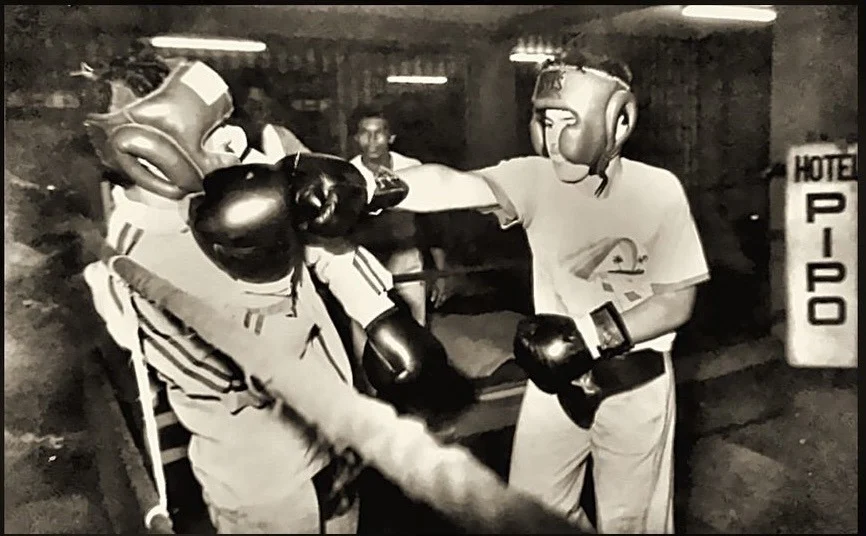
Recognizing that the fast-paced lifestyle was taking a toll on his conditioning, Gómez relocated his training camp to Maracay, Venezuela, at the suggestion of WBA President Gilberto Mendoza. Working at the Hotel Pipo alongside Venezuelan trainer Héctor Criollo, Gómez sought to isolate himself from local distractions and prepare for his first 130-pound title defense against Panama’s Alfredo Layne.
Despite the change in environment, the years of ring battles and weight fluctuations had taken their toll. Layne stopped Gómez in the ninth round, signaling that the great champion’s physical prime had definitively passed.
The Greatest Puerto Rican Boxer of All Time?
In evaluating the towering history of Puerto Rican boxing—a nation that has produced Hall of Famers and multi-division champions like Carlos Ortiz, Esteban de Jesús, Alfredo Escalera, Félix “Tito” Trinidad, Wilfred Benítez, Héctor “Macho” Camacho, Miguel Cotto, Edwin Rosario, and Iván Calderón—Wilfredo Gómez’s case for the top spot remains extraordinarily robust.
While Calderón logged 17 title defenses across two weight classes, Trinidad unified divisions with devastating power, Camacho captivated fans with unmatched speed, and Benítez became the youngest world champion in history at age 17, none matched the sustained, terrifying dominance that Gómez exhibited during his peak at super bantamweight.
His 17 consecutive knockout defenses in a single weight class stand as a monument to sustained excellence and stopping power that few fighters in any weight class have ever approached.
A Nickname That Fit Like a Glove
While history remembers Wilfredo Gómez primarily for his punch power, he was far more than a pure brawler. Inside the ring, "Bazooka" possessed refined technical skills, fluid upper-body movement, and precise defensive weaving that allowed him to slip incoming strikes and deliver lethal counterhooks.
When forced into brutal slugfests against dangerous punchers like Carlos Zárate and Lupe Pintor, Gómez proved his chin and fighting heart were equal to his offensive firepower. He fought with an unyielding determination that mirrored the proud combat sports traditions of his homeland.
Even in the modern era, as multi-division stars like Japan’s Naoya Inoue achieve incredible feats at super bantamweight, Gómez’s historical metrics at 122 pounds continue to serve as the gold standard for the division.
For fight analysts, historians, and fans of Puerto Rican boxing, the debate over the island’s ultimate fighter will endure across generations. Yet the numbers, the knockouts, and the three division championships carved out by the "Niño de Las Monjas" ensure that the name Wilfredo Gómez remains forever etched at the absolute pinnacle of boxing history.