’s Full-Court Press: Inside the Lemon-Lime Giant’s Multi-Season Global Return to the NBA
There are some sponsorship deals that arrive at just the right time, fundamentally altering how a brand connects with its audience while capturing the pulsing energy of an entire cultural movement. For Sprite, that magic moment arrived in the mid-1990s, setting off a golden era of sports marketing that left an indelible mark on both the beverage industry and the professional basketball landscape.
Sprite served as the official soft drink of the National Basketball Association (NBA) from 1994 to 2015, forging a legendary relationship that had actually begun years earlier in 1986. However, it was the launch of this expanded partnership in the mid-90s that coincided with Sprite carving out an entirely new brand identity. Operating at the dawn of the sports drink boom and right in the middle of another fierce skirmish in the historic cola wars, the Coca-Cola-owned brand tapped into Generation X irony and irreverence to hand consumers a deceptively simple call to action.
Its iconic “obey your thirst” pitch—the digested, no-nonsense message of which was to ignore the surrounding noise and remember that a crisp lemon-lime drink is simply refreshing—used knowing, zeitgeisty humor to carve out a massive slice of the counterculture. The youthful and dynamic energy generated by these campaigns proved to be a pristine match for the NBA, cutting neatly through the earnestness and bombast that characterized traditional sports marketing elsewhere. Between exceptionally smart creative execution and a sharp, authentic sense of the basketball universe stretching far beyond the boundaries of the big league, Sprite left a lasting, generational impression.
While the brand never truly left the court—retaining sponsorship deals with 17 individual NBA teams as recently as last season—The Coca-Cola Company confirmed a major multi-season global partnership in March to restore Sprite to its former league-wide category dominance. The high-profile return sees Sprite officially replace PepsiCo’s Mountain Dew and Starry drinks across the league.
“I’m super proud and excited that Sprite is back,” says Mickael Vinet, vice president of global sports, music, entertainment partnerships, and marketing for Coca-Cola. “And not only would I say it’s back in basketball globally, but I truly believe it is here to stay.”
For Vinet, this high-profile reunion carries deep personal and professional significance. The French executive has spent 26 years climbing the ranks at Coca-Cola, having originally started as an intern within the sports and entertainment team in his homeland. Sprite’s famous NBA activations were a prominent fixture of his early career, making the brand’s triumphant comeback one of the very first major partnership opportunities that landed on his desk after he assumed his current role in 2025. This revival, he notes, has generated immense internal excitement at the prospect of seamlessly connecting fans across sport, music, fashion, and the broader cultural ecosystem.
Even so, this new partnership drops the brand into a vastly different media and consumer environment. The modern “Never Stop Refreshing The Game” concept, which launched just before the tip-off of the 2026/27 season, must navigate a fragmented landscape where the brand no longer commands a single overarching claim and a solitary television advertisement. In restoring Sprite’s connection with the NBA today, Vinet and his team are tasked with bringing the campaign to life simultaneously across multiple digital and physical platforms spanning 25 fast-moving international markets.
Back on Court
The renewed NBA sponsorship restates a specific, highly strategic role for Sprite within the wider Coca-Cola suite of products.
“On Brand Coke,” Vinet explains, “we are very connected with the Olympic movement, with football. And I think Sprite and basketball should be what Coke is around football. I think that’s a simple way to visualise the ambition.”
Vinet firmly believes that Sprite retains a deeply natural fit with the core values and street-level culture of the global basketball audience. Yet, the successful execution of this ambitious new campaign will ultimately depend on uncovering the right consumer insights to build a productive, long-lasting commercial relationship.
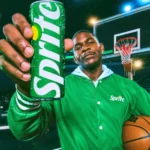
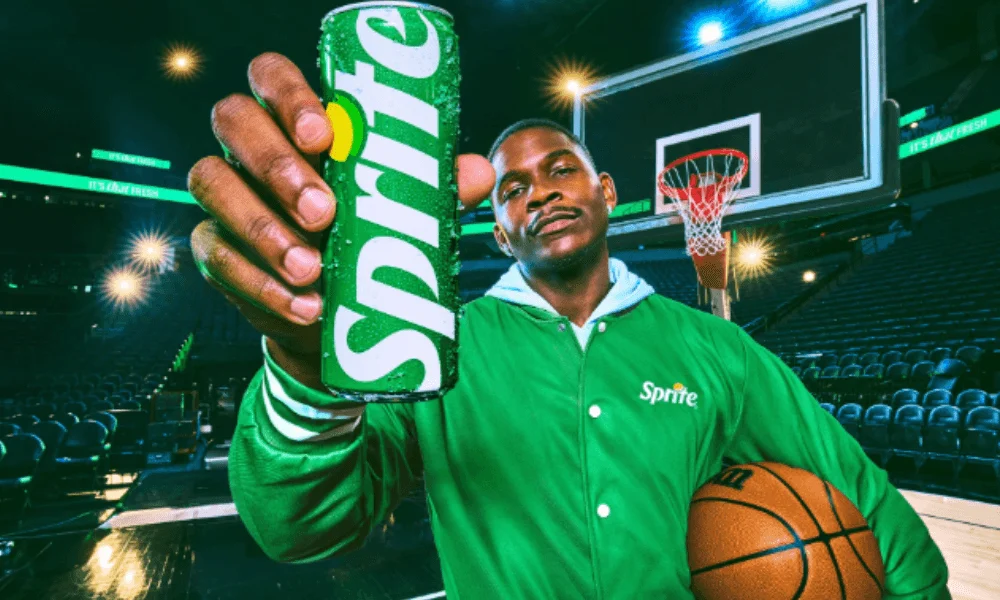
Beyond its renewed associations with individual teams, Sprite’s modern presence in the NBA has already been revitalized through high-profile endorsement deals. In 2024, Minnesota Timberwolves star guard Anthony Edwards fronted the modern restoration of the legendary “Obey Your Thirst” tagline. In one memorable early commercial appearance, Edwards completes a breathtaking dunk in front of an awed fan, who then watches the serial All-Star take a casual swig from a bottle of Sprite. The fan eagerly enjoys the same drink, only for his own ambitious attempt to complete a dunk to end in comical disaster. The advertisement serves as a winking, self-aware retread of a mid-90s spot featuring Grant Hill, which similarly made modest, humorous promises about the actual performance-enhancing powers of the central product.
Grant Hill himself even contributes the warm voiceover to the modern spot: “You want to hoop like Anthony Edwards? Practice. You want a refreshing drink? Obey your thirst.”
Edwards has since been joined on the active Sprite roster by Denver Nuggets icon Nikola Jokić. Released in October, the three-time league MVP’s introduction carries a similar deadpan tone but hits far fewer nostalgic notes. Jokić appears on a moody comedy club stage, casually sipping a Sprite and delivering spare, remarkably flat stand-up comedy to a mostly quiet audience. As the spot draws to a close, simple text flashes across the screen: “Jokes aside, welcome Joker.”
“I think what is interesting with the two is they have different perspectives, different personalities, different journeys,” Vinet says. “But they both have this unique edge that they will bring to what we do, and what will be very important is not just to have them as ambassadors, but to bring their stories and their views in the way we communicate and engage with fans.”
Jokić’s inclusion also serves as a sharp reminder of how profoundly the NBA’s demographic profile has evolved over the past decade. He was just one of 125 international players listed on opening-week rosters for the 2026/27 season. While international recruitment was already a growing feature of the league by the end of Sprite’s first run in 2015, the sustained, championship-winning achievements of stars like the Serbian center have thoroughly confirmed the NBA’s status as a truly global competition.
To put it another way, Sprite requires a much more internationally focused strategy this time around. Between an annual run of regular-season games staged outside North America—beginning in early November with the NBA Mexico City Game before high-profile stops in Paris and Manchester next January—and the league’s much-publicized long-term ambitions in Europe, the NBA currently offers a broader, more diverse platform than ever before.
Demonstrating this commitment to the international game, Sprite quickly followed up its domestic NBA deal by securing a multi-season global partnership to become an official partner of Euroleague Basketball. After debuting at the Euroleague Final Four in Athens, the brand’s distinct branding now appears prominently on-court and inside arenas throughout the 2026/27 season. Furthermore, Sprite is actively pursuing multi-channel engagements with European basketball culture through localized music, fashion, and fan-driven experiences.
Managing this vast international activity, Vinet acknowledges, presents a wonderful challenge, with the overseas live games serving as vital opportunities to build tangible live experiences outside of the United States. Content creation, meanwhile, sits squarely at the core of efforts to bring local intimacy and authenticity to the wider global collaboration.
Handing It Off
“The role of the brand,” Vinet suggests, “is not just to sponsor and to be visible. It’s to be a catalyst for this creativity and self-expression.”
Sprite’s historic basketball campaigns were famously steeped in playful pop culture references, ranging from its bold 1990s output to the mid-2000s emergence of mascot Miles Thirst—a poseable hip-hop action figure and miniature advertising sidekick to a young LeBron James. To capture the public imagination and hold fleeting attention spans in the modern digital era, however, creative messaging must survive and evolve far outside the direct control of the corporate marketing department.
“That’s what we have learned more and more to do, I think,” Vinet explains, “and that’s what we work on more and more from day one. At the moment, we have a core idea with content creators—not just at the end of the funnel, when everything is done and you just ask them to react, but to be part of the content creation itself. The way we create content, the way we organise ourselves, is very different than it was yesterday. And the truth is, we learn every day, there are things we will do that may not work, and that we will have to pivot.”
Executing a campaign of such immense scale and operational complexity is never a straightforward proposition. However, this is precisely where Vinet believes the institutional intelligence built up across the broader Coca-Cola organization proves exceptionally valuable.
“We learned a lot during this last Fifa World Cup,” Vinet notes, “having a lot of tools and using technology at the service of this real-time understanding of the emotions, the reaction of the fans, and being able then in the way we communicate to be connected in real time. Yes, there is a process in terms of approval that needs to go faster. There is a certain level of risk. But that’s the power of the technology. It allows to be much more personalised in the communication to the fans—much more in a dialogue, and much more real time.”
For any fast-moving consumer goods (FMCG) brand, a successful marketing campaign must seamlessly bridge digital messaging and physical product integration, bringing the beverage directly into the daily lives of target consumers. Sprite plans to approach NBA fans across multiple avenues during the current season. Promotional cans will feature interactive QR codes capable of unlocking high-value prizes, including VIP courtside tickets, official Wilson game-used balls, and exclusive merchandise. Additionally, Sprite will integrate into gameday food delivery partnerships across the US and enter the virtual gaming world of NBA 2K as a prominent sponsor of in-game power-ups and virtual items.
“There is a lot of content indeed that we can co-create with the athletes that will be leveraged by all our markets,” Vinet adds. “But there is as well a lot of flexibility and opportunity for each of the markets to develop locally relevant content, understanding from their side how fans engage with basketball.”
That targeted regional focus will dictate activations across other key territories as well. In South Asia, for instance, Vinet points out that streetball holds immense cultural importance, prompting Sprite to execute localized community programs dedicated to restoring neighborhood basketball courts. The “Hoops of Refreshment” initiative will likewise extend to other territories, offering vital support for community murals and live events that celebrate grassroots basketball culture.
Ensuring absolute consistency across all of these diverse platforms and physical activations remains an exacting, meticulous task, but Vinet views the entire undertaking as a golden opportunity to lay lasting foundations. He remains deeply proud of Sprite’s storied history and legacy within basketball culture, yet he is clearly eager to approach its future in the sport through an entirely modern lens.
“There are already ideas we are working on today, that take more time, that will come for year two,” he concludes. “This is why having this long-term visibility is a chance, because there are things we need to start preparing now for the future. And there are others that we need to test and learn during year one to be able to pivot and go to the next level.”