

In the landscape of modern physical culture, certain muscle groups command immediate attention while others quietly fade into the background. Among those frequently overlooked both in clinical research and commercial gym environments are the hamstrings. Walk into any fitness facility across the country, and you will routinely witness gym-goers hammering their quadriceps through relentless volumes of barbell squats, leg presses, and lunges. These compound movements ensure that the quads receive plenty of automatic volume whether a lifter intentionally programs for them or not. The hamstrings, however, rarely enjoy the same luxury. Unless an athlete makes a deliberate, conscious effort to incorporate targeted movements like leg curls and hip hinges into their routine, the posterior thigh muscles easily end up as an afterthought.
The disparity in attention is not limited to gym floors; it exists firmly within the scientific literature as well. Researchers have historically favored the quadriceps for a simple logistical reason: they are significantly easier to study. Most human beings store less subcutaneous fat over the top of their quads, and the individual heads of the quadriceps muscle group are far easier to image using ultrasound technology because they consistently sit closer to the surface of the skin than the deeper, more complex architecture of the hamstrings.
Despite this historical oversight, a growing body of scientific literature regarding hamstring training exists, largely driven by the fields of strength and conditioning as well as sports medicine. Given how prevalent and debilitating acute hamstring strains are in athletic populations, targeted hamstring training—specifically the implementation of Nordic hamstring curls—has received a massive surge of research interest as an intervention to mitigate injury risk. Recent scientific inquiries have broken down the specifics of exercise selection, offering vital clues on how to effectively develop every individual component of the hamstring muscle group.
To understand how to train the posterior thigh properly, one must first examine its basic functional anatomy. The hamstrings are not a single, uniform slab of muscle; rather, they comprise four distinct heads: the long and short heads of the biceps femoris, the semitendinosus, and the semimembranosus. Across this quartet, every single head shares the primary responsibility of flexing the knee joint, an action mirrored in standard leg curl variations. Furthermore, with the notable exception of the short head of the biceps femoris, the remaining three heads cross the hip joint as well, meaning they also actively contribute to hip extension.
Because of this biarticular nature, intuitive reasoning suggests that a comprehensive approach to hamstring development requires a careful combination of two distinct movement patterns: knee flexion exercises, such as leg curls, and hip extension exercises, commonly known as hip hinges. However, common assumptions about heavy compound lifts must be reexamined. Specifically, staple movements like barbell squats and heavy leg presses are likely not effective for building significant muscle hypertrophy in the hamstrings.

This limitation has been clearly illustrated in recent scientific literature. One notable study compared the muscular adaptations of the barbell hip thrust against the traditional barbell squat, ultimately revealing that neither movement stimulated substantial growth in the hamstrings. A subsequent study expanded on this by comparing a standard squat executed to ninety degrees of knee flexion against a deeper variation taken to one hundred and forty degrees of knee flexion. Once again, neither squat depth resulted in meaningful hamstring hypertrophy.
The root cause for this lack of growth lies in the biarticular nature of the muscles themselves. During any compound movement that requires an athlete to extend the knees and hips simultaneously—such as rising out of the bottom of a heavy squat—the hamstrings act as a functional double-edged sword. While they can assist in extending the hip, they simultaneously generate biomechanical torque to flex the knee, which actively resists and fights against the output of the quadriceps. To circumvent this internal mechanical conflict, the human nervous system typically recruits alternative prime movers that do not present this physiological friction, namely the gluteus maximus and the adductor magnus. Consequently, heavy compound lifts that demand high levels of torque for simultaneous knee and hip extension are fundamentally inefficient for driving hamstring hypertrophy.
Instead, if strength coaches and athletes want to make hip hinges genuinely effective for hamstring development, the execution must keep the knee joint relatively fixed throughout the movement, thereby keeping the demands for active knee extension to a bare minimum. Interestingly, detailed examination reveals that muscle hypertrophy patterns can differ noticeably between traditional leg curls and hip hinges.
A study conducted by Kawama and colleagues investigated the effects of varying training frequencies utilizing the eccentric-only lengthened partial stiff-legged deadlift exercise. The results indicated that the long head of the biceps femoris, the semimembranosus, and the semitendinosus all experienced robust muscular growth. In stark contrast, the short head of the biceps femoris failed to grow nearly as much under the same conditions.
Further research has directly compared specific hip hinge variations against leg curl variants to map out regional hypertrophy. In a study led by Bourne and researchers, the forty-five-degree back extension was directly compared to the demanding Nordic hamstring curl. The findings demonstrated that the long head of the biceps femoris and the semimembranosus grew more effectively using the back extension. Meanwhile, the short head of the biceps femoris and the semitendinosus showed superior hypertrophic responses from the Nordic hamstring curl.

In a similar vein, a recent study by Morin and collaborators compared the Nordic hamstring curl directly against the stiff-legged deadlift. The data revealed that the Nordic hamstring curl resulted in greater growth of the semitendinosus compared to the deadlift variant, whereas the stiff-legged deadlift promoted greater growth in the semimembranosus. Both movements stimulated similar levels of growth in the long head of the biceps femoris, though the researchers unfortunately did not track the short head in this specific trial.
Taken together, these three distinct studies deliver a clear message: hip hinges appear to be slightly more advantageous for developing the long head of the biceps femoris and the semimembranosus. Conversely, leg curls tend to be slightly more effective for targeting the short head and the semitendinosus. Beyond basic functional anatomy, this divergence provides a compelling, evidence-based rationale for including both movement categories within a well-rounded resistance training program.
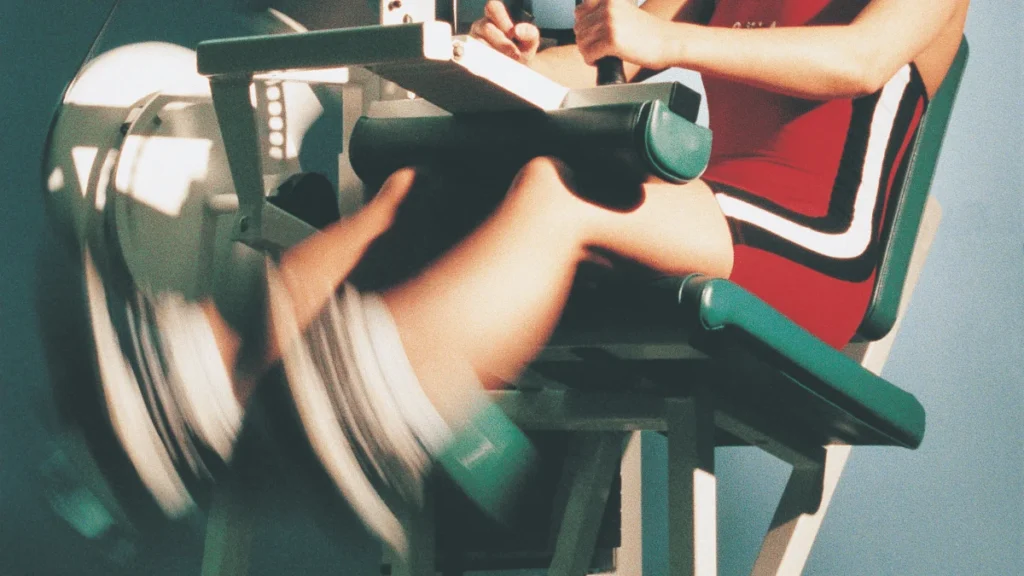
To refine exercise selection further regarding knee flexion movements, researchers Maeo and colleagues conducted pivotal work comparing different leg curl variations. Their first study contrasted the seated leg curl with the traditional lying leg curl. Performing a leg curl from a seated position inherently flexes the hips, placing a significantly greater stretch on the biarticular hamstrings than a flat lying position. On the other hand, the sartorius—a muscle that acts as both a knee flexor and a hip flexor—is placed in a more elongated state during the lying leg curl compared to the seated variation. The results confirmed that the seated leg curl induced greater growth of the biarticular hamstring heads, while the lying leg curl preferentially grew the sartorius.
A subsequent study by the same research group compared the seated leg curl, modified with a forward lean of the torso to maximize the stretch, against the Nordic hamstring curl. While the seated leg curl emphasizes the lengthened position for the biarticular hamstrings, the Nordic curl emphasizes high resistance in the stretch profile, becoming progressively more difficult as the body lowers toward the floor. The data showed that the Nordic curl drove greater growth in the short head of the hamstrings and the sartorius. Meanwhile, the seated leg curl resulted in superior growth for the long head and the semimembranosus. Growth rates for the semitendinosus, gracilis, and popliteus muscles remained comparable between both groups.
Synthesizing these findings suggests that the seated leg curl stands out as the most reliable option for maximizing overall hamstring growth. However, the lying leg curl retains value as a specialized tool for sartorius development, and the Nordic curl provides unique benefits for the short head and sartorius. Researchers note that these studies evaluated isolated curl variations; when implemented alongside hip hinges in a comprehensive regimen, the overall outcomes may shift slightly.

Additional research sheds light on related variables in hamstring development, even if not strictly tied to basic exercise selection. A conference abstract by Maeo et al. compared the effects of performing half-reps restricted to the stretched position against a full range of motion protocol using a multi-hip machine. The data indicated that muscular growth of both the hamstrings and the glutes was generally superior when utilizing the lengthened partial technique, suggesting that experimenting with partial repetitions in the deep stretch position could benefit lifters.
In another investigation, Cadeo and colleagues examined whether altering ankle positioning during lying leg curls could shift muscle recruitment. They compared standard curls performed with the ankle fully plantarflexed against a fully dorsiflexed position, aiming to manipulate the operating length of the gastrocnemius—a calf muscle that also assists in knee flexion—to shift more mechanical load onto the hamstrings. Ultimately, ankle positioning produced no measurable impact on the hypertrophy observed in the long head of the biceps femoris. Consequently, foot placement during leg curls remains largely a matter of personal comfort and preference.
Ultimately, achieving balanced and complete hamstring development requires a thoughtful combination of both hip hinges and leg curls. While hip hinges tend to preferentially load the long head and the semimembranosus, leg curls provide superior stimulus for the semitendinosus and the short head. Among the various curling options available, the seated leg curl appears most effective for general development, while lying curls and Nordic variations offer distinct, complementary advantages. By incorporating both movement families and selecting variations based on these scientific insights, athletes can construct a comprehensive, evidence-based approach to posterior chain training.