“His name is Wilfredo Gómez, and he will become a world champion.” With those exact words, journalist Alí Ramos opened his column in the Caracas newspaper El Nacional, capturing the aftermath of the bantamweight final at the 1974 World Amateur Boxing Championships in Havana.
Ramos was writing about a gifted 17-year-old phenom who had just delivered a startling performance on international soil, knocking out Cuba’s Luis Jorge Romero in the final round of the tournament. Contemporary press reports noted that even Cuban leader Fidel Castro was thoroughly captivated by the young fighter’s relentless rhythm and technical poise.
Alí Ramos proved to be remarkably prophetic. Gómez did not merely fulfill the prediction by capturing a world championship; he ascended to win titles in three distinct weight divisions during an era when boxing was defined by fiercely competitive ranks and fighters rarely possessed the luxury of avoiding top-tier rivals. In that golden period of the sport, the best routinely faced the best.
Though many sportswriters of today were not yet working in journalism when Gómez first burst onto the international stage, his explosive rise served as an enduring inspiration to follow his career closely. An in-depth evaluation of his record reveals a compelling argument: Wilfredo Gómez stands as the greatest Puerto Rican boxer of all time. Given a close vantage point to his career and a rigorous examination of his achievements, few narratives in modern sports history match the magnitude of his journey.
When a fight icon passes or completes their historic arc, sports culture often reflexively elevates them into mythic status, sometimes without complete analytical justification. In the case of Wilfredo Gómez, however, the numbers and performance metrics leave no room for hyperbole. Gómez is not simply a figure of legend; he possesses every statistical credential and qualitative milestone to be recognized as the supreme fighter in Puerto Rico’s rich boxing heritage, as well as the greatest super bantamweight in the history of the sport.
The figures surrounding his career are unequivocal. By the time he officially vacated his 122-pound super bantamweight crown, his professional ledger stood at 38 wins, one loss, and one draw, with every single one of his 38 victories coming by way of knockout. His lone defeat to that point had occurred in a courageous leap to featherweight against Salvador Sánchez, while his single draw had taken place in his professional debut against Jacinto Fuentes. Along the way, he established an astonishing record of 17 successful defenses of his super bantamweight title, finishing every challenger inside the distance—a feat that remains an unprecedented mark for the 122-pound division.
The Boy from Las Monjas
With an international resume of such destructive efficiency, the moniker “Bazooka” fitted Gómez like a glove. Yet to those who knew his origins, he was equally cherished as “El Niño de Las Monjas,” an homage to the humble San Juan neighborhood where he was born and raised.
His progression through the boxing hierarchy accelerated at a breathtaking pace. The natural agility and punching power he displayed from childhood transformed his development into a fast-track rise: he achieved amateur world champion status at age 17 and claimed his first professional world title at just 20 years old.
Before his triumph in Havana, Gómez represented Puerto Rico at the 1972 Munich Olympic Games as a flyweight. His Olympic campaign ended abruptly in his opening contest following a highly controversial decision awarded to Egypt’s Mohamed Selim. Unfazed by the setback in Munich, Gómez bounced back with determination, redeeming himself two years later at the amateur world championships in Cuba.
Having proved his dominance in the amateur ranks, Gómez made his transition to the professional circuit, embarking on the historic path that would ultimately secure his induction into the International Boxing Hall of Fame.
Unbeatable at 122 Pounds
Gómez’s designation as the premier super bantamweight in boxing history rests not only on his staggering completion rate but also on the remarkable caliber of opposition he turned away.
His professional voyage began in Panama on November 16, 1974, where he fought to a draw against local favorite Jacinto Fuentes. After shaking off the early pressure of that pro debut, Gómez launched an extraordinary streak, reeling off 15 consecutive victories—all by knockout—to earn a shot at the WBC super bantamweight world championship against South Korea’s Dong Kyun Yum in San Juan.
That championship night in Puerto Rico proved that Gómez was no fragile prospect, but a transcendent fighter destined to redefine the division. He stopped Dong Kyun Yum in the 12th round, sending the home crowd into euphoria and signaling the arrival of a national hero.
Throughout his historic reign at 122 pounds, “Bazooka” kept the judges out of the equation, stopping all 17 title challengers inside the distance. These opponents were far from routine ring work; his victim list read like a global showcase of top-ranked contenders and World Champions. Among those he knocked out during his title run were Royal Kobayashi, Juan Antonio López, Sakad Petchyindee, Juan “Kid” Meza, Carlos Zárate, Leo Cruz, Lupe Pintor, Derrick Holmes, and “Pambelito” Cervantes.
Moving Up to Featherweight
Having thoroughly cleared out the super bantamweight division, Gómez sought new frontiers and targeted the premier featherweight of his generation: Mexican legend Salvador Sánchez, widely regarded as one of the finest pugilists in boxing history.
Promoted by Don King, the high-stakes cross-border showdown was branded as “The Battle of the Little Giants.”
On paper, Sánchez versus Gómez presented a mesmerizing clash of elite styles, with the Puerto Rican champion entering the ring as a cautious favorite among oddsmakers. The Mexican standout represented Gómez’s equal in the 126-pound weight class, entering the bout on his own remarkable run of dominant victories.
While Gómez brought superior power and an immaculate championship record to the bout, he was also wrestling with less visible obstacles outside the ring: a challenging mix of sudden fame, immense wealth, and the surrounding distractions of high-profile celebrity.
These external factors began to compromise his dedication in the gym, turning his training camp into a social schedule where he spent more energy trying to make weight than refining tactical game plans. As a consequence, Gómez entered the ring far below his optimal physical condition. Yet, no surrounding circumstance detracts from the brilliant strategy and execution displayed by Sánchez that night.
The bout opened at a blistering pace, skipping any initial feeling-out period as both combatants immediately unleashed their power. Gómez pressed forward aggressively, attempting to overpower the featherweight champion, but Sánchez remained composed. Cold and clinical, Sánchez caught Gómez in the opening round with a crushing left hook that dropped the Puerto Rican and caused severe damage.
Following that early knockdown, Sánchez executed the precise counter-punching strategy that had established his reputation since winning the belt from Danny “Little Red” López. Balancing controlled pressure with flawless timing, Sánchez steadily dismantled Gómez over the ensuing rounds, putting the super bantamweight king through a punishing ordeal.
By the eighth round, with severe swelling across his face, Gómez finally succumbed to the Mexican champion’s volume and accuracy. It was a steep price to pay for underestimating an opponent of elite caliber.
Despite the setback against Sánchez, Gómez retained his 122-pound crown and promptly returned to his original weight class, defending his super bantamweight title four more times. His final title defense at 122 pounds proved to be one of his most memorable victories: a brutal, dramatic 14th-round knockout of Mexican warrior Lupe Pintor in a contest widely regarded as a classic.
With that victory, Gómez closed his iconic chapter at super bantamweight. When he permanently vacated the title, his career record stood at an astonishing 38 wins, one loss, and one draw, with every single victory achieved via knockout.
The Defeat Against Azumah Nelson
Having dominated 122 pounds beyond dispute, Wilfredo sought a permanent return to the featherweight division. A highly anticipated rematch against Salvador Sánchez was cruelly canceled when the Mexican champion died tragically in an automobile accident. In the aftermath, the vacant featherweight crown eventually found its home around the waist of Juan Laporte, a Puerto Rican fighter based in New York.
The opportunity for Gómez to capture a second world title in a second division arrived on March 31, 1984, when he faced Laporte at the Roberto Clemente Coliseum in San Juan. In a tense, tactical battle, Gómez outpointed his countryman over 12 rounds to claim a hard-fought decision win—marking one of only two victories in his entire professional career that did not come by way of knockout.
With little downtime, Gómez quickly accepted a mandatory challenge against another legendary figure of the era: Ghanaian powerhouse Azumah Nelson. In an emotional clash in San Juan, Nelson pushed a grueling pace, ultimately stopping Gómez in the 11th round to claim the featherweight belt Gómez had so recently won from Laporte.
Losing inside the distance on home soil was a painful blow for the San Juan idol, but his championship arc was still not fully written.
A Third World Title in a Different Weight Class
A fighter of Gómez’s supreme talent seemed bound to break historical thresholds. Unable to comfortably maintain the featherweight limit, he moved up once again, targeting the WBA super featherweight championship at 130 pounds.
The reigning WBA titleholder was American Rocky Lockridge, an elusive, powerful, and technically sound champion who had recently scored an impressive knockout victory over Roger Mayweather.
Lockridge agreed to defend his belt on Puerto Rican soil, where he met a determined Gómez. In a grueling, back-and-forth contest, Gómez dug deep to edge out Lockridge by split decision, relying on veteran instincts and relentless heart to capture his third world title in a third weight class under the WBA banner. Fighting in front of his home crowd once again proved to be a decisive factor in securing the judges’ nods.
Re-established on the world stage, Gómez saw his celebrity reach new heights, accompanied by a return to a high-flying lifestyle. His late-night venues, including the Flying Saucer nightclub he owned in Isla Verde, became legendary centers of local nightlife, attracting a persistent circle of entourage members and fans who naturally gravitated toward his star power.
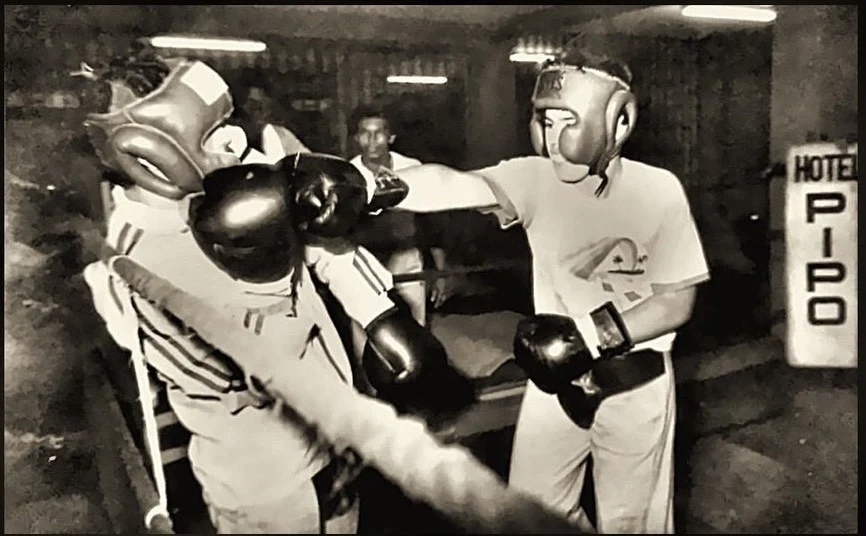
The lifestyle, however, inevitably exacted a toll on his conditioning. Recognizing the physical decline, WBA President Gilberto Mendoza recommended that Gómez move his training setup out of Puerto Rico. Gómez established his camp at the Hotel Pipo in Maracay, Venezuela, working alongside Venezuelan trainer Héctor Criollo to prepare for his first 130-pound title defense against Panama’s Alfredo Layne.
Despite the change of scenery, time had caught up with the great champion. Layne stopped an exhausted Gómez in the ninth round, taking the super featherweight belt. It was evident that the legendary "Bazooka" was no longer the explosive athlete who had dominated the boxing landscape a decade earlier; his physical gifts had permanently faded.
The Greatest Puerto Rican Boxer of All Time?
Beyond commemorating a legendary sports figure, the archival evidence strongly supports the case for Gómez’s supreme place in boxing history. Wilfredo deserves recognition as the greatest fighter ever produced by Puerto Rico—a country that boasts one of the most remarkable boxing traditions in the world, having produced legends like Carlos Ortiz, Esteban de Jesús, Alfredo Escalera, Félix “Tito” Trinidad, Wilfred Benítez, Héctor “Macho” Camacho, Miguel Cotto, Edwin Rosario, and Iván Calderón.
The sheer depth of that list illustrates the standard required to claim the top spot.
Iván Calderón recorded 17 title defenses, but those were divided across two distinct weight classes. Félix "Tito" Trinidad achieved incredible multi-division dominance with massive crossover appeal; Héctor "Macho" Camacho captivated fans with unmatched speed and showmanship; Wilfred Benítez made history as the youngest world champion ever at age 17. Yet, none matched the sustained, absolute reign of destruction achieved by Wilfredo Gómez. No record in Puerto Rican sports history quite parallels his primary championship run.
A Nickname That Fit Like a Glove
The "Bazooka" moniker was more than simple ring branding; it was an accurate descriptor of his physical presence inside the squared circle. His record and total knockout tallies remain historic benchmarks.
Yet, characterizing Gómez merely as a puncher does a disservice to his complete skill set. He was also a remarkably fluid defensive strategist. When he was not pursuing a stoppage, Gómez displayed masterful upper-body movement, weaving slipping techniques smoothly into counter-attacking opportunities.
In violent encounters against ruthless champions like Lupe Pintor and Carlos Zárate, he proved his ability to withstand heavy punishment when necessary. However, few opponents could cope with his precise combination punching, deadly left hook, and unwavering physical courage in the heat of battle—a trait that mirrored the fighting spirit of the Taíno heritage of his homeland.
Even in the modern era, dominated by brilliant contemporary champions like Japan’s Naoya Inoue, Gómez’s numbers at 122 pounds stand unmatched, reinforcing his historical case as the greatest super bantamweight to ever step into a ring.
While boxing historians and Puerto Rican critics may forever debate the top spot among the island’s fight icons, the statistical achievements, line of defeated champions, and 17 consecutive knockout defenses left behind by the "Niño de Las Monjas" present an enduring argument for Wilfredo Gómez as the ultimate Puerto Rican champion.