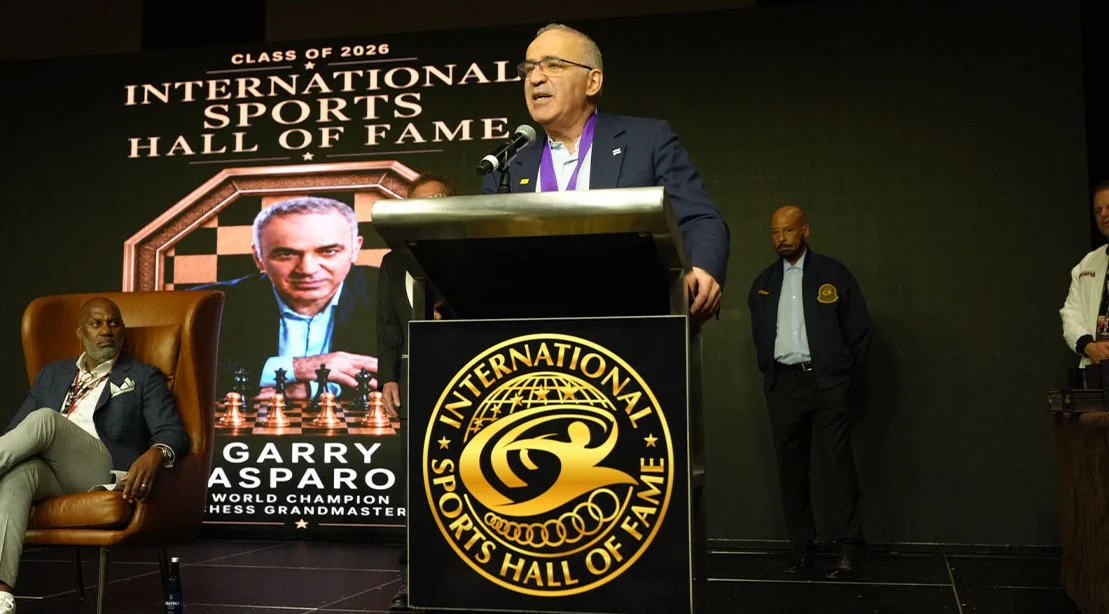
When the International Sports Hall of Fame (ISHOF) welcomed its prestigious Class of 2026 on September 26, the induction ceremony carried profound significance far beyond the presentation of a gold medal and a brief turn at the microphone for legendary chess icon Garry Kasparov. For the 13th World Chess Champion, the honor served to settle a debate that has lingered for generations across athletic and academic communities alike: Is chess truly a sport?
Addressing the audience gathered for the landmark event, Kasparov expressed deep gratitude for the recognition, viewing it as a definitive validation of the discipline he mastered. “I also want to thank you for an important contribution that might help end this debate once and for all. Chess is, in fact, a sport,” Kasparov declared during his acceptance speech.
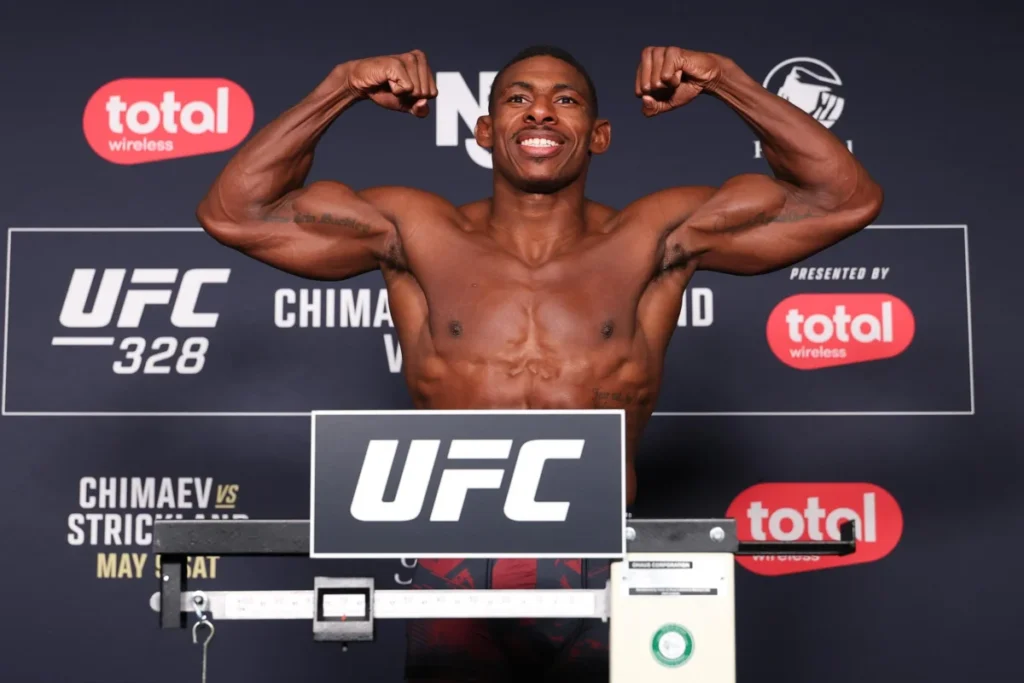
Standing alongside fellow 2026 inductees renowned for their physical prowess—such as legendary bodybuilder and Mr. Olympia winner Dexter Jackson, mixed martial arts pioneer Forrest Griffin, martial artist Vitomir Maričić, and the iconic exhibition basketball team the Harlem Globetrotters—Kasparov offered a witty acknowledgment of his own physical differences from traditional athletes. While joking that he might not possess the mountainous physique of a bodybuilder, he emphasized that sports, competitions, and athletics have always demanded a powerful mental component. When measuring greatness by the sheer demands of the mental game, Kasparov asserted that chess stands virtually unmatched among human endeavors.
“Chess is in many ways the purest expression of the mental focus and fortitude necessary to achieve greatness in just about any other sport,” Kasparov explained, drawing a direct parallel between the grueling psychological discipline required to calculate complex board positions and the rigorous concentration needed to excel in physical arenas.
Love and Dominance of the Game
The foundation of Kasparov’s unparalleled strategic mind was laid decades ago. Born in Baku, in the former Soviet Union and present-day Azerbaijan, in 1963, he discovered an early fascination with chess. His passion was actively encouraged by his parents, who both enjoyed playing the game. His father introduced him to the fundamental rules, but tragedy struck early when his father passed away in a car accident when Garry was just seven years old. Determined to nurture her son’s obvious intellect and passion, his mother enrolled him in the prestigious Baku Young Pioneer Palace chess circle, setting him on a path toward history.
By the age of 10, young Garry’s extraordinary talent caught the attention of the chess world when he was accepted into an elite training school run by former world champion Mikhail Botvinnik. Impressed by Kasparov’s photographic memory and his uncanny ability to calculate deep, complex variations across dozens of potential moves, Botvinnik served as a crucial mentor. Under this guidance, Kasparov developed the tactical brilliance that would soon propel him to the absolute summit of international competition.
Just twelve years after entering Botvinnik’s academy, Kasparov achieved the ultimate milestone in his field. In 1985, at the remarkably young age of 22, he defeated reigning champion Anatoly Karpov to become the 13th World Chess Champion.
“Karpov was still 34 at that time. So, I was quite young,” Kasparov recalled during his ISHOF induction speech, reflecting on the historic victory. “It convinced me that I could play a much bigger game.”
What followed was an era of unprecedented dominance. Kasparov held the official International Chess Federation (FIDE) World Championship title from 1985 until 1993, and subsequently held the Classical World Championship title until 2000. His iron grip on the sport extended to the rankings; he maintained the world No. 1 spot from 1984 continuously until his retirement in 2005. His peak FIDE rating of 2851, achieved in 1999, stood as the highest rating in the history of chess for more than a decade before being surpassed by Magnus Carlsen in 2013.
Beyond his human adversaries, Kasparov became a pioneer at the intersection of sports and emerging technology. Long before artificial intelligence dominated modern societal conversations, Kasparov stepped onto a global stage to face IBM’s supercomputer, Deep Blue, in a pair of landmark matches. Kasparov triumphed in the initial six-game encounter in 1996 with a 4-2 score. Following significant upgrades to the machine, IBM and Deep Blue claimed a narrow 3.5 to 2.5 victory in their 1997 rematch. Beyond the intense media attention and public intrigue, these historic clashes served a broader purpose for Kasparov, sparking a lifelong fascination with computer science and pushing him to consider how technology shapes human potential on a global scale.
His Noble Second Act
When Kasparov officially retired from competitive chess in 2005 while still at the absolute top of his game, he chose not to step away from the public eye, but rather to transition onto an even larger stage. He embarked on a passionate career in political activism, emerging as one of the most prominent and vocal critics of Russian President Vladimir Putin. His commitment to political reform led him to mount a presidential campaign in Russia in 2008, though his efforts were systematically blocked when the government prevented him from renting a venue large enough to gather the legally required number of supporters.
As one of Russia’s most visible dissidents, Kasparov endured intense government surveillance, physical harassment, and multiple short-term detentions by police during street protests. Facing the imminent threat of arrest in 2013, he made the decision to leave his homeland, eventually securing citizenship in Croatia—a move he described as becoming “a citizen of Europe.”
“By 2015, my name had disappeared from Russian sport records,” Kasparov noted regarding the government’s attempts to erase his legacy. Unshaken by the regime’s tactics, he extended his mission to the United States, viewing the nation through the lens shared by millions seeking freedom across the former Iron Curtain.
“So, I came to America and as millions and millions of people on the other side of the Iron Curtain, I viewed America as the beacon of hope,” Kasparov said.
His outspoken opposition to Putin continued unabated, leading the Russian government to officially designate Kasparov as a “foreign agent” in 2022. Despite these retaliatory measures, his advocacy for human rights and democratic institutions expanded. From 2011 to 2024, he served as Chairman of the Human Rights Foundation, an international nonprofit dedicated to defending fundamental liberties within authoritarian regimes worldwide.
In 2017, he founded the Renew Democracy Initiative, an American nonprofit organization focused on reinforcing liberal democracy both in the United States and globally. Furthermore, he continues to work closely with the Russian anti-war opposition coalition in exile, maintaining a fierce resistance against Putin’s regime and the ongoing invasion of Ukraine.
Giving Back to His Sport
Even as his global humanitarian and political efforts expanded, Kasparov never detached himself from the chess community. In recent years, his contributions to the game have centered on elite tournament organization, youth mentorship, the promotion of chess variants, and high-profile exhibition matches. He played a foundational role in launching the Grand Chess Tour, an elite circuit uniting the world’s top-ranked Grandmasters. He remains a prominent analytical voice, frequently offering sharp strategic commentary on contemporary world championship matches and top-tier events.
Although he no longer participates in regular tournament circuits, Kasparov periodically returns to the board for specialized exhibition play, highlighted by his 2025 clash with Viswanathan Anand and his 2026 match against longtime rival Veselin Topalov. Through the Kasparov Chess Foundation, a nonprofit organization he established in 2002, he concentrates heavily on chess education, digital coaching platforms, training camps, and the identification of young prodigies.
“Today, nearly every single American grandmaster under the age of 35 has come through the Foundation’s programs,” Kasparov noted of the organization’s profound impact on the next generation of players.
During his acceptance speech at the ISHOF ceremony, Kasparov extended warm congratulations to his fellow 2026 inductees, including Dexter Jackson, Forrest Griffin, Vitomir Maričić, and the members of the Harlem Globetrotters. He concluded his remarks by expressing hope that the recognition would amplify his mission far beyond the event in Las Vegas, serving as another platform in his ongoing pursuit of democratic renewal.
“Thank you again for this honor, which will hopefully bring attention to our shared fight to renew and revitalize American democracy and ensure that it’s robust enough to meet the challenges of the new era,” Kasparov said.