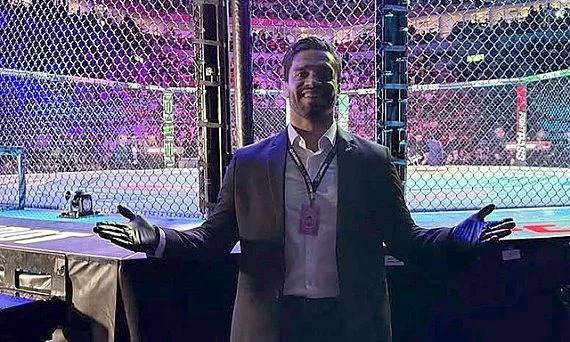
Tavares, who compiled a notable professional mixed martial arts record of 24-11-1 before stepping away from the sport for good in 2021, has officially traded his fighting gloves for a doctor’s white coat. The Brazilian veteran is now a practicing physician specializing in neurology. True to his roots in combat sports, Tavares is dedicating his medical expertise to a pressing issue affecting his former peers, currently working on an ambitious master’s thesis that explores potential living markers of chronic traumatic encephalopathy, commonly known as CTE, in former professional fighters.
Thiago Tavares seeks potential CTE markers in former UFC fighters
Speaking in an in-depth interview with Sherdog, Tavares shed light on the stark medical realities surrounding chronic traumatic encephalopathy, noting that the neurodegenerative condition can currently be definitively diagnosed only by examining brain tissue after a patient has passed away. His groundbreaking research aims to shift this paradigm by exploring whether advanced brain wave measurements combined with artificial intelligence could help identify a reliable, non-invasive marker in living patients.
"Unfortunately, the only way to confirm CTE is through the study of brain tissue (a post-mortem biopsy) in the anatomopathological exam," Tavares explained during the interview. "There is still no reliable marker able to indicate that an athlete is affected by CTE, so based on certain symptoms we say that he has traumatic encephalopathy syndrome."
The transition from absorbing strikes inside the Octagon to studying the neurological aftermath of combat sports represents a profound evolution for the veteran fighter. During his active career, Tavares was known for his durability, high-level grappling, and resilience against some of the toughest contenders in the lightweight and featherweight divisions. Having experienced the physical toll of the sport firsthand, he now views neurology not just as a medical specialty, but as a calling to protect those who follow in his footsteps.
To tackle this complex diagnostic challenge, Tavares outlined the parameters of his upcoming research project, which will involve a carefully selected cohort of 40 former UFC fighters from his own generation—athletes who competed at the highest level of the organization between 2010 and 2017. This specific group provides a vital demographic for study, given the era’s training methodologies, the evolution of athletic conditioning, and the accumulated impact of hard spars and competitive bouts over multiple years.
According to Tavares, his research team plans to utilize specialized diagnostic technology, pairing comprehensive clinical assessments of symptoms with cutting-edge hardware to search for elusive indicators of the disease in living subjects.
"We will use a helmet that performs a functional electroencephalogram and measures the brain’s waves, including the use of AI in an attempt to find that marker, on top of, obviously, the in-depth study of the symptoms that would allow us to state that an individual has CTE even before [they] die," Tavares added.
The integration of functional electroencephalography through a specialized helmet system represents a modern approach to assessing neurological function. By capturing real-time brain wave data and analyzing it with artificial intelligence algorithms, Tavares and his research colleagues hope to detect subtle patterns or anomalies that correlate with neurodegeneration. If successful, this methodology could pave the way for early detection frameworks, allowing neurologists to intervene, manage symptoms, and offer guidance to retired athletes long before degenerative changes become irreversible.
Beyond the scientific ambitions of his master’s thesis, Tavares remains deeply grounded in his gratitude for the sport that shaped his adult life. The financial stability and career longevity he achieved during his tenure with the Ultimate Fighting Championship provided the foundation he needed to transition into higher education and complete medical school. Now, as a licensed neurologist and researcher, he sees his current work as a way to give back to the combat sports community that supported him through decades of competition.
"Everything I have in my life, the UFC gave me," Tavares reflected. "I hope that at the next UFC in Brazil I get the chance to thank Dana White, Joe Silva and Sean Shelby in person. And I hope that, with my work in medicine, I can give some of that back by helping the future generations of this sport."