
When Katie Taylor steps through the ropes on Saturday night to defend her super-lightweight titles and command the attention of an entire nation one last time, the atmosphere will carry an unmistakable and bittersweet weight. At 40 years of age, after a career that systematically shattered barriers, rewritten the modern history of women’s combat sports, and secured her status as one of Ireland’s most revered sporting figures, the Olympic champion and multi-division world titleholder has confirmed that this bout will be her last. It is the closing chapter of an odyssey that began in absolute obscurity and now concludes on the grandest platform Irish sport can provide.
For her inner circle, her hometown community in County Wicklow, and the legions of supporters who have followed her across three decades, the realization that the final bell is approaching has prompted a profound sense of reflection.
“The end of an era, isn’t it?” said Trevor McMahon, Taylor’s brother-in-law and the founder of the gym in Bray where she regularly trains when back on home soil. “It’ll be an amazing night but it’ll also be a little bit sad. Everything she did, it might not ever be achieved again.”
Yet if there is sorrow in the prospect of her departure from the ring, there is immense consolation in the scale and setting of her valedictory appearance. Taylor will make her walk in front of a capacity crowd of 80,000 spectators inside Dublin’s Croke Park, the historic citadel of Gaelic games and the emotional heart of Irish athletics.

A fight of this magnitude in such a colossal venue was once dismissed by skeptics as an unfeasible gamble. Before tickets went on sale in June, questions circulated in some quarters as to whether a boxing event—even one headlined by Ireland’s most celebrated active athlete—could realistically fill a stadium of that scale. Those doubts were emphatically erased the moment the box office opened: every seat was snapped up in just 17 minutes, confirming the contest as one of the fastest-selling spectacles in modern Irish history.
The evening has evolved into a full-scale cultural celebration. The pop group Westlife and an assortment of musical acts have joined the official bill to heighten the sense of national festival, transforming what might have been an ordinary fight card into a stadium-sized carnival. Recognizing the communal importance of the occasion, the national broadcaster, RTÉ, secured the rights to air the card live and free-to-air, ensuring that citizens gathering in living rooms, village halls, and packed pubs from Donegal to Kerry will be able to watch the showdown without restriction. In the ring, Taylor will face Flora Pili, an undefeated 29-year-old French champion who brings her own unblemished record and the IBO super-lightweight strap into the crucible of Dublin.
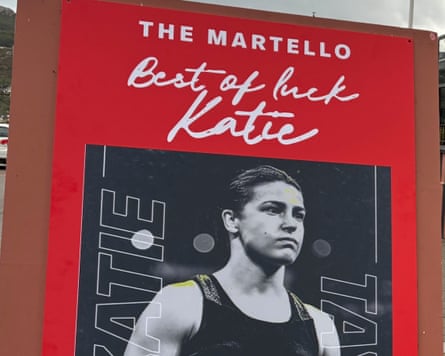
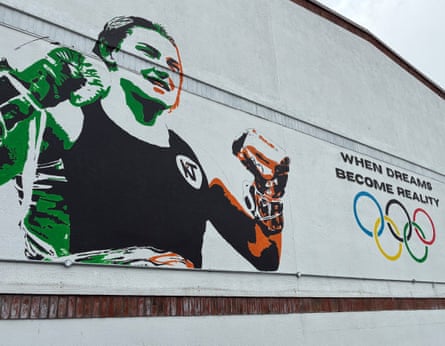
Nowhere is the anticipation more palpable than in Taylor’s hometown of Bray. Along the streets, shopfronts, and promenade of the seaside town, the countdown to Saturday has taken over daily life. Billboards featuring black-and-white portraits of Taylor bearing the simple message “Best of luck Katie” loom over public squares, while walls across the district display murals charting her journey from a childhood dreamer to Olympic gold medallist.
Near the family home, street vendors have spent the week attending to a steady stream of locals and visiting fans eager to secure memorabilia before the final curtain descends.
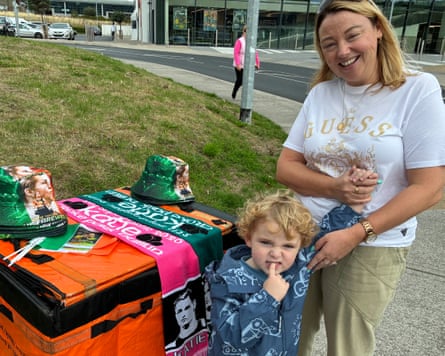
“Business is tipping away,” said David Finnegan, 55, who spent the week operating a stall stocked with commemorative hats, green-and-gold tricolours, scarves, and posters emblazoned with Taylor’s likeness. “This is her farewell, everyone wants to be part of it.”
Among those picking through the merchandise was Catherine Hill, 45, who had managed to secure one of the coveted 80,000 tickets for Croke Park and had brought her son along to buy a T-shirt for the occasion. For Hill, the significance of Saturday night stretches far beyond the technical mechanics of boxing; it represents a generational transformation in how young Irish girls perceive their place in the sporting world.
“It’s going to be amazing for Katie, the whole country and all women,” Hill said. “Every young girl now wants to be a boxer or an athlete. It wasn’t like that before.”
That cultural resonance crosses every demographic and generational divide. Another customer browsing the stalls was Denise, 71, who was purchasing armfuls of flags destined to decorate a pub in County Kerry where she planned to watch the broadcast alongside neighbors. Denise pointed not to Taylor’s belt collection, but to her quiet demeanour, as the key to her enduring bond with the public.
“What I love about Katie is that she’s not full of herself,” Denise said. “She’s down to earth and still meets up with her friends here. She’s so good with the children.”
Indeed, throughout Ireland, even those who otherwise express little interest in professional prize fighting have found themselves drawn into the emotional build-up. The affection directed toward Taylor is rooted in the unique qualities of her trajectory: a pioneer who changed the landscape of an entire discipline through sheer technical brilliance and punishing resolve, while remaining resolutely grounded and soft-spoken outside the ring.
Her career was forged against obstacles that once appeared insurmountable. Encouraged and initially trained by her father, Pete, Taylor first strapped on gloves as a young girl in Bray, working out of a spartan, tin-roofed shed so basic that it was known locally as “the Tin Can.” At the time, amateur and professional boxing authorities in Ireland and the United Kingdom strictly prohibited women and girls from competing in the ring. Refusing to accept the ban, Taylor tucked her hair into headgear, entered competitions disguised as a boy, and registered on tournament fight cards under the ambiguous moniker “K Taylor.”
That quiet defiance eventually gave way to active reform. Father and daughter lobbied boxing administrators relentlessly, ultimately persuading the Irish Amateur Boxing Association to officially lift the prohibition against female fighters in 2001, when Taylor was 15 years old. The victory opened the door for a generation of female boxers, but Taylor’s ambition extended further. She and her father became central figures in the campaign to convince the International Olympic Committee to add women’s boxing to the Olympic programme—a goal realized at the London 2012 Games, where Taylor delivered an unforgettable performance to capture the lightweight gold medal for Ireland amid deafening support from traveling fans.
When she eventually transitioned to the professional ranks, the pioneer’s mantle followed her. She headlined at Madison Square Garden in New York, participating in a transcendent, sold-out duel that elevated women’s boxing to mainstream global prominence, and later contested a punishing, defining trilogy against Amanda Serrano that cemented her reputation for unyielding ring warfare.
Despite that global stardom, she has continually returned to the gym that grounds her. McMahon, whose Liberty Boxing Gym in Bray serves as her regular training retreat whenever she returns to Wicklow, recalled that her work ethic has never varied, regardless of the size of her purse or the prestige of her titles.
“The talent was always there but it was more the dedication,” McMahon said. “She knew from the get-go what she was going to do. When she comes down to train in the club, the place is packed.”
Saturday’s fixture at Croke Park will also close an extraordinary historical gap. The last time a boxing ring was constructed on the sod of Croke Park was in the summer of 1972, when Muhammad Ali traveled to Dublin to defeat Alvin Lewis in an exhibition-turned-heavyweight battle that has lingered in Irish sporting folklore for more than half a century. To McMahon, Taylor’s farewell carries a depth that eclipses even that storied afternoon, because it belongs entirely to an Irish woman who built her sport from nothing.
Yet the sporting stakes of the night remain unforgiving. The farewell is no exhibition. Her opponent, Flora Pili, arrives with a perfect record of 12 victories from 12 professional bouts. At 29, the French fighter is in her prime, holds the IBO world title, and brings the hunger of a challenger with everything to gain by spoiling an icon’s swan song on foreign soil.
Taylor, however, is determined to unify the division, collect one last world championship belt, and leave the sport undisputed on her own terms. Those close to her preparation insist that retirement has not dulled her competitive ferocity.
“No matter how tough the fight is, Katie always seems to rise to the occasion,” McMahon noted. “If she’s beaten, you’d have to carry her out of there in a box.”
That combination of fierce competitiveness in combat and modesty in private life has forged a distinctive status for Taylor within Irish society. Laney O’Connell, 28, who lives on the residential estate where Taylor grew up, noted how proud the community feels when seeing the boxer serve as Ireland’s most prominent sporting figure on the international stage.
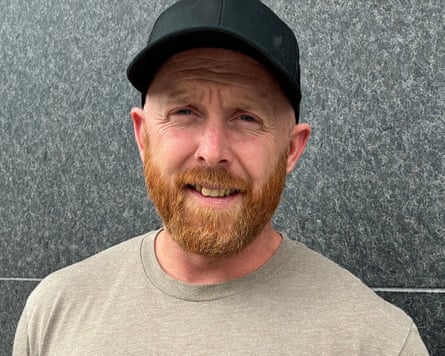
“When you meet her, she’s completely normal. I don’t think she realises just how big she is,” O’Connell said. “And it’s great to see the country represented by a woman instead of a man, especially not McGregor,” she added, drawing a contrast with mixed martial artist Conor McGregor.
As fight night nears, the prevailing emotion in Bray and across the island is a mixture of breathless anticipation and quiet relief that a beloved athlete will soon step away with her health, legacy, and dignity intact.
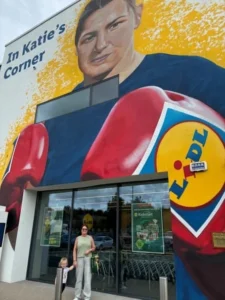
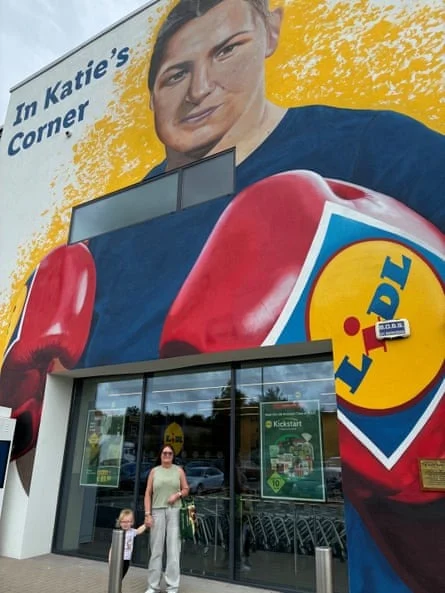
Standing beneath a large supermarket mural depicting Taylor alongside the words “In Katie’s corner,” Anne-Marie McHugh, 58, looked on with her granddaughter and reflected on what the fighter has given over decades of punishing sacrifice.
“It’s time for her to relax,” McHugh said softly. “She’s earned it.”
On Saturday, under the stadium lights of Croke Park and before a roaring crowd of 80,000, Katie Taylor will answer the bell one final time.