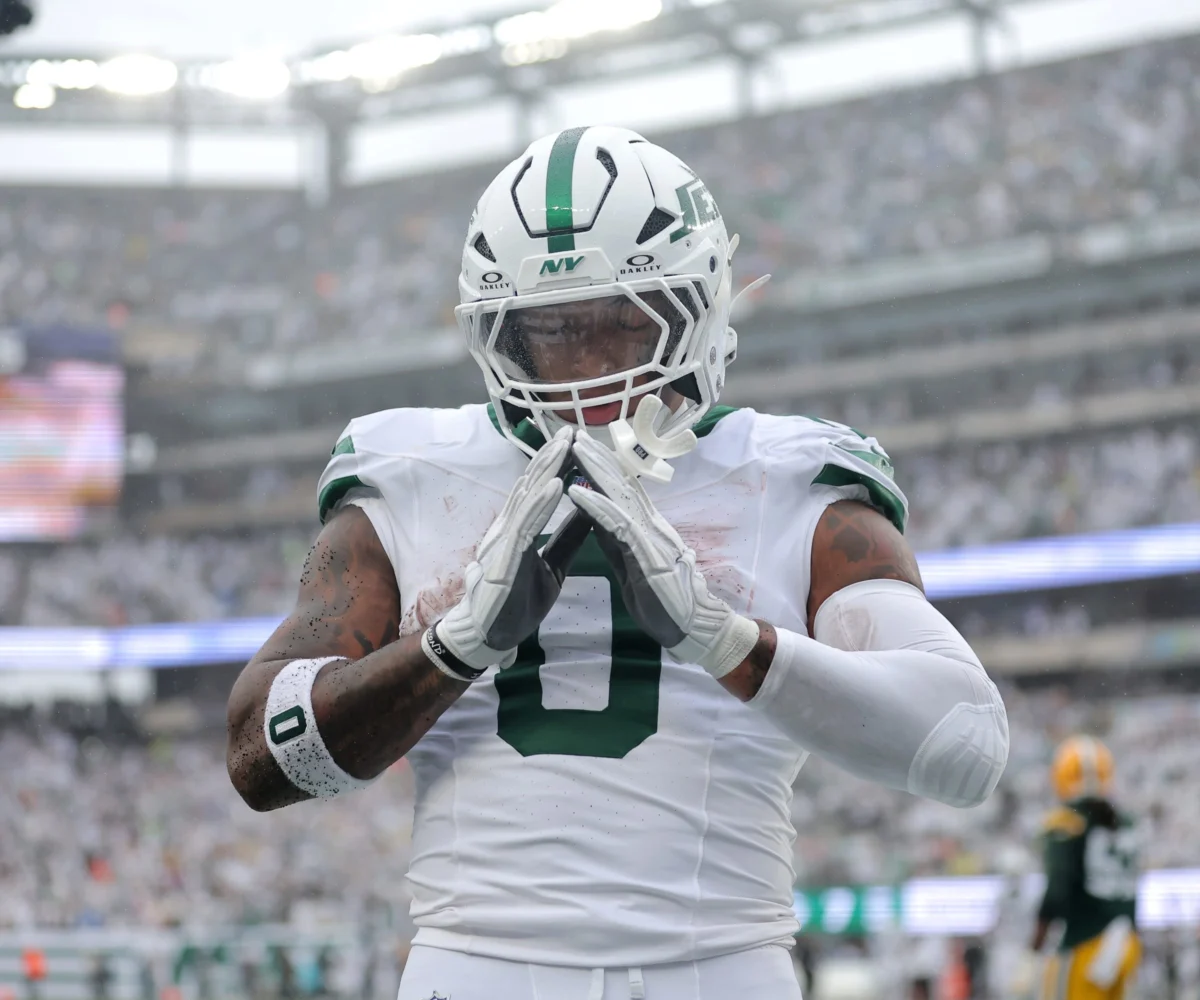
The journey of Daniel Jones has taken a dramatic new turn as the veteran quarterback looks to salvage his career with the Indianapolis Colts. For Jones, the transition represents a critical juncture following a turbulent end to his tenure with the New York Giants, an era marked by flashes of high-end rushing production, lingering injuries, roster upheaval, and an eventual release last November that officially closed the book on a once-promising marriage in the Meadowlands.
Jones’ final stretch in New York unraveled across ten difficult games. During that span, he managed just eight touchdown passes while turning the ball over nine times, failing to throw a single touchdown pass in six of those outings. His struggles were reflected deeply in advanced metrics, as his 6.1 yards per attempt ranked 35th out of 36 qualifying quarterbacks, and his completion percentage of 20.7 on pass attempts traveling 20 yards or more ranked dead last in the league. Compounding matters, his once-potent rushing game also crashed, causing him to average a career-low 4.0 yards per carry before his season was cut short.
Yet, despite the unceremonious departure from his original NFL home, a fresh opportunity materialized in Indianapolis this summer. Jones arrived in the Circle City and successfully won the starting job battle during training camp against third-year pro Anthony Richardson. Now positioned at the helm of the Colts offense, Jones finds himself surrounded by a robust supporting cast. Indianapolis boasts plenty of quality receiving options, anchored by wide receivers Michael Pittman and Josh Downs, alongside tight end Tyler Warren, whom the franchise selected 14th overall in April’s NFL Draft. With a sturdy offensive ecosystem and a scheme that can leverage his rushing capabilities, Jones enters the season with enough assistance to serve as a serviceable QB2 in fantasy formats for however long he maintains the starting assignment.
The road to this fresh start, however, was paved with mounting frustration in New York, where injuries and unmet expectations ultimately derailed a lucrative extension. Jones missed three games last year before suffering a torn ACL in his first game back from the sidelines. Having undergone reconstructive knee surgery in late November, questions loomed regarding his readiness for Week 1, a scenario that could have initially thrust backup Drew Lock into the starting lineup.
The Giants organization has spent the subsequent months grappling with the fallout of the four-year contract extension containing $92 million in guaranteed money that Jones signed the prior offseason. During his brief six-game window last year, Jones retained a measure of accuracy, logging a 75.0 on-target percentage—good for fifth in the league among quarterbacks with at least 160 attempts—and a 67.5 completion percentage that ranked seventh overall. However, those efficiency numbers were built almost entirely on an ultra-conservative, short-passing philosophy. His average depth of target was a scant 6.8 yards, ranking 36th in the NFL, while a meager 6.9 percent of his pass attempts traveled 20 yards or more downfield, placing him 38th. Out of 13 deep passes attempted, he completed just two and threw an interception.
While critics pointed to Jones’ lack of elite arm strength, analysts and team personnel frequently noted that his struggles were equally a product of surrounding circumstances. The Giants routinely fielded an offensive line that struggled in pass protection, and their receiving corps ranked at the bottom of the league in creating separation. Efforts to address these deficiencies included drafting electric wide receiver Malik Nabers sixth overall—who immediately stepped in as the clear-cut number-one target following a blistering 4.35-second forty-yard dash at his pro day—and signing experienced guards Jon Runyan and Aaron Stinnie to shore up the interior line. Still, the offensive transition was complicated by the departure of star running back Saquon Barkley, whose exit left Devin Singletary to shoulder the backfield load alongside an otherwise unimpressive ensemble cast.
The dink-and-dunk offensive approach deployed by New York had previously shown it could yield fantasy success when supplemented by elite rushing production. In 2022, Jones enjoyed a breakout campaign that culminated in a QB9 overall fantasy finish. That season, he utilized his legs to amass 708 rushing yards—ranking fifth among all quarterbacks—along with seven rushing touchdowns. His accuracy ticks also trended upward, raising his on-target rate to 76.1 percent and hitting 67.2 percent of his passes overall.
Even so, that success relied heavily on a heavy volume of designed runs and scrambles that masked limitations in the vertical passing game. His average target depth that year slumped to a career-low 6.4 yards, ranking 31st in the league, as he rarely tested defenses downfield. Only 4.4 percent of his attempts traveled beyond 20 yards, the lowest mark in the entire NFL. Consequently, his yards-per-attempt figure lagged at 6.8, a threshold he has never crossed above 7.0 in a single season.
Front office maneuvers during that era attempted to patch the receiving corps by bringing in veterans like Parris Campbell and Jamison Crowder, alongside a notable trade for tight end Darren Waller. Concurrently, Jones showed steady progress in protecting the football, leading the league in the previous season with a remarkably low 1.1 interception percentage alongside just three lost fumbles. That relative security prompted the Giants to commit to a four-year, $160 million contract extension, banking on his ongoing development under head coach Brian Daboll, the acclaimed offensive mind who previously helped shape Josh Allen into an elite superstar in Buffalo.
Yet, relying heavily on rushing production and short throws left a narrow margin for error. A neck injury ultimately cost Jones the final six games of that campaign, abruptly capping another year of unfulfilled potential. Aside from a lone explosive performance in Week 4 where he threw for 402 yards, his output across ten other starts barely averaged 200 passing yards per game. His yards-per-attempt metric hovered at 6.7, mirroring the numbers from his previous two seasons, while accuracy issues persisted as he ranked 22nd in on-target percentage at 73.4.
Those challenges prompted ongoing evaluations within the organization. When Daboll was hired, the mandate was clear: replicate the developmental leap that transformed Buffalo’s once-erratic passing attack. The front office actively overhauled a beleaguered offensive line through draft investments—such as first-round right tackle Evan Neal—and veteran acquisitions like center Jon Feliciano. The supporting cast was built to provide stability, provided that key offensive weapons like Barkley and the primary receivers could remain on the field.
The roots of these offensive evaluations trace back further to the earlier chapters of Jones’ career, including a stagnant sophomore campaign that followed a highly promising rookie introduction. After a stellar debut season, Jones struggled to take the expected leap forward. His yards-per-attempt figure remained stagnant at 6.6, ranking 27th in the league, and he surpassed 250 passing yards in a game just three times all year, failing to eclipse the 300-yard mark entirely after doing so five times during his twelve starts as a rookie.
The most glaring regression during that second year occurred in the red zone and in total touchdown output, where his scoring passes dropped from 24 down to 11. He lost five touchdowns in high-value red-zone situations despite logging an identical number of attempts, leading to an 11.9 percent red-zone touchdown pass rate that ranked last in the NFL. Mitigating factors included learning a second offensive system in as many years under coordinator Jason Garrett, losing Saquon Barkley to a season-ending injury in Week 2 that eliminated defensive respect for the run, and enduring an offensive line that surrendered a league-high pressure rate of 30.2 percent. Furthermore, Giants pass-catchers dropped 8.0 percent of their targets, the fifth-highest mark in the league.
Seeking to turn the page, the franchise opted to pass on taking a quarterback with the 11th pick in that year’s draft, instead trading down to secure speedy wide receiver Kadarius Toney and signing established deep threat Kenny Golladay. Those additions joined holdovers Darius Slayton and Sterling Shepard, alongside veteran tight end Kyle Rudolph, providing Jones with a revamped group of targets designed to ease his progression.
The optimism surrounding Jones initially caught fire during his historic 2019 rookie campaign. Entering the starting lineup in Week 3, Jones put together a series of standout performances, culminating in a historic Week 16 outing where he became the first rookie in NFL history to pass for at least 350 yards, five touchdowns, and zero interceptions in a single game. That surge effectively pushed long-time franchise cornerstone Eli Manning toward retirement and shattered several Giants rookie passing records. Standing 6-5, Jones also flashed elite mobility, recording some of the fastest tracking speeds among NFL quarterbacks at nearly 19.5 miles per hour.
However, the rookie campaign was equally defined by ball-security issues. Jones struggled with a bottom-10 interception rate of 2.6 percent and an alarming tendency to fumble, coughing up the ball 18 times—the fifth-most in a single season in NFL history—and tying a dubious rookie record with 11 fumbles lost. While analysts noted that he occasionally held onto the football too long, those turnovers were exacerbated by an offensive line that allowed pressure on nearly 30 percent of his dropbacks.
Long before those trials and triumphs, Jones entered the league as the surprise sixth overall selection in the 2019 draft, initially drafted to serve as Manning’s understudy. Evaluators viewed him as a developmental prospect following a collegiate career at Duke characterized by a 59.9 career completion rate and a 6.4 yards-per-attempt average. Yet, his ideal quarterback frame, combined with an MVP performance at the Senior Bowl that captivated the Giants’ front office, set the foundation for his professional journey.
Now, with his chapter in New York firmly in the past, Jones embarks on a vital redemption arc in Indianapolis. Armed with a fresh start, a capable offensive infrastructure, and the lessons learned through years of turbulence, the veteran quarterback aims to prove that his story in the NFL is far from finished.