


Across boxing gyms, broadcast booths, and training camps, one of the most enduring tactical axioms is the directive to "fight on the outside." Often prescribed to boxers with longer reaches, superior footwork, or defensive mindsets, the instruction is broadly understood as an order to operate at long range, keep distance, and retreat whenever an opponent applies pressure.
Yet an examination of ring mechanics reveals that this conventional interpretation rests on a profound tactical misconception. In practical application, the notion of fighting from the outside simply by retreating or trying to remain far away frequently leads to catastrophic tactical collapse. Fighters who equate distance with safety inevitably discover that moving in reverse yields the ring’s geography to their opponents, ultimately trapping them along the perimeter ropes where they absorb sustained punishment.
A closer look at how space, biomechanics, and spatial geometry interact inside the ring demonstrates that survival and success do not come from straight-line retreat, but from continuous lateral movement and constant angle manipulation.
The Pitfall of Linear Retreat
The primary trap for fighters attempting to maintain outside distance lies in their instinctive reliance on the straight backstep. In combat sports, taking a step directly backward is frequently treated as an immediate escape hatch. When an athlete is overwhelmed, struggling to read an opponent’s incoming combinations, or getting caught clean, the backstep presents itself as the most effortless defensive option available.
Superficially, the maneuver feels infallible. Stepping directly out of range nullifies punches entirely without requiring the razor-thin timing or technical composure needed to slip, catch, roll, or duck an incoming strike. Because a properly timed retreat places the target outside the physical reach of a fist, it offers an immediate sense of absolute safety.
However, linear retreat carries a fatal limitation: it does not fundamentally alter the tactical scenario. While a backstep may allow a boxer to avoid an initial jab or cross, the physical dynamic remains unchanged. The attacking fighter simply steps forward, closing the newly created distance and re-establishing engagement. Because the retreating fighter has moved backward without pivoting or turning the opponent, they find themselves facing the exact same offensive onslaught, only now with significantly less canvas behind them.
The geometric reality of a boxing ring imposes severe physical limits on reverse movement. Even from the exact center of the ring, a fighter rarely has room for more than two full backsteps before encountering the ropes. Even in an oversized ring, two consecutive retreating steps push a fighter perilously close to the boundaries, fundamentally shifting the psychological balance of the fight. Once compressed against the perimeter, a defender’s movement options vanish, leaving them vulnerable to the exact assault they sought to avoid.
Moreover, the nature of these retreats often deteriorates under pressure. Rather than disciplined micro-steps calibrated to keep the boxer in position to counter, stress-induced retreats typically turn into extended, panicky backward leaps that exhaust the defender and hand the aggressor complete control over the pace of the bout.
The Strategic Superiority of Lateral Movement
Attempting to escape forward pressure through straight-line retreat quickly becomes unsustainable. Relying on reverse footwork to survive demands an overwhelming advantage in foot speed and aerobic conditioning, while depending on an opponent who lacks the coordination to cut off the ring. Even under the best conditions, turning a bout into a footrace in reverse rapidly drains energy and fuels the attacker’s confidence as they register their opponent’s willingness to give ground.
The only viable way to escape pressure while preserving space is lateral movement. Instead of yielding distance along a straight line, a fighter must circle around the aggressor, moving either clockwise toward the opponent’s right or counter-clockwise toward their left.
Circling delivers tactical advantages that linear retreat cannot replicate. Foremost among these is the preservation of canvas. While backward movement rapidly runs out of space against the ring ropes, circular movement operates along an unbroken path. By constantly pivoting and navigating the perimeter of an opponent’s stance, a fighter never hits a dead end. Space remains permanently available, keeping the option of an emergency step backward intact as a secondary reserve rather than an overused default.
Equally critical is the ability to remain within effective punching distance. To halt an aggressive opponent, a fighter must pose an offensive threat that forces hesitation. Opponents advance fearlessly when their targets leap completely out of hitting range, because they know they face no immediate risk of return fire. When a retreating fighter is bumped backward, their off-balance counter-punches strike only empty air, allowing the pursuer to step in uncontested.
This spatial control separates undisciplined retreating from masterclass outside boxing. Historically celebrated outside fighters such as Muhammad Ali and Sugar Ray Leonard were often perceived by casual observers as simply backing away from danger. A technical breakdown of their ringcraft, however, reveals that they rarely retreated in straight lines. Instead, they moved laterally along sweeping circular paths, keeping their lead jabs firmly placed in their opponents’ faces. They never surrendered hitting range entirely; their movement was designed to keep pursuers walking onto strikes while maintaining the room necessary to operate.
Furthermore, moving laterally places extreme physical constraints on the attacker’s ability to throw punches. Human striking mechanics are naturally aligned for forward-facing targets. When a boxer circles, the attacking fighter is forced to throw at diagonal, off-center angles across their own torso. Attempting to land power punches against a target that is continuously sliding across one’s peripheral vision feels unnatural, diminishes mechanical leverage, and severely degrades accuracy.
Mechanics and Nuance: The Geometry of Circling
Executing effective lateral movement requires far more than haphazardly sidestepping around the canvas. Ring generalship depends on precise adjustments in angle, body posture, and rhythm.
A fighter must first understand the distinction between wide lateral movement and forward-angled lateral cutting. Circling purely sideways creates spatial separation and frustrates an opponent’s straight punching lanes. Conversely, angling a lateral step slightly forward applies subtle spatial pressure, catching an advancing opponent off guard and creating openings for immediate counter-striking. Shifting between these subtle directional variations prevents the opponent from establishing a predictable rhythm.
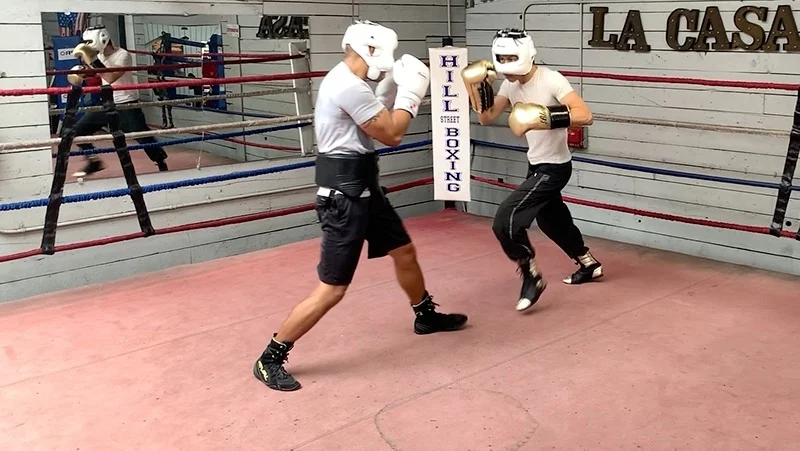
Stance alignment is another critical technical detail. While traditional boxing instruction often emphasizes a standard sideways defensive shuffle that mirrors agility drills, elite practitioners frequently employ a different approach: turning their torso sharply sideways and utilizing backward steps to trace a circular route around the opponent. This movement creates an orbital backward jog that preserves forward-facing counter options with the rear hand while maintaining continuous momentum.
By combining this circular backpedal with a persistent jab, a fighter creates a formidable defensive perimeter. When an opponent overreaches in frustration to bridge the shifting distance, the outside fighter can set their feet instantly and unleash power counters before resuming their circular path. Alternating these movement cadences—transitioning from backward circular skips in one direction to forward angled cuts in another—disorients an opponent’s footwork and neutralizes their combination punching.
Throughout these maneuvers, upper-body posture remains vital. A common flaw among fighters attempting to evade pressure is popping their torsos upright and lifting their chins in an effort to pull their heads as far from incoming punches as possible. This upright posture creates an easy, elevated target for looping hooks and overhand rights. True ring safety requires a boxer to maintain a disciplined torso crouch, keeping the head slightly lowered and angled forward toward the opponent. This posture maintains an athletic center of gravity, allowing the boxer to bounce laterally while retaining the ability to slip or duck beneath incoming shots at any moment.
Directional deception also plays an essential role in breaking pressure. Fighters can employ two distinct directional switches to disrupt an opponent’s pursuit:
- The directional fake: A fighter indicates an exit toward one side using a half-step, a head feint, or a momentary forward lean to simulate an incoming punch. When the opponent reacts or shifts their weight to cut off that lane, the defender immediately reverses direction into the vacated space.
- The doubled direction: Against disciplined opponents who refuse to bite on initial feints, a fighter can take a deliberate step in one direction and immediately commit to a second step along the same trajectory. If the opponent anticipates a misdirection and hesitates, the outside fighter is already completing their escape before the pursuer can reset.
Redefining What It Means to Fight on the Outside
When stripped of its common misconceptions, "fighting on the outside" is defined by continuous spatial adaptation rather than passive retreat. It is not an exercise in fleeing from combat or hiding at extreme range; it is the deliberate practice of continuous mobility that systematically preserves an athlete’s positional options.
Inside fighting is defined by stillness or unyielding forward pressure. Outside fighting, conversely, relies on lateral pathways that ensure a boxer is never stationary and never trapped.
Developing this capability requires fighters to actively purge the straight backstep from their muscle memory. In shadowboxing and heavy bag routines, practitioners must resist the instinctive reflex to retreat directly backward when simulating defense. Every defensive movement should instead incorporate diagonal withdrawals or immediate lateral pivots, ensuring that no defensive action leaves the fighter pinned without an immediate follow-up angle.
Stepping straight back may offer an alluring illusion of security, but the ropes always impose a hard limit on retreat. True control over the ring belongs to fighters who abandon the straight line, maintain continuous offensive range, and use the full geometry of the canvas to dictate terms.