


In the modern landscape of combat sports, viral highlight reels are dominated by explosive athletes pulling their heads wide to evade incoming fire before launching flashy, long-range counter-punches. It is a style that has defined a generation of fighters, heavily influenced by the athletic paradigms of the Mike Tyson era and the slick, distance-managing masterclasses of the Floyd Mayweather years. Yet, beneath the surface of televised professional bouts and social media highlight clips, a quieter, more economical school of movement is quietly reclaiming its place in the squared circle. The art of slipping to the inside of punches—once a foundational pillar of old-school boxing—is staging a subtle yet undeniable comeback.
While modern amateur and professional fighters frequently default to slipping to the outside, contemporary technicians such as Vasyl Lomachenko, alongside elite Soviet and Cuban-style fighters, have demonstrated the devastating effectiveness of moving directly into the line of fire. Far from being a revolutionary new strategy, inside slipping is a time-tested technique that has simply faded from standard gym curricula. To understand why this method is returning to prominence, boxing historians and trainers point to a combination of shifting media incentives, evolving athletic profiles, and the fundamental mechanics of ring efficiency.
The Historical Roots of Inside Slipping and Modern Shifts
To watch archival footage of boxing’s earlier decades is to witness inside slipping used as a matter of course. Historical fighters routinely utilized both inside and outside defenses, treating them as interchangeable tools depending on the tactical demands of the round. However, the contemporary default has swung heavily toward outside slipping, hit-and-run tactics, and lateral movement.
This modern preference can largely be traced back to two distinct eras that shaped the collective consciousness of current trainers and competitors. During the peak of Mike Tyson’s dominance in the 1980s, the boxing world was captivated by his explosive, outside-slipping entries followed by concussive knockouts. Tyson transformed the public perception of fundamental defense overnight, inspiring a generation of gyms to prioritize flashy, distance-based maneuvers that played well on pay-per-view television and satisfied an entertainment market hungry for immediate, clean knockouts.
Decades later, the paradigm shifted again toward the Floyd Mayweather era, embedding the shoulder roll and the Philly shell deeply into the global boxing vocabulary. While these styles proved exceptionally effective, they largely sidelined the direct, pressure-heavy mechanics of inside slipping. Amateur boxing, with its three-round structure and scoring systems that favor easily visible, clean punches thrown from a distance, further incentivized fighters to pull their heads entirely away from incoming blows.
Yet, as fighters transition to the professional ranks where bouts extend across twelve punishing rounds, the physical realities of the sport begin to shift. The constant lateral running required by outside slipping demands immense cardiovascular expenditure. In contrast, inside slipping offers a more energy-efficient alternative, effectively shortening the distance between competitors and conserving stamina over the long haul—a reality well understood by historical champions who regularly fought scheduled fifteen-round contests.
Mechanical Advantages and Strategic Realities
For fighters willing to embrace it, inside slipping offers profound tactical benefits that extend far beyond mere energy conservation. The technique fundamentally alters how distance is closed, how energy is expended, and how damage is absorbed during an exchange.
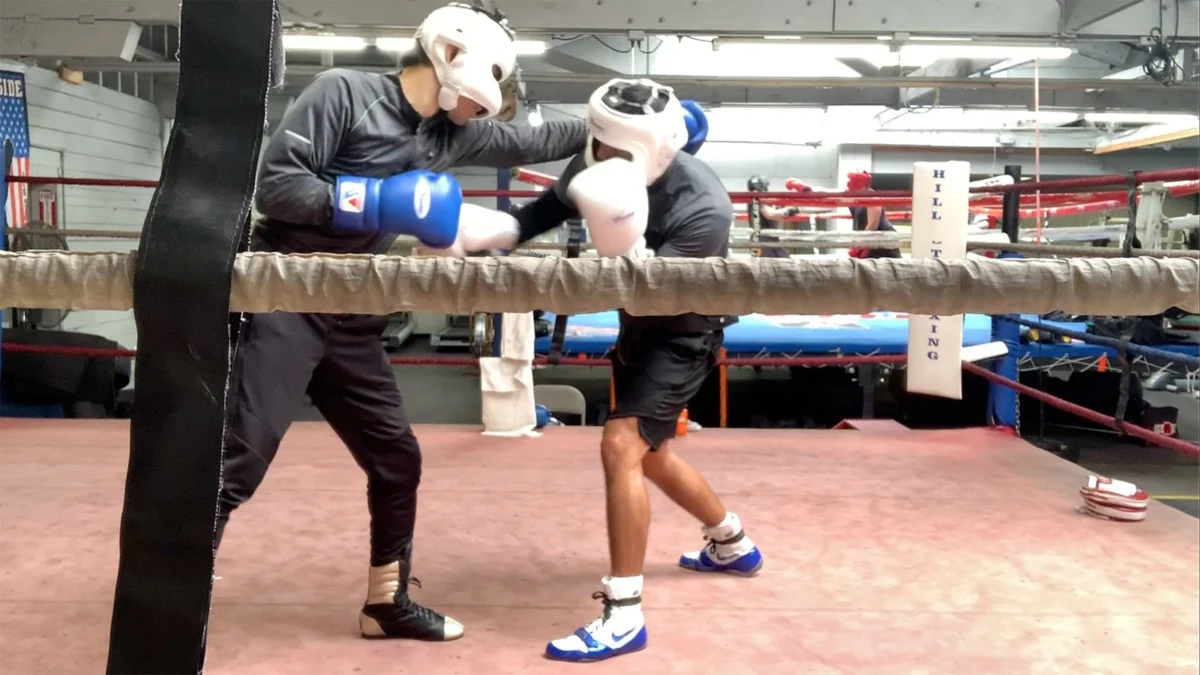
One of the primary advantages lies in visual and mechanical intuition. Human instincts naturally encourage individuals to turn their torsos away from an incoming threat. When an opponent throws a right hand, turning the torso away to slip inside feels remarkably organic compared to the counter-intuitive motion required to force the head toward the punch in an outside slip.
Furthermore, inside slipping inherently solves a common dilemma for competitors struggling against taller, longer-ranged opponents: closing the distance. Traditional outside slipping tends to move a fighter laterally or backward, inadvertently creating more space for an adversary to reset and land follow-up shots. Inside slipping, by mirroring the opponent’s movements and aligning bodies in closer proximity, naturally smothers the opponent’s punching space. By stepping inside a jab rather than away from it, a fighter effectively neutralizes the opponent’s reach advantage and forces a phone-booth exchange.
Safety and impact management also favor the inside technique. Physics dictates that when a fighter slips against the flow of a punch—as is common with outside slipping—any accidental contact compounds the momentum and impact of the incoming blow, frequently resulting in a knockdown. Conversely, slipping inside moves with the flow of the punch, allowing the defender to roll off the impact and significantly mitigate the force of a landed strike. This overlapping dynamic is precisely why traditional shoulder rolls and inside slips share such closely related mechanical roots; both utilize subtle torso rotations to deflect energy away from the target zone.
Implementing Inside Slips in Modern Fight Strategy
Integrating inside slipping into a competitive strategy requires a departure from conventional modern training habits, but the tactical payoffs are vast. Beyond simply closing distance, inside slipping allows fighters to execute advanced maneuvers such as passing completely through an opponent’s space during aggressive lunges or trapping rivals against the ropes by forcing them to over-rotate on their own power punches.
Rather than relying purely on blinding hand speed, inside slipping relies on timing and rhythm recognition. By studying an opponent’s cadence—the pauses between combinations, the frequency of attacks, and the recovery intervals—a boxer can slide effortlessly into the opponent’s peripheral vision, creating entirely new offensive and defensive angles that disrupt a rival’s timing.
While mainstream highlight reels continue to prioritize the flashy athleticism of outside-slipping distance fighters, the tradition of inside slipping has never truly vanished. Legendary champions from Roberto Duran and James Toney to Bernard Hopkins and Pernell Whitaker built their defensive legacies on the foundational mastery of inside maneuvers. As contemporary fighters and coaches continue to deconstruct the limits of modern styles, the timeless efficiency of inside slipping remains a potent reminder that the most effective defenses are often found not by running away from danger, but by stepping directly into it.