
Mike Tyson remains one of the most polarizing, iconic, and fiercely feared heavyweights in the storied history of professional boxing. Known during his prime for his explosive, concussive power, blistering hand speed, and a terrifying psychological aura that often defeated opponents before they even stepped into the squared circle, "Iron" Mike captured the imagination of the global sports world. He famously became the youngest heavyweight champion in boxing history at just 20 years old, marching through the division to ultimately unify the belts during a dominant era that cemented his status as a combat sports legend.
However, the trajectory of a prizefighter’s career is rarely linear, and by the mid-2000s, the landscape of Tyson’s life and professional journey had shifted dramatically. Years of intense personal struggles, well-documented legal battles, time spent in prison, and highly publicized personal demons had taken a visible, cumulative toll on his physical and mental well-being. By the time 2005 rolled around, the once-indomitable champion was a shadow of his former self, navigating the twilight of a turbulent career driven more by financial necessity than championship ambition.
It was against this complex backdrop that Tyson entered what would officially stand as the final professional bout of his storied career—setting aside, of course, his later exhibition and professional-licensing return against social media star turned boxer Jake Paul years later. His opponent on that fateful night in June 2005 was Kevin McBride, an unheralded, hardworking Irish-American journeyman. While Tyson was visibly past his prime, his name recognition remained massive, and the matchup against the largely unknown McBride was billed and viewed as a routine showcase fight meant to get the former champion back into the win column.
McBride brought few credentials to the ring that would traditionally worry a former undisputed heavyweight champion. He possessed no signature victories over elite contenders, had already accumulated a handful of losses against regional competition, and lacked the technical prowess associated with the upper echelons of the division. Yet, what McBride lacked in elite skill, he made up for with sheer physical dimensions, durability, and a heavy work rate. Standing significantly taller and heavier than Tyson, the Irish journeyman represented an awkward, plodding puzzle that an aging, undersized heavyweight would have to solve through sheer explosive violence or risk getting dragged into deep, exhausting waters.
As the opening bell sounded, the contest initially played out the way many observers and fans anticipated. Tyson started the fight strongly, showing flashes of the formidable movement and vicious intent that once defined his reign. He utilized sharp head movement to duck under McBride’s prolonged reach, burrowed inside, and landed heavy, thudding punches to the body and head. For the early rounds, it appeared that Tyson’s veteran savvy and remnant power might be enough to overwhelm the larger, slower opponent.
However, as the fight wore on, the stark reality of Tyson’s physical decline and lack of proper conditioning began to manifest in real time. The former undisputed champion visibly faded under the stifling pace and the physical burden of carrying an opponent much larger than himself. What had begun as crisp, aggressive combinations deteriorated into sloppy, desperate tactics. Tyson began leaning heavily on McBride—a fighter who would ultimately retire in 2011 with a modest career record of 35 wins, 10 losses, and 1 draw, having never fought for a major world title—in an effort to conserve his rapidly depleting energy reserves.
As fatigue set in and frustration mounted, the desperation reached a critical juncture in the later frames. In a bizarre and telling moment of the clinch work, Tyson even attempted to leverage McBride’s arm in a way that suggested an unorthodox attempt to break it, further highlighting his growing alienation from the sport and the sheer desperation of his situation inside the ring.
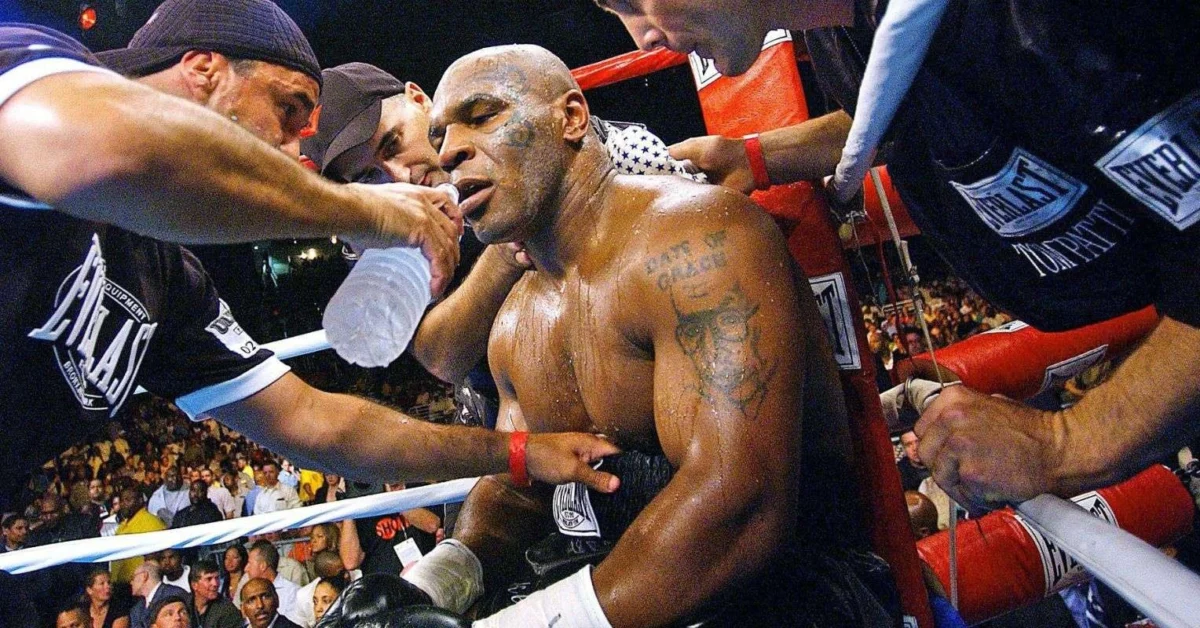
The physical and emotional exhaustion culminated at the end of the sixth round. When the bell signaled the end of the frame, Tyson returned to his corner, sat down heavily on his stool, and made a decision that shocked the combat sports world. He informed his corner team that he refused to continue, effectively quitting on his stool and bringing a definitive, unceremonious halt to the bout.
In the immediate aftermath of the fight, standing in the center of the ring under the glaring lights, Tyson offered a brutally honest, unvarnished assessment of his mental state and his relationship with the sport that had made him a global icon. He admitted candidly that he no longer possessed the intrinsic desire or psychological hunger to engage in the brutal art of prizefighting, revealing that he had stepped into the ring purely out of financial obligation rather than competitive spirit.
"I got the ability to stay in shape, but I don’t got the fighting guts I don’t think anymore… I’m just sorry I let everyone down, I don’t have this in my heart anymore," Tyson reflected during his post-fight remarks.
He elaborated further on the profound shift in his perspective, contrasting his modern reality with the ferocious persona that once terrorized the heavyweight division. "I’m just fighting to take care of my bills basically, I don’t have the stomach for this anymore, I’m more conscious of my children and those guys, I’m looking at my opponents, I just don’t have that ferocity, I’m not an animal anymore."
With those poignant words, the competitive career of one of boxing’s most electrifying figures drew to a quiet, somber close, leaving behind a complex legacy defined by unprecedented youthful brilliance, devastating dominance, and a sobering, deeply human conclusion.