Plenty has been said and written about the origins of LIV Golf, its astronomical finances, and its eventual structural collapse. Yet in chief executive Scott O’Neil, the breakaway golf circuit has an experienced administrator who remains adamant that there is plenty of reason for optimism. He believes that a reorganized “LIV 2.0” can achieve sustainable, long-term success on the global sporting landscape.
After Saudi Arabia’s Public Investment Fund (PIF) pulled the plug on its lavish funding in April, O’Neil immediately went about securing the critical support of players and commercial partners to finish out the season. Once that campaign concluded, he turned his full attention to drafting a completely new business plan that would allow LIV to continue operating without its original state-backed benefactor. Filing for Chapter 11 bankruptcy gave the enterprise the necessary breathing room to pursue an independent path. Now, that strategy has yielded its first major milestone: signing up BC Partners as its inaugural outside investor in a transaction that could ultimately be worth up to US$300 million.
Speaking at Leaders Week London at Stamford Bridge, O’Neil referenced “triple-digit growth” in 2025 and reported that LIV’s revenues were up “another US$100 million” during the first quarter of 2026. He also talked up strong fan support in markets traditionally underserved by the established traditional tours, alongside lucrative new deals with an array of blue-chip sponsors and the healthy demographic diversity of the tour’s audience.
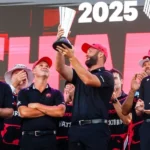
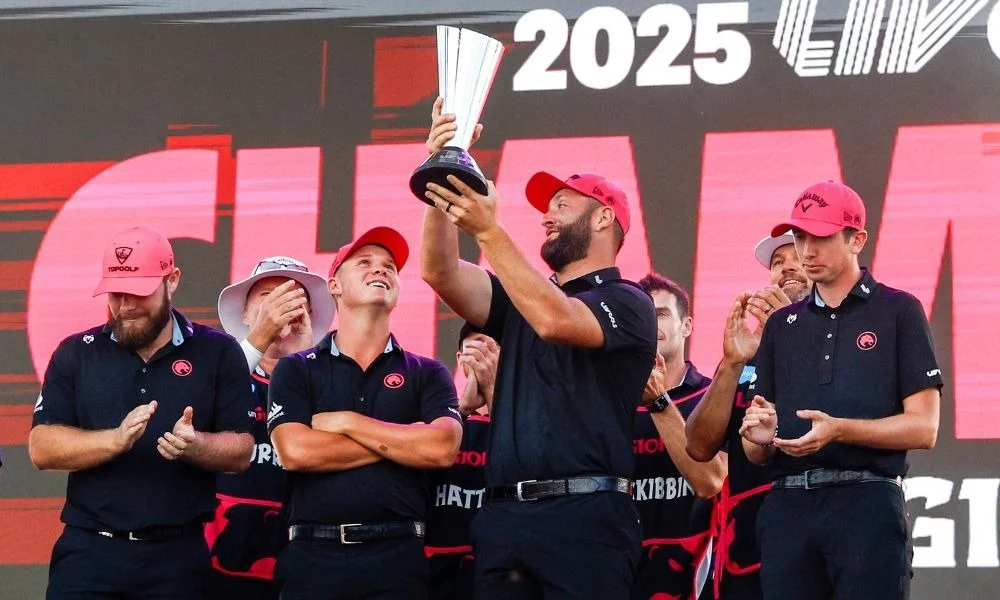
The resilience of the tour has also been reflected on the course. In a stunning recent highlight, Anthony Kim completed one of the most inspirational and improbable comebacks that professional golf has ever seen, outdueling Jon Rahm and Bryson DeChambeau to capture the individual title at LIV Golf Adelaide. After 12 and a half years away from competitive play due to a debilitating series of injuries and personal challenges, Kim returned in 2024 to join LIV Golf. He initially struggled while trying to shed competitive rust and recapture the magic of his early years as a touring professional.
Thanks to his personal mantra of “1% better every day,” Kim showed dramatic improvement over the final months of his campaign. At The Grange, he completed his remarkable journey, proving that perseverance can overcome almost any obstacle. Not only did Kim capture his first professional victory of any kind in nearly 16 years, but he did so while paired in the final group against two of the best players in the world, who simply could not keep up with his precise iron play and hot putter.
“I’m very overwhelmed with this feeling right now,” said Kim, who began the week working through visa issues just to get into Australia before officially signing with 4Aces GC right before the tournament started. “लेकिन my plan is to keep getting better and start winning some more trophies.”
Despite such fairy-tale moments on the course, the harsh economic realities of LIV’s early years cannot be easily dismissed. Broad broadcast reach often masked modest actual television viewership, and multibillion-dollar financial losses are hard to disguise. Indeed, industry estimates suggest that the PIF invested between US$5 billion and US$8 billion since LIV’s inception in 2021.
LIV’s initial grand ambition—to innovate golf with a signature 54-hole format, secure exclusive contracts with the best players in the world, and eventually force a lucrative merger with the PGA Tour and DP World Tour—may now be a thing of the past. Instead, the vision moving forward centers on catalyzing commercial momentum and transforming its competing teams into genuinely investable assets.
“The most important thing always is keeping this team together,” O’Neil said. “Having BC Partners on our side and seeing whether we can raise some money, getting the players on board and ready to go for 2027, are also important.”
“There’s so much momentum here, and to have the rug pulled at that time… I was just grateful that [BC Partners head of credit] Ted Goldthorpe and his leadership and vision were able to come on board, and that we have this team that just pulls together and gets it done.”
Why BC Partners is Backing LIV 2.0
While the investment from BC Partners will not entirely cover the vast historical expenditures of the league, its financial commitment will enable a successful exit from Chapter 11 bankruptcy protection—a crucial first step in realizing LIV’s revamped operational vision. O’Neil also noted that key commercial partners are continuing to support the venture, with US broadcaster Fox keeping valuable schedule slots open for future LIV tournaments.

Furthermore, LIV is now completely free from the massive, guaranteed contracts that initially lured marquee names like Jon Rahm and Bryson DeChambeau, a shift that will dramatically lower its ongoing operating expenses. However, this financial tightening is already proving challenging when it comes to retaining those very same superstar talents without the backing of bottomless state coffers.
Just hours after O’Neil appeared alongside Goldthorpe at industry events, a lawyer representing Jon Rahm informed a bankruptcy court hearing that the Spanish star would be officially leaving LIV Golf. The 31-year-old was one of the league’s most high-profile signings when he jumped from the PGA Tour in 2023, with reports valuing his initial contract at more than US$300 million.
However, Rahm will not be part of the tour’s future after deeming the revised financial and structural terms of LIV 2.0 to be what his legal counsel described as “unacceptable.” The two sides are currently engaged in advanced discussions regarding a consensual separation agreement.
That departure is far from an insignificant blow. The financial viability of BC Partners’ investment is directly contingent upon LIV successfully re-signing at least half of the players to whom it currently owes deferred money. Moreover, the league cannot simply retain its lowest-paid members; the re-signed contingent must account for a full two-thirds of all outstanding financial obligations.
Speaking prior to the public disclosure of Rahm’s plans to exit, Goldthorpe emphasized that player enthusiasm was a primary driver behind BC Partners’ decision to invest, alongside the commercial momentum highlighted by O’Neil.
“The players that play for us love playing on LIV,” Goldthorpe said. “So, retaining the players—and the key players—is a hurdle, but I think it’s a very achievable hurdle in a short period of time.”
“We know the PIF very well and they’re very sophisticated and very smart. No one spends six or seven billion dollars on something and it’s worth zero. It just doesn’t exist. So that was kind of our starting framework.”
“We have not only some of the best players in the world, but also, from a business perspective, some of the most marketable players in the world. Think Bryson DeChambeau and Cam Smith and Dustin Johnson. As a businessperson, these are fantastic people, assets, players. There’s a lot here we can work with.”
LIV Will Look ‘A Lot Like Formula One’
As part of its strategy, BC Partners is creating a dedicated holding company to house its various sporting investments and plans to leverage its media assets to increase their overall market value. Nevertheless, the primary vehicle through which LIV plans to achieve financial sustainability is the sale of equity stakes in individual teams, with participating players themselves given ownership shares in each franchise.
LIV is placing immense confidence in this corporate structure, promising that both competing athletes and outside investors will share in commercial revenues, prize pools, and the broader enterprise value of LIV 2.0. Both O’Neil and Goldthorpe believe this concept is uniquely positioned to capitalize on surging interest in sports investments from private equity firms. These institutional investors increasingly view sports franchises as resilient revenue streams with massive commercial upside, driving up valuations across traditional and disruptor sports properties alike.
Speaking at the Sportico Invest Conference, Goldthorpe estimated that individual LIV teams could achieve valuations exceeding US$100 million “in very short order.”

“If you look at the athletes that really made a lot of money, they made it through ownership, not through paychecks,” Goldthorpe added. “Look at David Beckham in Miami, or Magic Johnson with the Los Angeles Lakers. If we can show people that this is a sustainable business and league, those teams have tons of value. So, my guess is that over time this will begin to look a lot more like Formula One, or other leagues that are analogous to what we’re trying to do.”
However, the original iteration of LIV also harbored hopes that its teams would transform into valuable independent assets, a vision it ultimately struggled to realize. Additionally, the team-based competition structure has faced persistent hurdles in capturing the broader public imagination, despite being heavily promoted at every available turn.
LIV now hopes that by tapping into passionate local fan bases—such as those cultivated in Australia, South Africa, and South Korea—it can inspire a level of tribal fandom akin to the Ryder Cup or international soccer. The concept of player-owned franchises could also prove more palatable to golf traditionalists than a league perceived as being centrally controlled and funded solely by a foreign sovereign wealth fund. Under the new model, golfers would theoretically be far more invested in the long-term fortunes of their respective teams.
“I think having superstar athletes as your partners on your side of the table, with not only a meaningful stake in their teams but also a meaningful stake in the league, is absolutely a tremendous advantage,” O’Neil said.
“And look, this is a five-year-old league. It’s a baby. It’s up on its feet and it’s out of diapers, but it’s a baby. So, from our standpoint, the growth opportunity is huge. There’s so much white space: title sponsors, key television markets. This is a rocket ship waiting to take off.”
“The team element is fun. The one question I get from new people is, ‘I don’t get this team thing.’ And I say, ‘Do you get the Ryder Cup? Do you get the Olympics? How about college golf?’ We’re not splitting atoms. We’re having fun and bringing new people to the game.”
Finding a Place in the Ecosystem
O’Neil also pointed to TGL, the high-tech, indoor golf league created by Rory McIlroy and Tiger Woods’ TMRW Sports venture, as clear evidence of underlying market demand for innovative golf formats. City-based franchises in TGL—which was originally conceived partly in response to the massive financial disruptions caused by LIV—have successfully sold for upwards of US$80 million, pushing the league’s overall enterprise valuation to an estimated US$1 billion.
“[That] gives us a lot of conviction and hope,” O’Neil said.
Yet industry observers note that TGL functions largely as a complementary product rather than a direct competitor to existing traditional tours, securing guaranteed commitments from star players and a major broadcast partnership with ESPN while expanding into women’s competitions.
Where LIV ultimately fits within the broader professional golf ecosystem remains a more complex question to answer. For now, however, the organization has a defined pitch, a locked-in tournament schedule, and is actively reemploying staff members who were previously let go during the restructuring. Moreover, leadership insists it no longer harbors any desire to pick hostile fights with the establishment.
“There’s so much value destruction when you’re nasty and angry and fighting, and there are fines and suspensions and all this stuff,” O’Neil reflected. “It’s not value-accretive; it’s value-destructive. So, starting over, I think we would have come into the business with more of an olive branch and a partnership approach than we did.”