

Push-ups remain a cornerstone of athletic conditioning, uniquely surviving the often myopic fitness world’s tendency to categorize movements strictly as "right" or "wrong." They are old-school, demanding, and far more technical than many realize. Requiring dynamic stability and global coordination from head to toe, push-ups rely on a relatively small joint—the elbow—to lower the entire body to the floor and press it back up. Yet, despite their reputation as a basic calisthenic movement, relying on bodyweight does not automatically make them foolproof. More importantly, using them as a crude yardstick for upper-body strength without ensuring proper execution fails athletes entirely.
According to strength coach Rachel Hayes, push-ups for female athletes serve more as a reflection of existing strength rather than a fundamental exercise used to build it. Consequently, coaches must guide athletes through progressive, whole-body movements rather than forcing a generic, one-size-fits-all approach. While training frameworks often center on female athletic development, these principles underscore a broader coaching truth: being male does not automatically guarantee push-up mastery, just as being female never justifies dismissive or diminutive modifications. Every athlete deserves meticulous guidance, but programming identical routines for both men and women overlooks vital developmental differences and ultimately underserves everyone.
Developmental Considerations in Youth Athletics
Puberty is a deeply dynamic and complex transition. Significant hormonal, anthropometric, and neuromuscular changes drastically alter physical performance during adolescence. For practitioners overseeing youth sports or prescribing training regimens for teenagers, understanding these shifts is essential. Girls generally enter puberty and experience physical changes earlier than boys, typically between the ages of 9 and 11, though the exact timing and pacing vary significantly from person to person.
Among the numerous transformations occurring through adolescence, two stand out as particularly influential regarding relative upper-body strength development. The first is Peak Height Velocity, commonly

known as the adolescent growth spurt. During this window, long bones such as the femur and tibia experience rapid vertical growth. This sudden surge in stature coincides with an elevated center of mass, making trunk control considerably more challenging. Because push-ups require a synchronized effort across nearly every joint from the hips upward—with the pelvis and spine acting as vital structural support—this developmental shift carries implications that extend far beyond a single exercise.
The second critical factor involves strength and neuromuscular control. Literature indicates that following the growth spurt, adolescent females do not experience an equivalent "neuromuscular spurt." While growth yields larger bodies across both sexes, maturing males adapt with disproportionately greater muscular power to meet the control demands of a larger frame. Females do not display identical adaptations to the same degree, a divergence most pronounced in the upper body, where disproportionate strength gains heavily favor adolescent males in the upper extremities, trunk, and lower limbs.
Recognizing this dimorphism does not mean viewing these differences as insurmountable barriers preventing girls from performing push-ups. Rather, they highlight why upper-body strength training must be intentionally distinct, and why lumping male and female athletes into identical programs fails to meet their unique developmental needs.
Mastering Foundational Postures
Before asking athletes to execute a complex, multi-joint movement like a push-up, coaches must address specific positional awareness across the pelvis, head, and scapulae. Skipping these foundational structural mechanics leaves training rooms filled with athletes trapped in excessive extension, hanging passively on their skeletal systems rather than actively engaging their musculature.

To visualize this foundation, imagine four individuals standing in a rectangle, each holding the corner of a massive blanket. If several gallons of water were poured directly into the center, the middle would instantly sag to the floor, likely tearing the corners from the participants’ hands. This analogy highlights a first-principles approach: long before attempting standard planks, the ability to manipulate axial and appendicular skeletal structures into advantageous positions is essential. This lack of foundational posture is often compounded by modern lifestyle factors and early sports specialization.
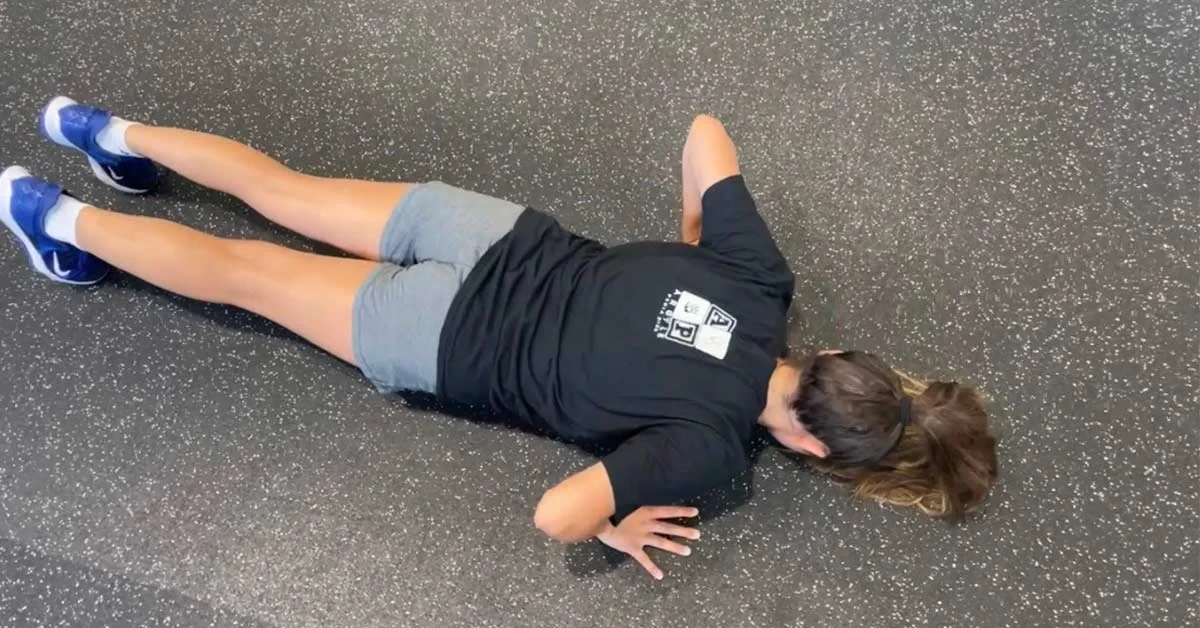
The first structural focus involves posterior pelvic tilt and anti-extension. Athletic floors frequently feature individuals attempting planks or push-ups whose lower backs fall into hyperextension, pulling the navel toward the floor. This places undue stress on the lumbar facet joints while simultaneously allowing the shoulder blades to collapse forward. Correcting this requires teaching posterior pelvic tilt and lumbar spine anti-extension through foundational movements like dead bugs. Introducing these concepts first in a supine position and later transitioning to a prone position establishes direct carryover for push-ups, body saws, and abdominal wheel rollouts.
The second focus centers on cervical retraction. Pronounced cervical extension—where the head juts forward and the gaze lifts upward—frequently disrupts upper-body alignment. Correcting this requires teaching active neck retraction and protrusion, beginning in a seated position before progressing to a prone setup against gravitational resistance. Like pelvic control, cervical alignment serves as an indispensable piece of a larger movement puzzle; omitting it compromises downstream lifts such as Romanian deadlifts.
The final foundational element involves scapular protraction and retraction. Athletes frequently struggle to move their shoulder blades smoothly around the ribcage. Mastering this mobility is crucial for successful pushing and pulling mechanics, preventing unwanted elevation or anterior tipping during movements like push-ups, rows, and overhead work. Establishing this competence early paves the way for sound mechanics across all upper-body patterns.

Structuring Progressions for Success
Building toward a technically proficient push-up is a deliberate process. A reliable methodology establishes a solid isometric foundation before simultaneously developing eccentric and concentric phases through distinct pathways. This is precisely where training differences between sexes become most apparent. Female athletes generally require extended time dedicated to building concentric pushing strength before achieving a full push-up, whereas male athletes often require a greater focus on positional integrity. Coaches must meet athletes at their current capability level rather than rushing them toward arbitrary benchmarks.
Weight rooms offer abundant resources that can be creatively repurposed far beyond their original design. For instance, utilizing rubber bumper plates for floor presses provides an optimal starting point for training pushing strength before transitioning to traditional bench variations. This approach also serves as a practical solution when equipment availability or appropriate dumbbell weights are limited.
Emphasizing the eccentric phase—the lowering portion of a lift—can further widen the strength gap between maximum eccentric and concentric capacities, theoretically supporting long-term concentric gains. Once structural positions are firmly established, athletes transition into the eccentric phase of the push-up while maintaining precise skeletal alignment. Although the concentric, or pushing-up, phase may initially lag behind, combining isometric and eccentric work provides a potent stimulus for strength development and essential neuromuscular coordination.
During the isometric stage, particularly with middle school and early high school athletes, extensive focus is placed on positional strength through planks. While sometimes viewed as rudimentary, planks function as an isometric classroom, allowing coaches to reinforce posterior pelvic tilt, cervical retraction, and shoulder protraction under maximal range-of-motion control. If an athlete struggles to maintain a stable plank, dynamic progressions like push-ups will inevitably break down.

As athletes demonstrate sustained control during static holds lasting upwards of twenty seconds, eccentric elements are introduced. Because dropping straight into standard push-ups often causes athletes to revert to extension patterns, coaches frequently utilize hands-elevated descents or band-assisted lowerings to preserve a full range of motion. Short blocks of eccentric bench press variations can also be integrated to further emphasize strength development.
Ultimately, progressions should serve as evaluations of competence, safety, and confidence, acting as bridges between foundational movements and advanced lifts. Once an athlete achieves a technically sound push-up, volume should be managed carefully to ensure high-quality repetitions continue driving strength adaptations without sacrificing form.
Long-term athletic development requires taking a step back and prioritizing isolated mechanics before demanding complex, multi-joint bodyweight movements. For female athletes, push-ups function far more as a reflection of established strength than as a standalone tool to create it. Meeting athletes where they are—and respecting the physiological nuances of their development—ensures they are properly prepared for success in the weight room and beyond.