
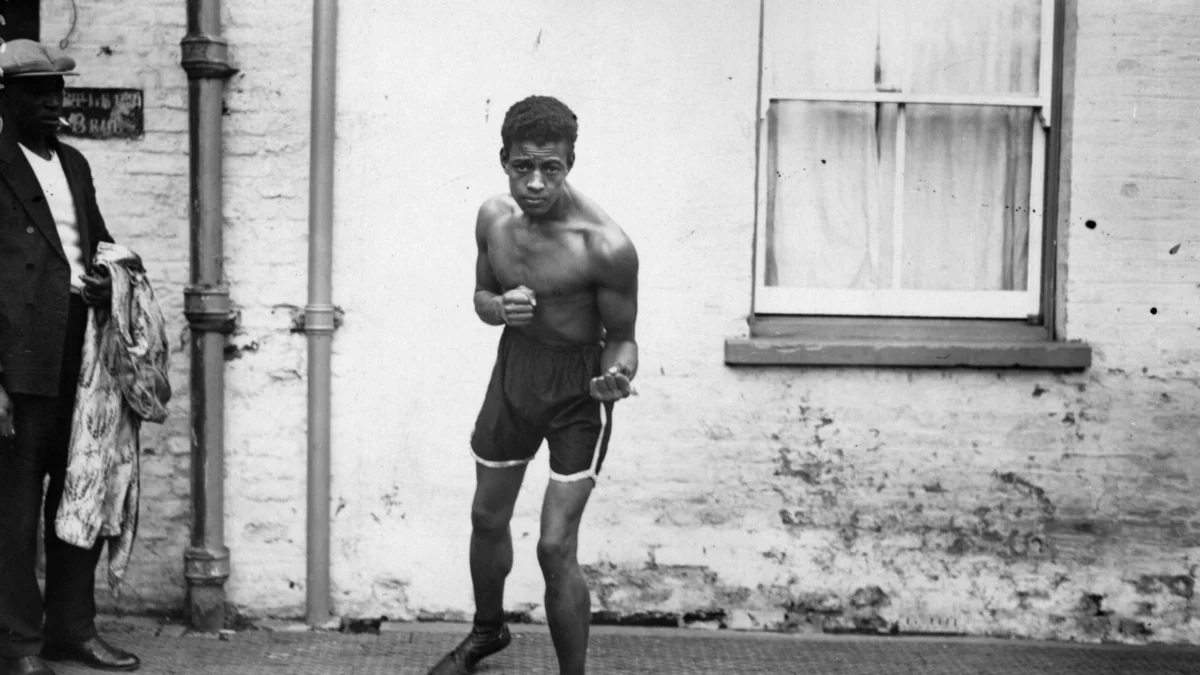
More than five decades after his death, Len Johnson—one of the most extraordinary middleweight boxers in British history and a fearless civil rights campaigner—is set to become the first Black person to be honoured with a dedicated statue in Manchester.
The decision by Manchester City Council marks a momentous step forward in recognizing a figure whose impact resounded far beyond the boxing ring. Born in Clayton, Manchester, in 1902, Johnson amassed an astonishing record of more than 90 professional victories during a career that spanned the 1920s and early 1930s. Yet, despite defeating the finest fighters of his era, he was consistently barred from contesting for the official British middleweight title simply because of the colour of his skin.
Refusing to be broken by the institutional prejudice that robbed him of global sporting glory, Johnson channelled the fierce determination he cultivated in the ring into a lifelong crusade against racial discrimination, economic inequality, and social injustice. In his post-boxing life, he evolved into a trade unionist, a prominent member of the Communist Party, a community leader in Moss Side, and an influential activist who played a pivotal role in dismantling racial barriers across Manchester and the wider United Kingdom.
Now, following years of tireless campaigning by local advocates, city officials have confirmed that a permanent statue of Johnson will be erected in a prominent location opposite Manchester Victoria Station, ensuring his legacy as both an elite athlete and a pioneer of equality is permanently etched into the city’s urban landscape.
Why a Boxer Barred from Becoming Champion Is Being Honoured
Len Johnson’s journey into the world of prizefighting began under remarkably unpretentious circumstances. Born Leonard Benker Johnson on October 22, 1902, he was the eldest of four siblings raised in a working-class Manchester household. His father, a former boxer who had migrated to Britain from Sierra Leone, and his mother, an Irish immigrant, instilled in him a resilient work ethic during an era when mixed-race families faced profound social hostility.
Despite his father’s athletic background, Johnson did not initially set out to pursue a professional career in combat sports. As a young man, he possessed minimal formal training or technical knowledge of boxing. However, an unexpected altercation at his workplace served as the catalyst for his transformation. Recognizing his son’s raw instincts and need for guidance, Johnson’s father took the teenager to observe a local boxing contest to introduce him to the disciplined art of the sport.

Determined to test himself, the young Johnson began a rudimentary training regimen, skipping rope using a piece of discarded household washing line to build stamina and footwork. Just a few weeks after attending his first match, he stepped into the ring for his debut bout at the Alhambra Theatre in Openshaw. Facing fellow teenager Jerry Hogan, Johnson delivered an emphatic performance, securing victory via a third-round knockout.
That initial victory marked the dawn of an exceptional athletic career. Over the subsequent decade, Johnson established himself as a master technician in the middleweight division, combining sharp defensive reflexes with precise counter-punching to outclass opponents across the country.
A Career Defined by Skill and Institutional Barriers
Johnson’s definitive breakthrough on the national stage arrived in 1925, a year that saw him deliver some of the most impressive boxing displays in British rings. Over the course of just seven months, Johnson twice defeated Roland Todd, the reigning British middleweight champion. That same year, he earned a decisive victory over Ted ‘Kid’ Lewis—a hall-of-fame fighter later described by former heavyweight champion Mike Tyson as "probably the greatest fighter to come out of Britain."
Under normal circumstances, such dominant performances against world-class opposition would have guaranteed Johnson an immediate shot at the official British championship belt. However, British boxing authorities enforced a strict racial barrier that prevented non-white athletes from competing for domestic titles.
The obstacle came in the form of Rule 24, a discriminatory regulation established by the British Boxing Board of Control (BBBofC). Under Rule 24, eligibility for British championship title contests was restricted strictly to boxers who were "born of white parents." Because Johnson’s father was Sierra Leonean, the board repeatedly denied him the right to contest for the national championship he had rightfully earned.
Seeking international opportunity, Johnson travelled to Australia in 1926. Demonstrating his superior skill on foreign soil, he captured the Empire middleweight title. Yet, upon his return to England, sporting authorities delivered another bitter blow, informing him that his international achievement would not be officially recognized in his home country due to his racial background.

The pervasive prejudice severely restricted Johnson’s earning potential and career mobility. In a poignant interview conducted in 1930, Johnson spoke candidly about the systematic exclusion he faced at the height of his athletic prime.
"I’m barred from the Albert Hall and the National Sporting Club. In fact, whenever there is big money, I’m kept out of it," Johnson explained. "The prejudice against colour has prevented me from getting a championship fight. I feel now that there is no use whatever going on with the business."
Despite his frustration, Johnson continued to compete until his retirement in 1933, finishing his ring career with over 90 professional victories. Though he was systematically deprived of the official titles and wealth he deserved, his brilliance in the ring made it impossible for contemporary observers to deny that he was one of the finest boxers of his generation.
From the Boxing Ring to Civil Rights Activism
When Len Johnson stepped out of the ring for the final time after his last fight in 1933, his fighting days were far from over. Instead of retreating into quiet retirement, he redirected his formidable discipline and public profile toward advocating for political change and social justice.
In the wake of World War Two, Johnson formally joined the Communist Party and emerged as a dedicated community leader in the Moss Side district of Manchester. Deeply attuned to the economic struggles of the working class and the systemic barriers facing minority residents, he became a trusted advocate for local people, offering practical assistance and fighting for fair housing, employment rights, and racial equality.
Johnson’s political stature grew rapidly, extending far beyond the boundaries of Manchester. In October 1945, he served as a local representative at the historic 5th Pan-African Congress, which was convened at Chorlton-upon-Medlock Town Hall. The landmark conference brought together prominent intellectuals, activists, and anti-colonial leaders from around the globe, providing a crucial momentum-building moment for the movement that eventually liberated numerous African nations from colonial rule.

The Battle Against the Pub Colour Bar
Throughout the mid-20th century, anti-Black discrimination remained widely practiced across British society, often through an informal but rigidly enforced custom known as the "colour bar." Under this practice, commercial establishments—including hotels, restaurants, and public houses—were legally permitted to deny entry and service to non-white customers simply based on their race.
In 1953, Johnson directly confronted this unjust system during an incident at the Old Abbey Taphouse, a pub situated just south of Manchester city centre. Upon entering the establishment, Johnson was refused service solely because of his skin colour.
Refusing to accept the insult passively, Johnson teamed up with his close friend and fellow activist Wilf Charles to mount a direct-action campaign aimed at exposing and dismantling the pub’s discriminatory policy. The pair immediately escalated the issue by bringing their complaint directly to the Mayor of Manchester.
Demonstrating a sharp understanding of public relations and community mobilization, Johnson and Charles organized a high-profile demonstration. They returned to the Old Abbey Taphouse accompanied by a crowd of approximately 200 supporters, alongside representatives from the local and national press. Facing an overwhelming public presence and intense media scrutiny, the landlady of the Old Abbey Taphouse capitulated, agreeing to serve Johnson inside the pub—a notable moment, given that Johnson himself was not a consumer of alcohol.
The successful protest at the Old Abbey Taphouse resonated far beyond the doors of a single public house. By publicly calling out racial segregation and mobilizing community solidarity, Johnson helped catalyze a broader shift in local public opinion, effectively bringing an end to the "colour bar" in pubs across Manchester. The landmark action served as a vital precursor to national legislative reform, occurring twelve years before the United Kingdom officially outlawed racial discrimination in public venues under the Race Relations Act of 1965.
Len Johnson Campaign
Len Johnson passed away in 1974 at the age of 71. While his remarkable contributions were deeply appreciated by those who knew him and studied his era, his story risked being overlooked by broader historical narratives for decades.

In recent years, however, a dedicated group of grassroots advocates, community organizers, and sports historians launched a sustained campaign to ensure Johnson’s legacy receives the permanent recognition it deserves in the city where he was born and spent most of his life.
Organized under the banner of the Len Johnson Campaign CIC and led by campaigner Deej Malik-Johnson, the initiative undertook extensive fundraising activities to secure financial backing for a public monument. To raise awareness and funds, the campaign hosted diverse community initiatives, including an annual high-profile celebrity football match. The effort garnered widespread public attention, drawing support from prominent figures across sports and digital media, including popular internet personality Angry Ginge, darts star Luke Littler, and former world champion boxer Tony Bellew.
The persistent efforts of the campaign culminated in a major victory when Manchester City Council formally announced that a permanent statue of Johnson had been approved. The monument will be positioned in a high-visibility location directly opposite Manchester Victoria Station, serving as a prominent civic landmark. Funding for the memorial will be provided through public donations raised by the Len Johnson Campaign CIC, with final construction remaining subject to standard planning permissions.
Welcoming the council’s decision, Deej Malik-Johnson emphasized the profound historical resonance of the project.
"Today’s news is another milestone towards properly acknowledging the historic contributions of a working-class, mixed-race Mancunian whose brave actions in the past developed the foundations of a better future," Malik-Johnson said.
"In a sport and a society rigged against him because of his skin colour, Len made himself a champion for people outside the boxing ring," he added. "At home and abroad, as an athlete, a worker, an organiser, a politician and a family man, he exemplifies the best of us."

City leaders have also voiced strong support for the civic memorial. Tracey Rawlins, Deputy Leader of Manchester City Council, paid tribute to Johnson’s dual legacy as a supreme sportsman and a tireless champion for civil rights.
"Len Johnson was not only one of the best boxers of his era, he was also a model of a Mancunian – a community champion who contributed much to the city during his lifetime," Rawlins said. "His life and his remarkable achievements are part of Manchester’s history and deserve to be told."
"The planned statue will provide both a springboard for people to learn more about Len and a focal point for the city to remember and honour him," Rawlins added.
Once erected, the statue will stand as a permanent tribute to a man who knocked down racial barriers both inside and outside the ring, ensuring that the legacy of one of Manchester’s most courageously transformative figures inspires generations to come.