
For those who find their greatest life joys in the seemingly disparate worlds of spectator sports, live theatre, and classical music, discovering a classic play that seamlessly fuses all three can feel like an embarrassment of riches. It is a rare collision of high art and raw physical survival, which makes it all the more surprising that Clifford Odets’ masterpiece, Golden Boy, has remained largely in the shadows of the British theatrical landscape for nearly half a century. Having not been staged in the United Kingdom for more than forty years, the play’s long absence may well be attributed to its highly unusual, almost paradoxical premise. Yet, a striking new London production has brought this mid-century classic roaring back to life, proving that the ancient, brutal poetry of the boxing ring remains one of the most powerful metaphors available to the modern stage.
Written in 1937, Golden Boy tells the poignant story of Joe Bonaparte, a gifted young violinist growing up in Depression-era America. Blessed with a delicate touch and a promising future in classical music, Joe also possesses a fierce, natural talent for boxing. Lured by the intoxicating promise of fame, fast money, and immediate escape from the crushing poverty of his youth, he abandons his instrument for the violence of the prize ring. In the current London revival, this agonizing conflict is brought to life by Josh O’Connor, an actor whose physical and dramatic range has recently been on display in cinema. Fans of the Knives Out franchise will have recently seen O’Connor with his fists raised as a boxer turned priest in the mystery film Wake Up Dead Man. On the London stage, O’Connor proves to be no less compelling, throwing himself into the role with a visceral, bruising commitment. Watching him attack a heavy bag on stage, delivering powerful blows that echo through the theatre, one cannot help but feel a genuine sense of anxiety for his character’s precious, artistic hands. It is a performance of intense physical realism, where the actor’s sculpted, athletic definition is clearly the result of grueling preparation rather than the clever work of a theatrical makeup artist.
At first glance, a drama built around a fatal choice between a career as a struggling classical musician and a life as a stone-cold ring assassin might seem implausible, perhaps even bordering on the absurd. In the intimacy of the theatre, however, any skepticism quickly evaporates. Clifford Odets, one of the foundational and most influential voices of American realism, was not merely inventing a bizarre scenario; he was reflecting the stark realities of 1930s New York. It was a bleak, unforgiving era when opportunities for immigrant families were vanishingly scarce, and the brutal world of professional boxing offered a rare, glittering mirage of escape from systemic poverty.
Beyond its historical realism, the play operates as a profound allegory. As Joe Bonaparte finds his footing inside the ropes, learning to embrace the violence required to win, the audience witnesses the steady erosion of his more tender, sensitive self. In gaining the world of wealth and acclaim, he systematically destroys his own capacity for a quieter, more harmonious contentment. The violin and the boxing glove stand as two opposing forces pulling at the human soul: one representing creation, patience, and internal beauty; the other representing destruction, immediacy, and external dominance.
This thematic tension explains why boxing has long provided such fertile ground for storytellers across both stage and screen. It is a historical fact that Hollywood has produced more movies about boxing than any other sport in existence. Writers, directors, and actors remain endlessly drawn to the square circle, despite the deeply held cultural belief—central to Odets’ play—that a sensitive, artistic nature is inherently incompatible with physical violence.
Perhaps the enduring appeal of the fight game lies in its striking resemblance to ancient Greek tragedy. A fighter stepping into the ring is a protagonist stripped down to the absolute rawest state of humanity. Isolated under the harsh glare of the canopy lights, wearing nothing but shorts and gloves, the boxer faces destiny alone, forced to discover the absolute limits of personal autonomy in real time. There is also an undeniable aesthetic beauty to the sport that appeals directly to the dramatic arts. The choreographed movement across the canvas—a high-stakes ballet of ducking, dodging, dancing, and explosive physical collision—possesses a natural theatricality that translates effortlessly to the stage and the camera lens.
The sheer versatility of the boxing narrative is another reason for its longevity. The sport can be loaded with an almost infinite variety of subtexts, psychological dramas, and heavyweight thematic concerns. In the hands of a left-wing dramatist like Odets, the grim, exploitative fight world of the 1930s becomes an excoriating critique of capitalism and the deceptive, destructive traps of the American Dream. Yet, that very same historical environment can be transformed into something entirely different.

Consider Ron Howard’s acclaimed 2005 film Cinderella Man, in which Russell Crowe portrays the real-life heavyweight champion James J. Braddock during his legendary title fight against the formidable Max Baer. Working with the exact same bleak, Depression-era backdrop as Golden Boy, Howard and Crowe managed to turn the brutal realities of the ring into a deeply moving, feel-good fairytale of perseverance, family devotion, and muscular Christianity. It is a testament to the sport’s narrative flexibility that it can stretch to accommodate both devastating social critiques and uplifting parables of the human spirit.
Dramatists are also drawn to the complex, highly ambivalent ethics of the fight game. Alfred Hitchcock, the legendary master of cinematic suspense and moral ambiguity, was a passionate devotee of boxing. Exactly ninety-nine years ago this month, Hitchcock released The Ring, the only film in his vast filmography for which he claimed sole writing credit. A silent, black-and-white feature from 1927, the film carries all the stylistic hallmarks of its era: women in elegant cloche hats, heavy circular eyeliner, and characters whose movements appear jankily accelerated between frames.
Yet, The Ring remains highly regarded for its startlingly realistic fight scenes. This authenticity was largely due to the casting of lead actor Carl Brisson, who had previously reigned as a Danish and European boxing champion. Furthermore, the film showcased Hitchcock’s early genius for technical innovation, utilizing pioneering point-of-view camerawork to vividly capture the disorienting sensation of a fighter sliding into a deep concussion.
Hitchcock’s protagonist in The Ring was a morally compromised figure, a wannabe adulterer navigating a corrupt world. Decades later, during the 1940s, a dark wave of American film noirs found the boxing gym and the smoky arena to be the perfect backdrops for gritty tales of vice, greed, and moral decay. Masterpieces of the genre like Body and Soul, Champion, and The Set-Up used the sport to explore the dark underbelly of post-war society. Even a young Stanley Kubrick chose to immerse himself in this world for his second feature-length film, Killer’s Kiss. The movie perfectly captured the sordid, high-stakes atmosphere of the fight game, a mood famously summed up by the sensationalist tagline on its original promotional poster: “Her Soft Mouth Was The Road to Sin-Smeared Violence!”
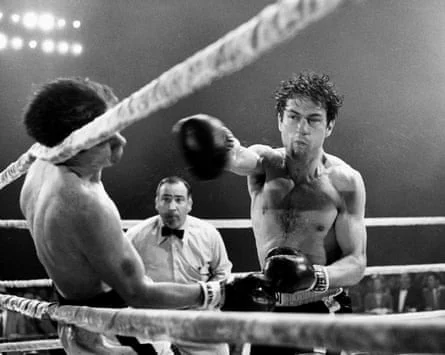
No discussion of boxing’s cinematic legacy would be complete without the contribution of Martin Scorsese. His 1980 masterpiece, Raging Bull, is widely considered the absolute pinnacle of the genre, yet it remains an incredibly brutal and challenging watch. The film offers an unsparing, black-and-white portrait of the real-life middleweight champion Jake LaMotta, depicting him not as a heroic figure, but as a deeply abusive, paranoid, and pathological antihero.
Interestingly, Scorsese himself had initially been highly reluctant to make a boxing movie, having little personal interest in the sport. It was his close friend and collaborator, Robert De Niro, who became utterly obsessed with LaMotta’s self-destructive psychological journey. De Niro recognized the profound dramatic potential in the physical and emotional transformation required to tell the story, eventually turning in an Oscar-winning performance that set a new benchmark for actor commitment.
This physical challenge represents another major reason for boxing’s enduring status in the performing arts: it offers the ultimate test of an actor’s dedication. On the unforgiving cinema screen, where every muscle fiber and drop of sweat is magnified, it is virtually impossible to fake the highly specialized physique and movement of a trained fighter. Over the decades, some of the industry’s biggest names have willingly subjected themselves to months of physical torment, strict dieting, and daily sparring to achieve absolute authenticity.
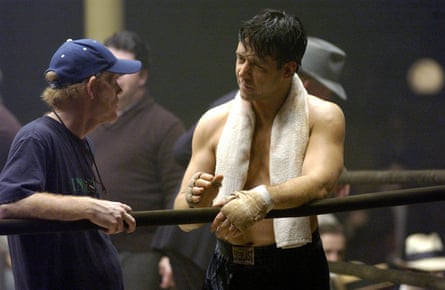
Actors like Daniel Day-Lewis in The Boxer, Jake Gyllenhaal in Southpaw, Will Smith in Ali, and Hilary Swank in Million Dollar Baby all pushed their bodies to the absolute limit. Mark Wahlberg, a lifelong boxing enthusiast, went so far as to construct a professional ring in his own home, honing his pugilistic skills for five long years before cameras finally rolled on The Fighter. In a bittersweet twist of Hollywood irony, despite Wahlberg’s monumental physical dedication, it was his co-star Christian Bale who walked away with the Academy Award for his supporting role.
For modern performers, this grueling process of physical transformation can take on a deeply spiritual dimension. Michael B. Jordan, the star and director of the highly successful Creed franchise, has described the intense preparation for his roles as a form of therapy, allowing him to completely lose himself in the psychology of a fighter. Jordan has spoken openly about his desire to experience the genuine physical toll of the sport, admitting to breaking his hand multiple times during production. For him, the swollen hands and the deep, post-training aches are not obstacles to be avoided, but essential tools for connecting with the character on a primal level.
Similarly, Sylvester Stallone’s decades-long contribution to the cinematic mythology of boxing has been so profound that the actor was eventually awarded a lifetime spot in the International Boxing Hall of Fame, forever blurring the lines between fictional representation and the real-world sport.
The relationship between real-world boxing and its fictional portrayal has become remarkably circular over the years. Stallone’s original, Oscar-winning 1976 screenplay for Rocky was famously inspired by his experience watching the legendary, gritty bout between the underdog Chuck Wepner and the heavyweight champion Muhammad Ali in 1975. Forty years after that historic fight, the narrative came full circle when Liev Schreiber portrayed Wepner in the 2016 arthouse biopic The Bleeder, exploring the real-life struggles of the man who inspired the fictional Rocky Balboa. The cinematic fascination with this origin story continues to grow, with audiences set to witness the dramatic behind-the-scenes creation of the classic film in the upcoming biopic I Play Rocky.
Ultimately, this ongoing dialogue between the ring and the stage reveals an extraordinary cultural truth. While professional boxing’s mainstream popularity and cultural dominance have undoubtedly declined since the golden era of the mid-twentieth century, our collective fascination with the sport’s dramatic representation has never wavered. Whether through the tragic, violin-playing protagonist of Clifford Odets’ 1930s masterpiece or the sweat-drenched cinematic heroes of the modern era, the boxing ring remains the ultimate stage for exploring the deepest, most turbulent depths of the human condition.