The behind-the-scenes story of how the original Rocky film came into existence has long carried an uncanny resemblance to the plot of the movie itself. It is a narrative defined by an unknown talent harboring an improbable dream, an entrenched industry displaying deep skepticism, and a steadfast refusal to yield to daunting odds. When Sylvester Stallone set out to crack the film business and bring his breakthrough screenplay to the big screen, his real-life struggle contained every vital element of the underdog tale he was determined to share. Half a century after the film’s historic debut, director Peter Farrelly’s biographical drama I Play Rocky has adapted those striking parallels into a crowd-pleasing cinematic story of its own.
The project represents a remarkable afterlife for what began as a modest boxing picture. Produced on a shoe-string budget of just $1 million, the original 1976 film defied expectations to become the highest-grossing motion picture of its year. It capped off its astonishing run by capturing the Academy Award for Best Picture, triumphing over one of the most competitively stacked fields in cinematic history. Yet the film’s most enduring achievement may well be the sheer persistence of its core narrative. Critics at the time were far from universally convinced, with the New York Times dismissing it as a "sentimental little slum movie" and reviewer Gene Siskel writing it off as a "flatout schmaltzy saga." Despite those early dismissals, audiences and filmmakers have spent the past five decades continually finding new ways to reinvent the tale across six direct Rocky films, three Creed spin-offs, a Broadway musical, and an almost uncountable array of documentaries, novelizations, and video games. At some point across those decades, a script completed in just three and a half days—and never designed to serve as commercial intellectual property—evolved into something resembling contemporary folklore.
That legacy takes center stage in I Play Rocky, in which relative newcomer Anthony Ippolito takes on the formidable role of Stallone. The film serves as an unabashedly emotional homage to the 1976 original, the celebrated New Hollywood era of American filmmaking, and the timeless principle of betting on one’s own potential. During recent press screenings in New York, the emotional pull of Farrelly’s unreserved sincerity and old-fashioned storytelling proved readily apparent, reducing viewers to tears much as the original picture did fifty years prior. Audiences in 1976 yielded to the very same set of narrative dynamics, demonstrating the timeless power of a well-crafted underdog story.
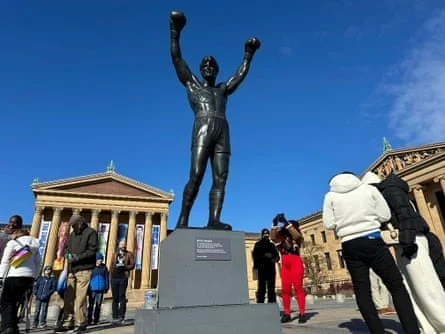
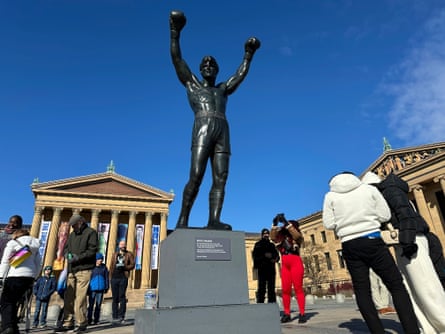
The new biopic is poised to resonate strongly in Philadelphia, where the character of Rocky Balboa long ago ceased being a simple work of fiction and became something closer to the foundational text of the city’s collective identity. For generations raised in the area, the film’s psychological footprint remains ubiquitous. Visitors continue to gather at the Philadelphia Museum of Art, sprinting up the landmark stone steps to raise their arms in triumphant celebration while entirely bypassing the masterpieces by Cézanne, Picasso, and Duchamp housed inside. Nearby stands a ten-foot-tall bronze statue crafted in Stallone’s likeness—originally created as a prop for Rocky III—that has been elevated to the status of an official municipal landmark. Across town in the Italian Market, produce vendors work in the same neighborhood where Rocky famously jogged past astonished bystanders during director John G. Avildsen’s guerrilla-style location shoots. The city’s identity remains deeply tied to the battered rowhouses and industrial stretches fanning out from Center City. Local memory still holds vivid accounts of seeing Rocky during its initial run at the now-defunct Sam Eric movie palace on Chestnut Street, where audiences routinely rose to their feet during the final fight against Apollo Creed, cheering and shouting as though attending a live championship bout.
Rocky was far more than a movie filmed in Philadelphia; the character effectively embodied the specific self-image the city wished to project. Scrappy, stubborn, unpretentious, perpetually underestimated, and driven by an intense desire to overcome self-doubt, the fictional fighter captured the spirit of his environment. Stallone recognized the broader cultural appeal of his creation from the outset, writing in his 1977 tie-in publication, The Official Rocky Scrapbook, that the character was to the 1970s what Charlie Chaplin’s Little Tramp had been to the 1920s.

That populist attraction has been inherited and passed down through generations in unexpected ways. In 2013, Philadelphia writer Dan McQuade carefully mapped out Rocky’s training route from Rocky II, discovering that the fictional run would have covered more than 30 miles across the city. His analysis inspired an actual annual ultramarathon in which local runners retrace the grueling, absurd course. While Chicago claims Ferris Bueller, Boston points to Will Hunting, and Brooklyn embraces Tony Manero, Philadelphia adopted a fictional boxer as a secular patron saint. The choice carries a complex historical contrast when weighed against the city’s actual sports history. Heavyweight champion Joe Frazier was a genuine Philadelphia legend who trained on the city’s streets and defeated Muhammad Ali in one of the most famous bouts in boxing history. Yet while Rocky was a fictional journeyman who lost a close decision to an Ali-inspired champion, it is the fictional Italian Stallion whose monument attracts steady streams of tourists, while Frazier’s statue stood far less noticed at the base of the museum stairs.
This contrast highlights the racial and social realities of 1970s Philadelphia. Frazier was a Black man and an authentic working-class Philadelphian by way of Beaufort, South Carolina, whose real-world accomplishments carried none of the tidy sentimentality of a Hollywood script. Rocky was white, ethnically Italian, and conveniently fictional, his personal struggles detached from the complex racial dynamics of the city that embraced him. When Rocky arrived in theaters in 1976, Philadelphia was entering the second mayoral term of Frank Rizzo, the former police commissioner whose administration was marked by deep racial tensions, including a high-profile raid in which officers stripped members of the Black Panthers naked in the street for news photographers. The city’s overwhelming cultural elevation of a fictional white hero over a real Black champion reflects how public memory often selectively chooses which stories become universal and which remain localized.
The Philadelphia depicted in the original film was a city grappling with industrial decline. Manufacturing facilities were shutting down, suburban migration was draining middle-class populations from central neighborhoods, and the post-war industrial economy was eroding. Avildsen’s lens captured vacant lots, elevated train lines, and streets that appeared perpetually damp and bleak. The aesthetic sat remarkably close to the stark urban imagery featured in David Lynch’s Eraserhead, a film informed by Lynch’s time at the Pennsylvania Academy of the Fine Arts, which he described as a deeply decadent, decaying, and fear-ridden environment.
Fifty years later, many of those former industrial sectors have transformed into sought-after residential enclaves. Conversely, neighborhoods like Kensington—whose worn streets provided much of the raw atmosphere for the 1976 film—have become internationally known for open-air drug markets and the gritty street rap of artists like Skrilla. Higher education and dining establishments now drive large portions of the local economy, and the downtown skyline has expanded dramatically even as poverty remains a persistent issue. The working-class Philadelphia of the 1970s lives on as much in the city’s self-perception as it does on its physical streets.
The world-building of the original Rocky provided that local identity with a global platform. Beyond its regional ties, the underdog narrative model perfected by the film established an enduring archetype for modern storytelling. While Rocky did not invent the underdog narrative, it streamlined an ancient storytelling structure into a reliable formula that reshaped popular culture. The core blueprint—an outsider paired with a crusty mentor, a high-stakes training montage, a formidable favorite, and a final contest where personal validation outweighs the literal score—became a genre unto itself. Films ranging from The Karate Kid and Cool Runnings to Searching for Bobby Fischer and Akeelah and the Bee borrowed directly from this established structural template.
Over time, this narrative pattern evolved into something broader than mere commercial repetition. Just as classic dramatic works like Shakespeare’s Macbeth have been continuously reinterpreted through grand opera—such as Verdi’s 1847 adaptation, recently featured at the Metropolitan Opera—and literary classics like Jane Austen’s Sense and Sensibility receive fresh cinematic adaptations, Rocky entered a distinct realm of contemporary myth-making. A story transitions into folklore when successive generations find compelling reasons to retell it. Even the film’s various sequels achieved notable cultural milestones: director Quentin Tarantino has cited Rocky II as his favorite entry in the franchise, Rocky III earned a Japanese Academy Award nomination for Best Foreign Film, and Rocky IV stood as the highest-grossing sports film for a quarter of a century.
The evolution of Rocky’s opponents over the years mirrored changing cultural anxieties within the United States. Apollo Creed, the charismatic Black champion, reflected the shifting social dynamics of the 1970s. Clubber Lang presented a more intense and aggressive challenge to Rocky’s position at the top. By the mid-1980s, Ivan Drago transformed the boxing ring into an explicit Cold War arena, positioning Rocky as a symbol of American resolve against the clinical machinery of Soviet athletics in a classic piece of Reagan-era pop culture. Later chapters turned inward, examining the realities of aging, loss, and obsolescence. The underlying social dynamics were famously satirized by comedian Eddie Murphy, who noted how Italian-American theatergoers would exit Rocky screenings strutting as if they had personally won a world title in the ring.
By the time the franchise expanded with the Creed series in 2015, the narrative dynamic shifted gracefully. Starring Michael B. Jordan as Adonis Creed, the series positioned an aging Rocky as the mentor rather than the primary fighter. The central themes of legacy, discipline, and self-determination were passed smoothly to a new generation, allowing the broader narrative to evolve without sacrificing its foundational appeal.
Despite decades of sequels and spin-offs, the original 1976 film retains a surprisingly grounded core message that routine repetition has sometimes obscured. Rocky Balboa ultimately loses his fight against Apollo Creed on points, but the official decision proves largely secondary. By standing his ground through fifteen brutal rounds, he achieves personal redemption, establishes his self-worth, and finds love, escaping the prospect of remaining, in his own words, "just another bum from the neighborhood." His true triumph is not over his opponent, but over the fear of his own insignificance. The film reframed the American dream into a deeply personal, emotional triumph, delivering an enduring message: an individual does not need to win in order to matter.
That central theme connects directly back to the narrative of I Play Rocky, where the origin story of the film merges with the legend it created. Sylvester Stallone’s refusal to sell his script unless he was cast as the lead character—turning down increasingly lucrative financial offers despite living in near-poverty—has become as famous as Rocky’s refusal to stay down on the canvas. The unknown actor who gambled everything on his vision became another central figure in the very mythology he drafted using a nineteen-cent Bic pen and a forty-nine-cent notepad.
There remains something inherently compelling about this cycle of storytelling. The cultural background and specific details may change, but each generation continues to embrace its own variation of the same fundamental struggle against overwhelming odds. Philadelphia, meanwhile, continues to see its spirit reflected in that journey. As its urban landscape evolves, its sports teams compete, and its population shifts, the city retains its deep connection to the fictional fighter trudging through the cold winter air toward an uncertain victory. Half a century after Rocky first arrived in theaters, the story remains inextricably linked to the city that inspired it.