

The conventional wisdom in combat sports often relies on familiar terminology that, upon closer analytical inspection, can mislead aspiring athletes. Among the most pervasive and potentially damaging concepts in modern boxing is the notion of "fighting on the outside." For generations, trainers and commentators have used the phrase to describe long-range combat, leading many fighters to believe that success at a distance is achieved simply by maintaining maximum physical separation or by retreating from pressure. However, veteran boxing analysts and elite coaches argue that this interpretation is fundamentally flawed. True outside fighting is not about running away or staying far; rather, it is a dynamic, continuous process of spatial management that rejects the passive safety of the straight backstep.
To understand why traditional perceptions of outside fighting fail, one must examine the universal reliance on the backstep. In the heat of competition, when a fighter is overwhelmed by an opponent’s offensive output or struggling to read incoming punches, stepping backward functions as an instinctive panic button. Statistically, the backstep can momentarily avoid danger more easily than complex defensive maneuvers such as slipping, rolling, ducking, or blocking. Simply moving out of range guarantees that an incoming strike cannot land.
Yet, this temporary safety net carries a severe strategic limitation: the backstep fails to fundamentally alter the tactical scenario. At best, a retreat buys relief from one or two punches before the opponent advances to close the distance once again. This leaves the retreating fighter in the exact same precarious position as before, but with significantly less available canvas.
The spatial geometry of a boxing ring imposes strict limitations on linear movement. Even within a standard-sized ring, a defensive-minded fighter starting near the center can rarely afford more than two consecutive backsteps before finding their back against the ropes. The first step removes them from the center, and the second frequently compromises their position entirely, pinning them along the perimeter or creating intense psychological pressure. Relying on sheer athletic speed and explosive footwork to outrun an opponent is similarly unsustainable. Such an approach demands superhuman endurance and assumes an immobile opponent, a scenario that quickly unravels when facing a relentless adversary who gains confidence from witnessing an opponent flee.
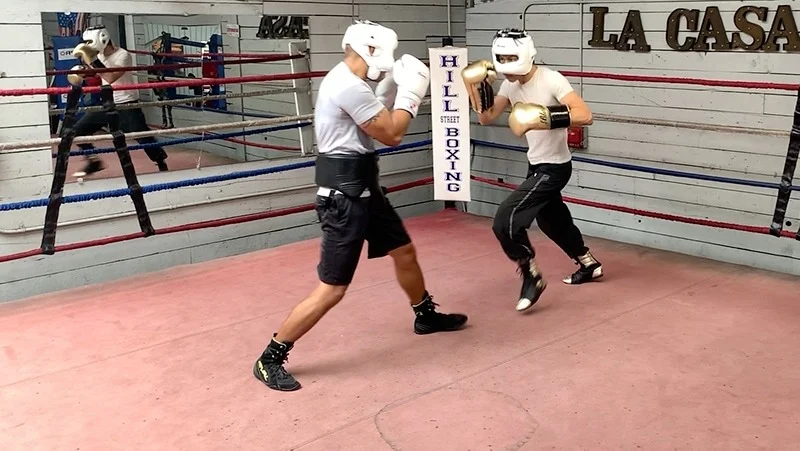
Consequently, boxing authorities emphasize that the only viable method for maintaining distance without sacrificing ring generalship is lateral movement. Circling an opponent—whether clockwise to their right or counter-clockwise to their left—ensures that a fighter never exhausts their spatial options. Unlike linear retreats, lateral movement preserves an escape route while keeping the opponent engaged and hesitant to advance unchecked.
The tactical advantages of lateral movement are manifold. First, circular footwork ensures that a fighter never runs out of space. While linear regression inevitably leads to the ropes, continuous lateral displacement maintains a buffer of open canvas, preserving the option to step backward only as an absolute last resort.
Second, circling allows fighters to remain within effective punching range. Many struggling fighters fall into a cyclical pattern where an aggressive opponent lands a blow, the defender throws a reactionary counter into empty air while stumbling backward, and the attacker advances unopposed to repeat the cycle until the referee intervenes. By contrast, legendary technicians like Muhammad Ali and Sugar Ray Leonard utilized lateral movement not to run away, but to orbit their opponents while continuously delivering the jab. Their apparent flight was, in practice, a calculated offensive posture that kept them within striking distance while frustrating incoming attacks.
Third, lateral targets present a notoriously difficult geometry for opponents to strike. Conventional advice often dictates circling away from a rival’s power hand or avoiding the quadrant where they possess the greatest leverage. However, experienced analysts suggest that the primary defense lies in the angle of attack itself. Striking at diagonal angles feels inherently unnatural for an orthodox or southpaw fighter accustomed to linear exchanges, meaning that a laterally moving opponent forces attackers to constantly adjust their punch trajectories, disrupting their timing and power generation.
Mastering lateral movement involves nuanced adjustments to body mechanics and angles of approach. Boxers can modulate the opponent’s psychological response by varying their circling paths, moving either sharply sideways to disrupt rhythm or stepping slightly forward to pressure the attacker’s guard. Furthermore, while traditional lateral movement often involves shuffling sideways in a defensive stance, elite practitioners frequently employ a technique that mimics a backward jog while circling at an angle. This sophisticated bouncing rhythm allows a fighter to pepper opponents with the jab, maintain a protective torso hunch with the head forward, and instantly set their feet to counter over-reaching blows.
Tactical variations, such as the two-direction switch, further complicate an opponent’s read. By initiating a slight head fake, a half-step in one direction, or even a subtle forward motion to draw a reaction before darting the opposite way, a fighter can exploit an opponent’s anticipation. Even against disciplined opponents who do not react immediately to initial feints, committing to a full or half-step in a chosen direction establishes immediate momentum, leaving the fighter halfway out of danger if the opponent fails to respond.
Ultimately, the phrase "fighting on the outside" should be reinterpreted not as a static location far away from the opponent, but as an active state of continuous motion. To remain on the outside is to avoid stationary pauses and linear retreats, relying instead on a fluid combination of lateral circling, precise head movement, and calculated offensive pressure. Breaking the ingrained habit of taking straight backsteps during shadowboxing and heavy bag sessions is crucial for developing this adaptive mindset. By prioritizing circular mobility over frantic flight, fighters can maintain spatial control and ensure that they are always positioned to dictate the pace of the bout.