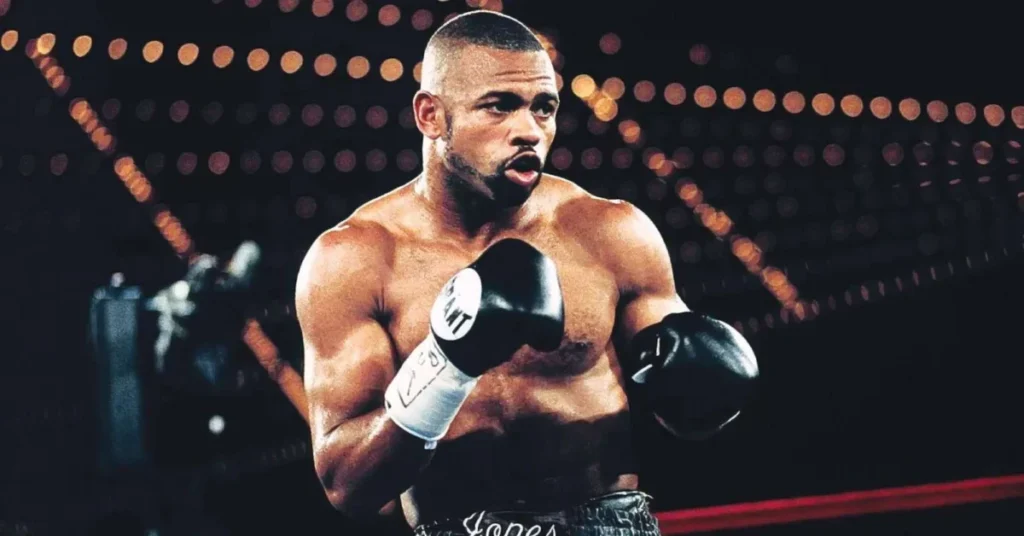


Even when a fighter feels entirely in control of a contest, the absolute pinnacle of the sport can harbor hidden dangers that only a true master recognizes. For Roy Jones Jr., a man who reigned as the undisputed king of the pound-for-pound rankings during the peak of his athletic powers, a career defined by breathtaking speed, unmatched reflexes, and devastating power included dozens of elite nights under the bright lights. Yet, looking back across a legendary tenure that spanned decades and divisions, the multi-weight world champion has identified one specific adversary who stood above all others as his most formidable test.
Despite securing a comprehensive and convincing victory on the judges’ scorecards—a performance that featured a third-round knockdown and a tactical masterclass—Jones has revealed that James Toney remains the finest and most challenging opponent he ever shared a boxing ring with. Speaking candidly during a recent appearance on All The Smoke Boxing, Jones reflected on the historic 1994 showdown that cemented his status as an all-time great, offering a rare glimpse into the psychological and physical chess match of facing another generational talent at the height of their powers.
"From the third round, I kind of felt like I could do whatever I wanted to do, because I felt like I was in control," Jones recalled during the interview. "But make no mistake about it—James Toney is probably the best fighter I’ve been in the ring with. Even when you’re in control, you’re not fully in control because James is that good."
The admission sheds fresh light on a rivalry that captured the imagination of the boxing world during an era when the sport routinely delivered superfights between undefeated, prime-age champions. Back in 1994, Jones and Toney collided in a highly anticipated super-middleweight championship bout. Jones, who had famously dethroned Bernard Hopkins the previous year to claim the IBF middleweight crown, stepped up in weight to challenge Toney for the IBF super-middleweight title. What followed was a tactical exhibition of skill, speed, and ring generalship. Jones showcased his supernatural athletic gifts, dropping Toney in the third round and out-boxing him over twelve frames to secure a unanimous decision victory that left no doubt as to who was the superior fighter on that specific evening.
However, Jones’s reflection underscores the unique greatness of Toney, a fighter who, like Jones himself, would eventually retire as an all-time great and secure a swift, well-deserved induction into the International Boxing Hall of Fame. Toney’s career longevity was legendary, though it arguably extended far beyond the point of safety as he fought on well past his prime, but his prime-era incarnation was an extraordinarily clever, defensively sound, and relentlessly punishing operator.
To understand the weight of Jones’s compliment, one must look at the broader tapestry of a career that saw the American pound-for-pound legend conquer multiple weight classes and compile an astonishing resume. For the better part of a decade, particularly while campaigning between the 160lb middleweight and 175lb light-heavyweight limits, Jones was widely regarded by peers, pundits, and fans as practically unbeatable. His style—characterized by hands held low, blurring hand speed, lateral movement that rendered opponents helpless, and a terrifying one-punch knockout capability—made him the most feared man in boxing.
That aura of invincibility remained completely intact until 1997, a year that brought the only real blemish on his record during his absolute prime. In a light-heavyweight defense against Montell Griffin, Jones suffered a controversial disqualification loss after striking Griffin while he was down on one knee in the ninth round. At the time of the stoppage, Jones had been comfortably ahead, but the rulebook cost him his undefeated status and his championship belt.
True to his fierce competitive nature, Jones wasted no time righting the wrong. In their immediate rematch later that same year, Jones left nothing to chance, scoring a devastating first-round knockout finish over Griffin to recapture his championship momentum. That explosive victory sparked another dominant run, seeing Jones reel off 14 consecutive victories as he continued to clean out the light-heavyweight division and eventually set his sights on the ultimate heavyweight glory.
The defining moment of that heavier ambition came when Jones made the bold decision to move all the way up to heavyweight, challenging John Ruiz for the WBA world title in 2003. In a historic performance, Jones triumphed by unanimous decision, becoming the first former middleweight champion in over a century to capture a heavyweight title. But that extraordinary physical achievement came at a cost. When Jones subsequently chose to drop back down to the light-heavyweight division, the sudden weight fluctuation took a heavy and irreversible toll on his body and his historically unmatched reflexes.
The consequences of that weight drain became agonizingly clear when Jones met Antonio Tarver in their first encounter. Although Jones managed to scrape through with a narrow majority decision victory, the vulnerability was evident. In their subsequent rematch, the ending was far more emphatic and abrupt, with Tarver landing a crushing second-round knockout that signaled a turning point in Jones’s career. From that moment onward, while Jones continued to lace up the gloves for numerous high-profile bouts well into his later years, he was never quite the same dynamic, untouchable fighter who had terrorized the 160 to 175-pound landscapes during the 1990s.
Yet, long before the weight struggles and the devastating nights against Tarver, the defining chapter of Jones’s legacy was forged against elite operators like Toney and Hopkins. Both men went on to carve out legendary careers that spanned decades, mirroring Jones’s own remarkable endurance in the sport. While Hopkins famously redefined longevity by winning world titles well into his late forties, and Toney collected major honors across multiple weight divisions up to cruiserweight and heavyweight, it is Toney’s specific in-ring intellect and resilience that clearly left the most indelible impression on Jones.
The acknowledgment by Jones that Toney represents the absolute pinnacle of the opposition he faced serves as a poignant reminder of the sheer caliber of talent that defined 1990s boxing. Even for a fighter blessed with physical gifts that occurred perhaps once in a generation—someone who could routinely toy with world-class contenders and make it look effortless—the puzzle presented by James Toney was one that could never be entirely solved with mere dominance. As Jones himself noted, true control in the presence of a fighter of Toney’s extraordinary caliber is always an illusion, cementing a mutual respect between two icons of the sport whose paths crossed at the absolute zenith of their respective powers.