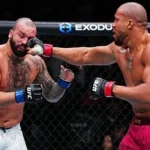
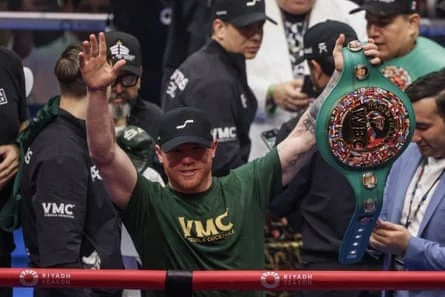
RIYADH — Saúl “Canelo” Álvarez reclaimed the WBC super-middleweight world championship on Saturday night, delivering a measured, tactically sharp performance to earn a unanimous-decision victory over the previously unbeaten Christian Mbilli at Kingdom Arena. The triumph marked a triumphant return to the championship ranks for the Mexican icon, who was stepping into the ring for the first time in more than a year following the loss of his undisputed status.
In front of a captivated crowd in the Saudi capital, the 36-year-old Álvarez leaned heavily on the craft and experience amassed over more than two decades in the prize ring. Facing an opponent five years his junior who had built a reputation on relentless aggression, Álvarez relied on his signature counter-punching and precise, punishing body work to neutralize the Frenchman’s furious forward momentum. Over the course of 12 tactical rounds, the veteran demonstrated that his ring intellect and defensive reflexes remain potent weapons against the division’s rising forces.
The ringside judges reflected Álvarez’s command of the cleaner, more damaging exchanges, turning in scorecards of 115-112, 116-111, and 117-110 in favor of the Mexican challenger. The decisive scores underscored Álvarez’s ability to bank rounds by choosing his moments, diffusing Mbilli’s high-output attacks with sharp counters and disciplined defensive movement.
The high-profile title bout took place against a backdrop of severe geopolitical tension and heightened security across Riyadh. In the days leading up to the event, concerns over safety had dominated conversations throughout the city after the Saudi-led military coalition confirmed that it had intercepted a series of missiles and drones launched by Iran-aligned Houthi forces. The regional escalation had already disrupted the kingdom’s bustling autumn calendar, prompting authorities and organizers to cancel or postpone several major gatherings and high-profile exhibitions, including the Six Kings Slam tennis tournament.
Despite the pervasive unease and the visible tightening of security protocols surrounding major venues in the capital, the championship clash went forward as planned. The promotion had been cast into uncertainty three weeks prior, following a deadly missile strike on King Khalid International Airport in Riyadh that claimed the lives of at least 12 people and left more than 300 injured. The danger was magnified when a second projectile struck a passenger terminal at the airport the following day, prompting an immediate crisis for civilian aviation. In the aftermath of those strikes, several major international commercial carriers took the precautionary step of suspending flights to Saudi Arabia, casting a logistical cloud over the influx of visitors, international media, and sporting personnel typically expected for a major fight week.
Amid the volatile climate, Turki al-Sheikh, the chairman of Saudi Arabia’s General Entertainment Authority and the primary catalyst behind the kingdom’s emergence as a heavyweight boxing hub, revealed that Álvarez had remained completely steadfast in his commitment to the fixture. Al-Sheikh publicly stated earlier in the month that the Mexican star had reached out directly to offer personal assurances that he had no intention of pulling out or seeking a postponement. According to Al-Sheikh, Álvarez conveyed that he was determined to fight in Riyadh this October regardless of the circumstances unfolding on the ground, with the Saudi official summarizing the veteran champion’s resolve simply by writing on social media: “He fears nothing.”

Inside the ring, Álvarez’s poise appeared entirely unruffled by the tumult outside the venue. Facing Mbilli, a rugged and aggressive opponent who entered the ring with an unblemished record of 29 victories and one draw, Álvarez understood he would need to weather heavy pressure. Mbilli sought to establish his rhythm from the opening bell, coming forward aggressively, cutting off the ring, and attempting to overwhelm Álvarez with sheer volume and physical output.
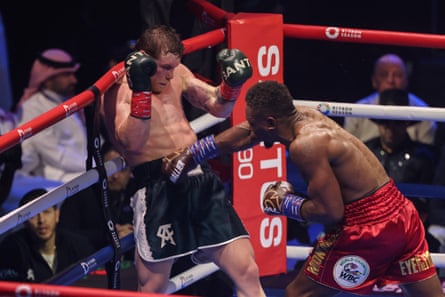
Mbilli’s game plan was clear: crowd the older champion, force him to work at an uncomfortable pace, and test his stamina following his extended layoff. Yet Álvarez’s seasoned counter-punching repeatedly dictated the terms of engagement. While Mbilli pushed the pace and threw a substantially higher number of punches, it was the Mexican who consistently found the mark with the crisper, more telling blows.
Álvarez’s work to the body was particularly impactful, slowing Mbilli’s advances as the bout progressed and opening up lanes for attacks upstairs. The definitive moment of the contest arrived in the seventh round, when Álvarez timed a crushing, pinpoint uppercut through Mbilli’s guard. The punch visibly staggered the French champion, sending shockwaves through his legs and forcing him into survival mode for the remainder of the frame. Though Mbilli demonstrated immense heart and durability to regain his footing and continue pressing forward through the championship rounds, he was unable to land the game-changing blow required to overcome Álvarez’s technical superiority.
When the final bell sounded, there was little doubt regarding the outcome. When the judges’ scorecards were announced, confirming Álvarez as the new WBC super-middleweight champion, the Mexican fighter celebrated with evident emotion. The victory restored him to the summit of the 168-pound weight class, a division he had previously dominated with absolute authority.
Speaking in English inside the ring shortly after his hand was raised, an elated Álvarez reflected on the historical significance of the moment in the context of his enduring career.
“It’s something unbelievable. It feels like my first title,” Álvarez said. “Now, after 21 years as a professional, 16 years ago I won my first title. Now I won that title again. I’m so proud of my team.”
Reflecting on what continues to drive him after more than two decades in the grueling sport, he added: “I love boxing. That’s why I’m here, because I still love boxing and I enjoy it a lot.”
The victory marked a vital chapter of redemption for Álvarez, who improved his professional ledger to 64 wins, three losses, and two draws. His legacy had faced fresh questions following his previous ring appearance in September 2025, when he suffered only the third defeat of his career in a unanimous-decision loss to Terence Crawford in Las Vegas. That setback had stripped Álvarez of his undisputed super-middleweight crown, bringing an end to his historic reign as the simultaneous holder of all four major sanctioning body belts at 168 pounds.
After Crawford subsequently departed the division and announced his retirement from the sport, the championship landscape at super-middleweight fractured. Mbilli, who had previously captured the WBC interim belt, was formally elevated to full champion. The 31-year-old Cameroon-born French boxer had earned his position near the top of the division through years of bruising performances, though his perfect record had sustained its first minor blemish when he fought to a hard-fought split draw against Lester Martínez on the undercard of the Álvarez-Crawford event. That draw had snapped Mbilli’s unblemished run of 29 consecutive professional victories, but his elevation to full world champion presented him with the defining opportunity of his career against Álvarez. Saturday’s defeat in Riyadh was the first official loss of his professional career.
While the contest was an undeniable athletic success for Álvarez, the unusual circumstances surrounding the event were not entirely absent from his thoughts. When addressing the crowd and international viewers in Spanish during his post-fight remarks, Álvarez made an apparent, indirect reference to the security environment and travel challenges that had shadowed fight week. Specifically, he drew attention to the notable absence of his immediate family, who are traditionally a permanent fixture at ringside for his career milestones.
“I also want to thank my family, who are watching me from afar today for the first time,” Álvarez said. “My siblings, my parents, my daughters, my son, and my wife — who also couldn’t make it due to certain circumstances.”
Although Álvarez stopped short of elaborating further on those specific circumstances or directly linking his family’s absence to the regional missile strikes and flight cancellations, the admission highlighted the unusual atmosphere under which the championship bout took place.
The security concerns of the past weeks have raised questions regarding Saudi Arabia’s broader ambitions to cement itself as the premier global destination for mega-scale international sporting events. Under the leadership of Al-Sheikh and the General Entertainment Authority, the kingdom has spent heavily to transform Riyadh into the unofficial capital of elite professional boxing, luring the sport’s biggest international stars with unprecedented financial purses. That rapid expansion into global sports has drawn significant international scrutiny regarding the kingdom’s human rights record, alongside frequent accusations of sportswashing from critics who view the events as an effort to reshape the nation’s global reputation.
The successful staging of the bout ensured that Saudi Arabia’s boxing enterprise maintained its momentum despite the geopolitical instability in the surrounding region. For Álvarez, the night delivered complete sporting vindication, proving that even after 21 years and more than 60 professional fights, he remains a formidable world champion capable of commanding boxing’s grandest stages.