
More than half a century after his passing, Leonard Benker Johnson is finally receiving a monumental tribute in the city that defined his life. Manchester City Council has confirmed that a new statue honoring the legendary boxer and civil rights activist will be erected opposite Manchester Victoria Station, pending final planning permission.
The milestone marks a historic moment for Manchester, as Johnson is set to become the first Black person to be commemorated with a statue in the city. For decades, local campaigners have fought to secure a permanent memorial for the working-class hero whose exceptional athletic prowess was suppressed by the institutionalized racism of early 20th-century British sport.
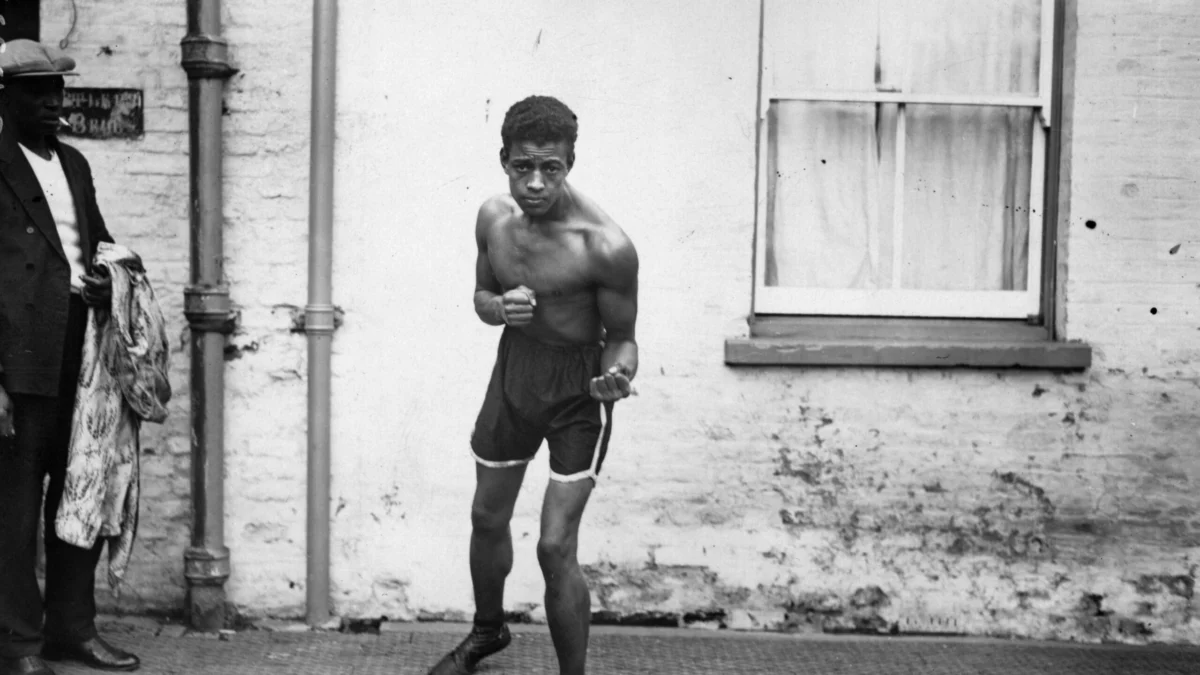
Born in Clayton, Manchester, on October 22, 1902, Johnson was the eldest of four siblings, born to a father from Sierra Leone and a mother from Ireland. Despite growing up with little exposure to the sport, he discovered boxing almost by chance. Following a physical altercation at his workplace, his father—a former boxer himself—decided to introduce him to the local boxing scene.
Just a few weeks later, after improvising his training routine by skipping with an old washing line, a teenage Johnson stepped into the ring for his very first bout at the Alhambra Theatre in Openshaw. He emerged victorious, securing a third-round knockout against fellow teenager Jerry Hogan. That initial triumph set the stage for an extraordinary athletic career that would eventually yield more than 90 victories.

A Dominant Force Blocked by the "Colour Bar"
Johnson’s reputation quickly grew as he dominated opponents across the country, establishing himself as one of the finest fighters of his generation. His true breakthrough arrived in 1925, when he achieved the remarkable feat of defeating the reigning British middleweight champion, Roland Todd, twice in the span of just seven months.
That same stellar year, Johnson also secured a victory against Ted ‘Kid’ Lewis, a fighter whom heavyweight icon Mike Tyson would later describe as "probably the greatest fighter to come out of Britain."
Yet, despite proving himself superior to the top fighters in the country, Johnson was systematically denied the opportunity to compete for the sport’s highest domestic accolades. The British Boxing Board of Control enforced a notorious regulation known as Rule 24, which explicitly restricted championship contests to boxers "born of white parents."
Faced with a domestic system that shut him out of major venues and lucrative bouts, Johnson sought opportunities abroad. In 1926, he relocated to Australia, where he successfully won the Empire middleweight title. However, upon returning to England, he was informed that his achievement would not be recognized by the domestic boxing establishment.

In a poignant statement reflecting on his career in 1930, Johnson expressed the deep frustration and injustice of his predicament. "I’m barred from the Albert Hall and the National Sporting Club. In fact, whenever there is big money, I’m kept out of it," he said. "The prejudice against colour has prevented me from getting a championship fight. I feel now that there is no use whatever going on with the business."
Fighting Racism Outside the Ring
Although systemic prejudice robbed him of a championship belt, Johnson’s competitive drive and commitment to justice did not fade; rather, they found a new outlet in political activism and community leadership. Following the conclusion of the Second World War, he joined the Communist Party and emerged as a prominent figure in the Moss Side area of Manchester.
His political and social engagement extended far beyond local organizing. In 1945, Johnson acted as a local representative at the historic Pan-African Congress held at Chorlton-upon-Medlock Town Hall—a pivotal gathering that helped lay the groundwork for the liberation of numerous African nations from colonial rule.
Johnson’s activism remained a constant fixture of his daily life, confronting discrimination wherever it manifested. In 1953, he made national headlines after being refused service at the Old Abbey Taphouse, a pub located just south of Manchester city centre. The establishment operated under a widespread "colour bar," a discriminatory practice that permitted businesses to turn away patrons solely based on their race.

Refusing to accept the bigotry, Johnson teamed up with his friend Wilf Charles to launch a direct campaign against the pub’s policy. The duo brought their grievance directly to the mayor and subsequently returned to the Old Abbey Taphouse accompanied by approximately 200 supporters and members of the press. Faced with the formidable protest, the landlady ultimately served Johnson a drink, despite him not being a regular consumer of alcohol.
That courageous stand helped dismantle the informal "colour bar" across pubs throughout Manchester, serving as a vital stepping stone in the city’s broader struggle against racial segregation. It was not until 1965, nearly two decades later, that racial discrimination in public houses and businesses was finally outlawed nationwide under the Race Relations Act. Johnson passed away in 1974 at the age of 71, leaving behind a profound legacy of resistance and equality.
Securing a Lasting Legacy
The initiative to erect a permanent memorial for Johnson has been spearheaded by the Len Johnson Campaign, led by Deej Malik-Johnson. Over the years, the campaign has worked tirelessly to raise funds and awareness, organizing events such as an annual celebrity football match featuring internet personality Angry Ginge. The grassroots effort has garnered substantial backing from high-profile figures, including professional darts player Luke Littler and former world champion boxer Tony Bellew.
The announcement by Manchester City Council designating a prominent site opposite Manchester Victoria Station for the monument has been hailed as a long-overdue triumph.

"Today’s news is another milestone towards properly acknowledging the historic contributions of a working-class, mixed-race Mancunian whose brave actions in the past developed the foundations of a better future," said Deej Malik-Johnson following the council’s confirmation. "In a sport and a society rigged against him because of his skin colour, Len made himself a champion for people outside the boxing ring. At home and abroad, as an athlete, a worker, an organiser, a politician and a family man, he exemplifies the best of us."
Local civic leaders have similarly praised the initiative, emphasizing the cultural and historical importance of educating future generations about Johnson’s contributions to the city.
Tracey Rawlins, deputy leader of Manchester City Council, noted that Johnson was much more than a gifted athlete. "Len Johnson was not only one of the best boxers of his era, he was also a model of a Mancunian—a community champion who contributed much to the city during his lifetime," she said. "His life and his remarkable achievements are part of Manchester’s history and deserve to be told. The planned statue will provide both a springboard for people to learn more about Len and a focal point for the city to remember and honour him."