
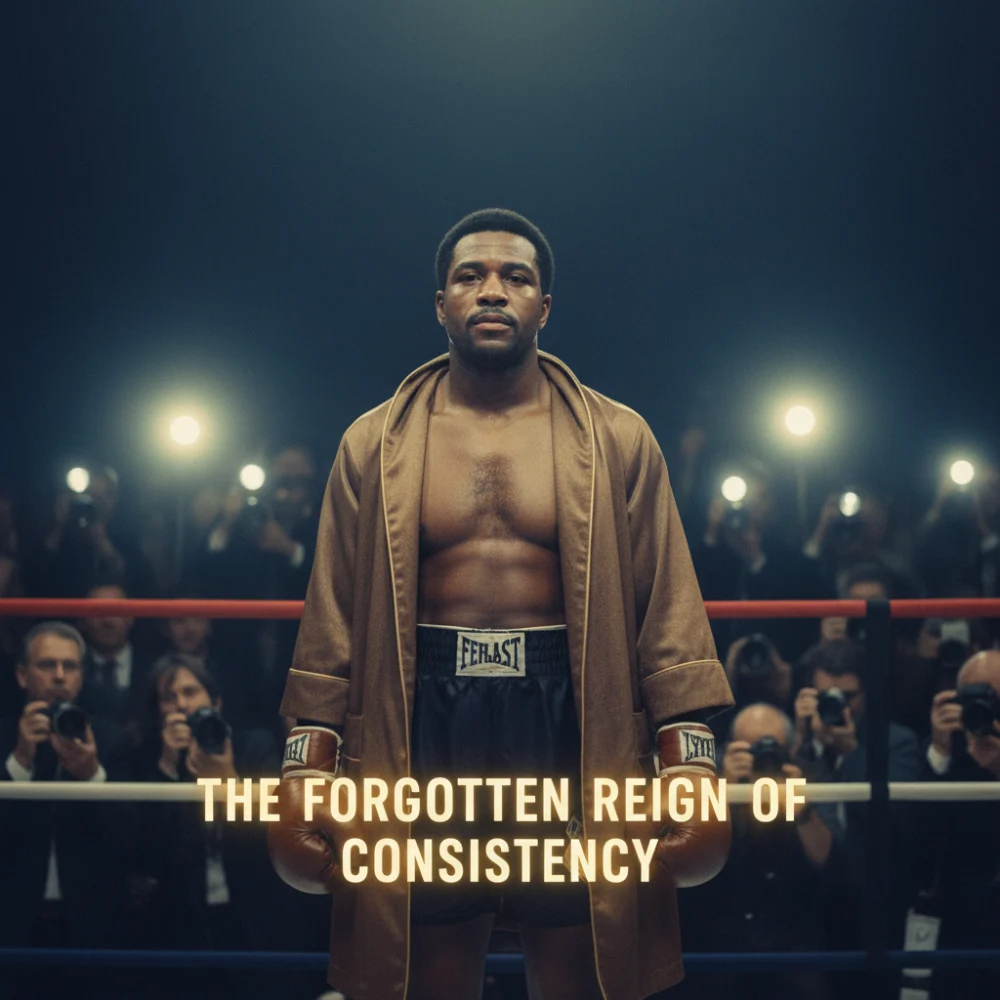
In the pantheon of boxing history, timing is often just as important as talent. To be remembered as a legend, a fighter often needs a great rival or a specific cultural moment to define them. Larry Holmes, one of the most technically gifted heavyweights to ever lace up gloves, suffered from a peculiar historical misfortune: he was the bridge between the two most famous heavyweights in history. Caught in the shadow of Muhammad Ali’s twilight and the explosive rise of Mike Tyson, Holmes’s reign is often unfairly labeled as a dull interregnum, rather than the era of dominance it truly was.
Despite the lack of fanfare during his prime, the statistics of Larry Holmes’s career are staggering. He won his first 48 professional fights, falling just one victory short of matching Rocky Marciano’s undefeated record before a controversial loss to Michael Spinks. He made 20 successful title defenses, a number second only to Joe Louis in heavyweight history. This was not a champion who dodged contenders; this was a workmanlike king who cleared out the division with a level of consistency that is almost nonexistent in modern boxing.
The Education of the Easton Assassin
Born in Georgia and raised in Easton, Pennsylvania, Holmes did not have the amateur pedigree of an Olympic gold medalist like Ali or George Foreman. He dropped out of school early to support his family and learned to box in local gyms. His true education, however, came from being a sparring partner. Holmes spent years sparring with champions like Joe Frazier, Earnie Shavers, and most notably, Muhammad Ali. It was in these grueling sessions that he learned the nuances of distance, timing, and survival against the best punchers on the planet.
Those years in the gym forged his greatest weapon: the left jab. Boxing historians and pundits universally agree that Larry Holmes possessed the greatest jab in heavyweight history. It was not merely a range-finder; it was a power punch in itself. Snapping, accurate, and thrown with bad intentions, the Holmes jab could swell eyes, break noses, and completely disrupt an opponent’s rhythm. It was the piston that powered his entire offense and the shield that protected his chin.
The Night He Became King
Holmes’s crowning moment came on June 9, 1978, in a fight that is frequently cited as one of the greatest heavyweight bouts of all time. He faced Ken Norton for the WBC Heavyweight title. Norton, the man who had broken Ali’s jaw, was a physical specimen with an awkward, cross-armed defense. The fight was a grueling war of attrition that lasted 15 rounds. Going into the final round, the scorecards were dead even. The 15th round of Holmes vs. Norton remains legendary—three minutes of non-stop slugging where both men poured out every ounce of their energy. Holmes edged it out, winning a split decision and claiming the title.
Following the Norton victory, Holmes began a reign of terror that lasted seven years. He defeated a “Who’s Who” of the era, including Earnie Shavers (surviving a monstrous knockdown that would have killed lesser men), Trevor Berbick, Leon Spinks, and Gerry Cooney. He was an active champion, often fighting multiple times a year, maintaining peak physical condition and refusing to let himself balloon in weight between bouts.
The Burden of Beating the Idol
Perhaps the most damaging moment for Holmes’s public image was his 1980 defense against Muhammad Ali. Ali, a shell of his former self and showing early signs of Parkinson’s, came out of retirement in a misguided attempt to reclaim glory. Holmes, who idolized Ali and had worked for him, did not want the fight. In the ring, Holmes dominated his former boss, physically dismantling him but visibly holding back to avoid inflicting permanent damage. He wept in the locker room after the fight. Instead of being celebrated for beating the greatest, he was resented by the public for beating up a national hero.
This resentment fueled the narrative of the 1982 fight against Gerry Cooney. Promoters and media played up the racial angle, dubbing Cooney the “Great White Hope.” The hype was astronomical, with snipers positioned on the arena roof due to death threats. Despite the immense pressure and a hostile atmosphere, Holmes remained cool. He systematically broke Cooney down, stopping him in the 13th round. It was a masterclass in composure, yet Holmes still struggled to win the adoration of the mainstream public.
The End of the Streak and the Comebacks
In 1985, at the age of 35, Holmes faced Michael Spinks, a light heavyweight champion moving up in weight. Holmes was 48-0, one win away from history. In a massive upset, Spinks won a controversial decision. A rematch months later yielded the same result, though many observers felt Holmes had done enough to win the second encounter. The streak was over, and Holmes retired shortly after.
However, the story of Larry Holmes is also one of longevity. He returned to the ring multiple times. He was lured back to face a prime Mike Tyson in 1988, where he suffered the only knockout loss of his career. Yet, unlike many boxers who fade into obscurity, Holmes reinvented himself as a crafty veteran. In the early 1990s, he mounted a serious comeback, proving that his skills had not eroded.
One of the most impressive performances of his late career was against Ray Mercer in 1992. Mercer was an undefeated Olympic gold medalist and a terrifying puncher who had just brutally knocked out Tommy Morrison. Holmes, then 42 years old, was given no chance. In a display of pure ring IQ, Holmes danced, jabbed, and outsmarted the younger man, winning a unanimous decision. It was a victory for the “Old School” and proved that technique ages better than athleticism.
Why Is He Often Forgotten?
When discussing the “forgotten” nature of his reign, several factors come into play:
- Lack of Charisma: Holmes was a pragmatist. He didn’t have Ali’s poetry or Tyson’s menace. He was a blue-collar fighter in a glamour division.
- Style of Fighting: While effective, a jab-heavy style is not always the most cinematic. Holmes was a scientist in the ring, dissecting opponents rather than obliterating them quickly.
- The Shadow of Ali: Succeeding a global icon is an impossible task. No matter how good Holmes was, he was simply “not Ali.”
Furthermore, Holmes had a chip on his shoulder regarding the media, often feeling disrespected. This friction led to soundbites that were sometimes taken out of context, further alienating him from the press corps that wrote the history books.
Re-evaluating the Legacy
In recent years, boxing historians have begun to correct the record. When analyzing head-to-head matchups, many experts believe a prime Larry Holmes presents a nightmare scenario for almost any heavyweight in history. His jab, chin, recuperative powers (as seen in the Shavers fight), and stamina were elite. He possessed the size to handle the super heavyweights of the modern era and the speed to box with the smaller, faster men of the 70s.
Larry Holmes stands as a testament to the power of fundamentals. He did not rely on intimidation or raw power alone; he relied on the sweet science. He mastered the basics to such a degree that they became unstoppable weapons. His reign was not just a placeholder era; it was a clinic in heavyweight boxing that lasted nearly a decade.
Today, as we look back at the heavyweight lineage, Larry Holmes firmly belongs in the top five, arguing his case alongside Ali, Louis, and Marciano. The “Easton Assassin” may not have been the most beloved champion of his time, but his reign of consistency remains a benchmark that few have ever approached, and likely, few ever will.