

In a recent video presentation, Davidson introduced a series of precise mechanical adjustments for split squats, hinges, and kickbacks designed to maximize mechanical tension in the lengthened position of the muscle. By shifting focus from the peak contraction at the top of a movement to the deep stretch at the bottom, Davidson demonstrates how subtle postural cues can dramatically alter muscle recruitment without necessarily requiring heavier loads.
The core premise of Davidson’s approach centers on what he defines as the "feel versus real" dilemma. Traditional training philosophy often prioritizes the peak squeeze of a repetition, where a muscle is shortest and experiences the highest localized sensation of burning or fatigue. However, Davidson notes that this sensation can be misleading for hypertrophy.
While short-position training delivers a high degree of tension when the muscle is contracted, contemporary sports science increasingly points toward lengthened-position training—where maximum stress is applied while the muscle is stretched out—as a superior driver of actual muscle growth. Davidson acknowledges that while shortened-position work retains value, it yields less muscular adaptation per unit of work compared to movements that prioritize the stretch. As a practical shortcut for evaluating any glute exercise, Davidson suggests observing the muscle itself, noting that an effective movement should visibly increase the volume and profile of the glute region as it enters the stretch phase.
To organize effective program design, Davidson categorizes lower-body movements into three primary buckets: squats, hinges, and isolations, emphasizing that every comprehensive routine should incorporate at least one squat or hinge pattern. The mechanical foundation governing these patterns relies on a straightforward rule regarding the line of force: when knees are positioned far from the line of force, the emphasis shifts toward the quads, whereas positioning the hips far from the line of force targets the glutes and hamstrings. Tailoring a program depends entirely on individual physique goals and structural needs. Lifters looking to improve side-to-side symmetry or overall posterior development can strategically deploy squats and hinges, while those lacking upper and outer roundness can shift volume toward abduction work to target the gluteus medius and minimus.
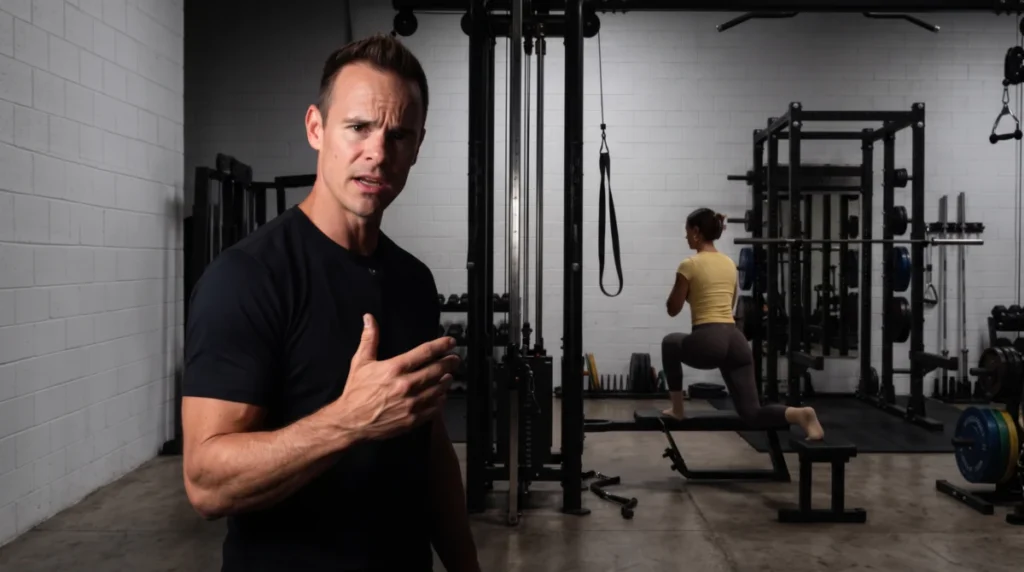
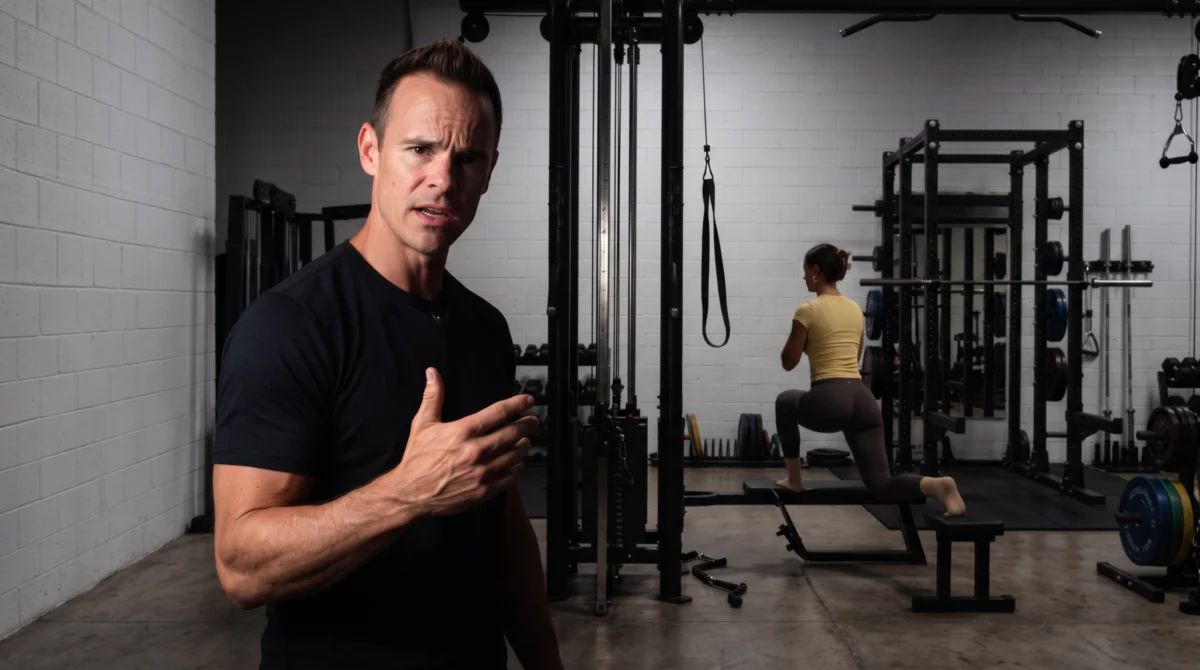
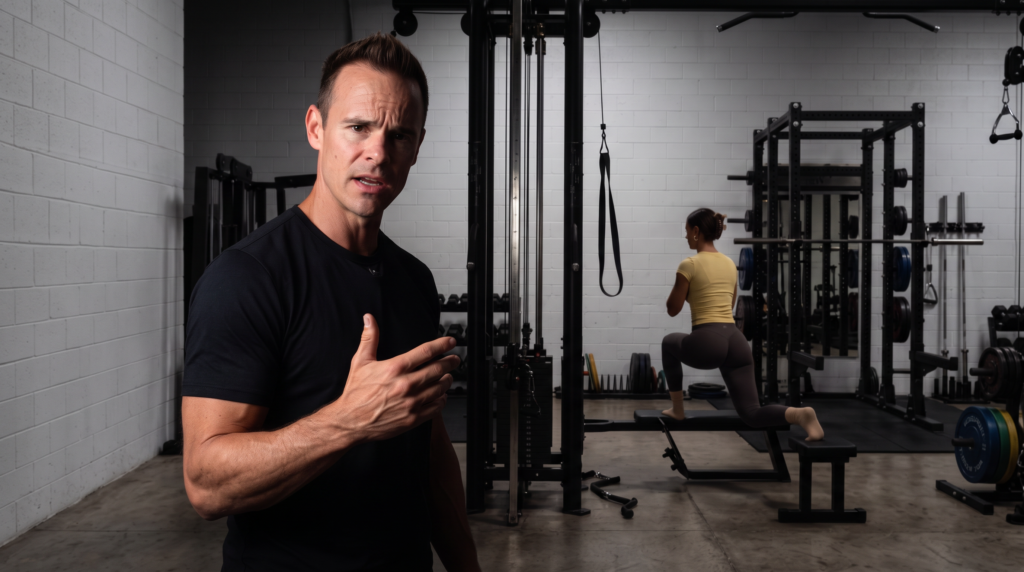
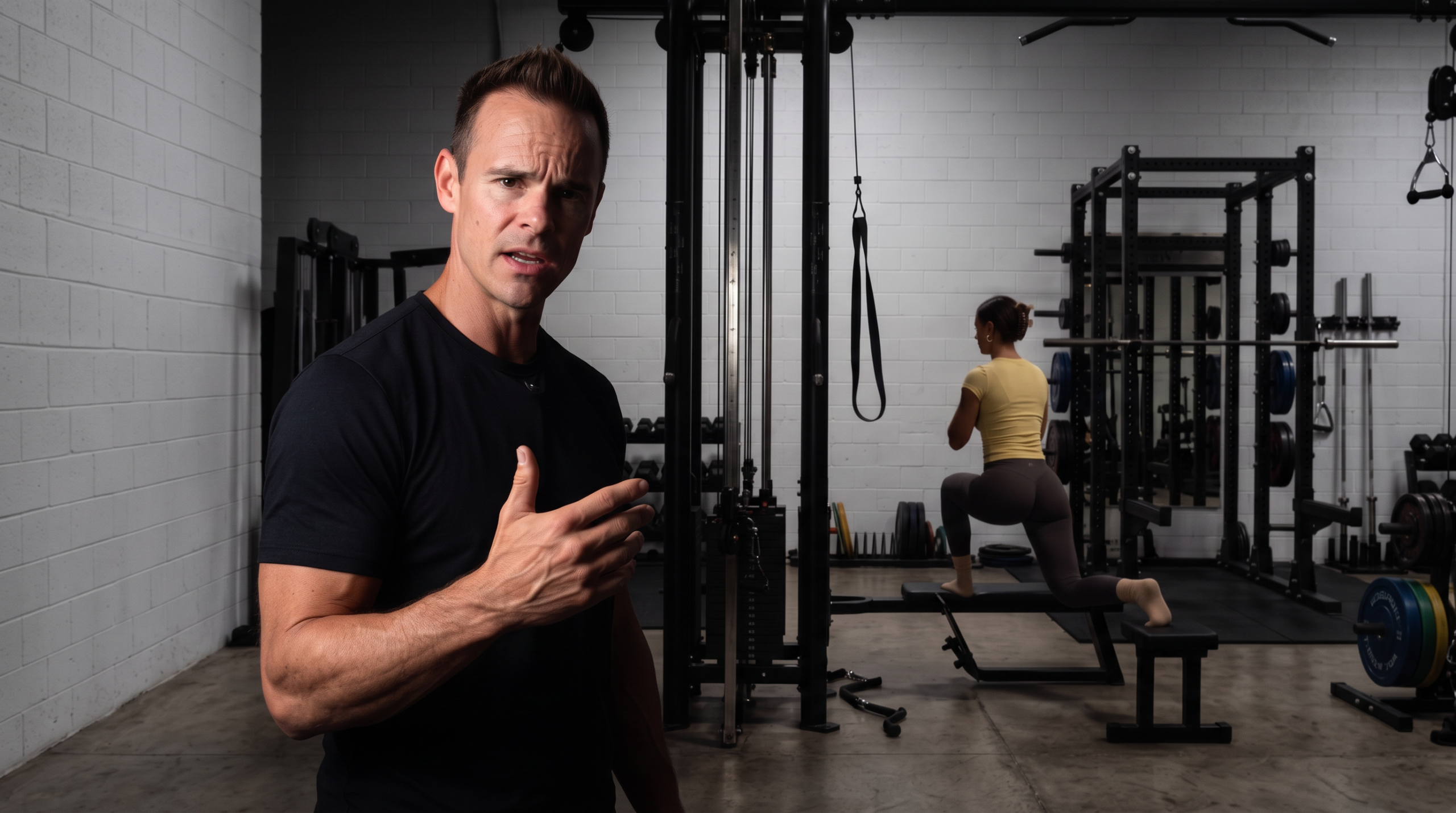
Demonstrating these principles in practice, Davidson examined the mechanics of a frontal-plane split squat with the front foot elevated on a Smith machine. When evaluating the movement from the side, the primary indicator of success is whether the working-side glute sits further back in space relative to the opposite side. To achieve this optimal pelvic positioning without awkwardly trying to force the pelvis through direct verbal cues, Davidson utilizes the body’s natural sensory feedback loops, specifically leveraging the hands and feet, which carry vastly more sensory information than the hips.
The technique begins with a simple upper-body reach. By extending the arm opposite the working leg forward and slightly toward the midline, the lifter naturally drives the ribs back, which in turn drags the pelvis into the correct alignment. This is paired with a secondary adjustment of turning the rear heel outward, causing the back leg to turn inward and further twisting the pelvis toward the working side. Although some lifters express concern over atypical knee positions, Davidson emphasizes that the split squat is intended to train the front leg, using the rear leg simply as a navigational rudder. This setup secures deep eccentric loading—what Davidson describes as the real heavy hitter for muscular growth—while keeping the body stacked along a unified axis from the head, nose, and sternum down through the belly button, zipper, knee, and big toe.
Moving from split squats to hinge patterns, Davidson analyzed the mechanics of a 45-degree back extension, noting that the primary objective is to actively tip the pelvis until the tailbone points toward the ceiling at the bottom of the movement. Because the glute muscle is structurally attached to the pelvis, maximizing stress requires the pelvis itself to move through a full range of motion until it reaches parallel during hinges. To facilitate this without letting the lower back or hamstrings take over the movement, specific setup adjustments are necessary. Bending the knees slightly effectively shortens the hamstrings, reducing their capacity to generate force and steal tension from the glutes. Furthermore, adjusting the hip pad and backrest angle ensures that the pelvis is not blocked from tipping, which otherwise forces lifters to bend solely from the lumbar spine rather than utilizing the hip joint.
Protecting the lower back during hinge movements also depends heavily on understanding the line of force, which Davidson defines as gravity pulling straight down through the mid-foot. Any load positioned behind the barbell absorbs stress, while anything in front escapes it, explaining his preference for a straight-arm barbell hold over alternative grips because it projects more of the spine ahead of the load.
To address isolation work, Davidson turned to bench-supported kickbacks, explaining that free-standing variations often fail because lifters lack a stable surface to brace against, resulting in the standing leg absorbing the primary stimulus. Much like a unsupported dumbbell row yields less weight and stimulation than a supported variation, proper kickbacks require the knee and hand to block directly opposite the leg’s path of motion. For abduction work, this involves turning the pelvis and opposite side extremities into internal rotation to properly challenge the targeted fibers. For straight gluteus maximus extension, the setup reverses with internal rotation on the working side and an emphasis on driving the heel downward. Davidson reiterates that the primary stimulus occurs at the front end of the movement where the force begins, rather than the trailing end of the repetition, giving lifters a precise mechanical framework to re-evaluate their entire lower-body training regimen.