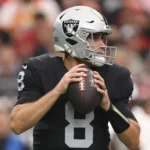

The trajectory of Los Angeles Chargers quarterback Justin Herbert offers a fascinating study in elite physical traits colliding with fluctuating offensive schemes, injuries, and shifting supporting casts. Since bursting onto the scene as the sixth overall pick in the 2020 NFL Draft, Herbert has experienced the dizzying heights of record-setting rookie production, top-tier fantasy finishes, and historic efficiency metrics, balanced against the frustrating realities of coaching changes, offensive lulls, and untimely injuries.
To understand where Herbert stands heading into the modern era under the leadership of head coach Jim Harbaugh and run-minded offensive coordinator Greg Roman, one must trace the arc of his professional career from his unexpected debut to the sophisticated, high-efficiency, yet lower-volume role he currently occupies.
The Record-Breaking Emergence and Early Years
It took an errant medical misfortune—specifically a pre-game team doctor’s injection that inadvertently punctured Tyrod Taylor’s lung just before Week 2 of the 2020 season—to thrust Herbert into the starting lineup. He seized the opportunity instantly, proving that he should have been the primary option from day one. Standing tall at 6-foot-6 and 236 pounds with plus athleticism and a 4.68-second speed in the 40-yard dash, Herbert immediately showcased the ideal physical profile of a modern NFL franchise quarterback.
During his stellar rookie campaign, he shattered numerous league records. He threw 31 touchdown passes—the most by any rookie in NFL history—and averaged 289.1 passing yards per game, becoming the youngest player ever to throw 30 touchdowns in a single season while joining elite company as just the fourth rookie to eclipse 4,000 passing yards. Although pre-draft scouts had questioned his touch on deep throws coming out of Oregon, Herbert quickly put those concerns to rest with a cannon arm that produced 10 touchdown passes on attempts traveling 20 yards or more downfield, tying for the league lead with eight completions of at least 50 yards. He also excelled under pressure, completing 54.9 percent of his passes in those situations, and chipped in five rushing touchdowns to boost his value.
That momentum carried seamlessly into his sophomore campaign under head coach Brandon Staley and offensive coordinator Joe Lombardi. Herbert became the only player in NFL history to throw 30-plus touchdown passes in each of his first two professional seasons, shattering franchise and league benchmarks for passing yards and 300-yard games in a player’s first two years. Finishing as the overall QB2 in fantasy football, he recorded at least 300 yards or three touchdown passes in 12 different games, finishing the year with 38 passing touchdowns and 5,014 passing yards. Supported by reliable weapons like Keenan Allen, Mike Williams, Austin Ekeler, and tight end Gerald Everett, alongside an improving offensive line anchored by first-round pick Zion Johnson and center Corey Linsley, Herbert looked ready to dominate the decade.
Injuries and Offensive Transitions
However, the subsequent seasons introduced turbulence. Herbert’s third year in 2022 was heavily compromised by injuries. Fractured rib cartilage suffered in Week 2 hampered him for multiple weeks, leading to a sluggish mid-season stretch where he threw seven interceptions across nine games while his average target depth dropped to a pedestrian 6.2 yards. Compounding matters, standout left tackle Rashawn Slater suffered a season-ending biceps tear in Week 3, and wide receivers Keenan Allen and Mike Williams struggled to stay on the field simultaneously, playing just four full games together.
While Herbert still managed to finish second in the NFL with 4,739 passing yards, it required a massive volume of 699 attempts. His touchdown passes dropped by 13 from the previous year, and his yards per attempt (YPA) plummeted to 6.8, prompting the organization to part ways with Joe Lombardi’s scheme and install Kellen Moore as offensive coordinator. Moore’s arrival promised a more balanced attack to help improve passing efficiency, even if it meant sacrificing some of the astronomical pass attempts Herbert had grown accustomed to.
Unfortunately, the injury bug struck again. Just as Herbert looked poised for a resurgence under Moore, fractured finger cartilage in his non-throwing shoulder and a subsequent finger injury on his throwing hand that required surgery cut his season short, forcing him to miss the final four games. Even when healthy, the numbers reflected a more conservative approach. Herbert posted an on-target percentage of 74.3 percent, but his average target depth sat at a middling 7.6 yards, and he completed just 32.2 percent of his deep attempts of 20 yards or more.
The Harbaugh and Roman Era: A Shift in Philosophy
Entering the Jim Harbaugh era, the Chargers underwent a dramatic roster and philosophical overhaul. Gone were foundational pieces like Austin Ekeler, Keenan Allen, and Mike Williams. In their place came a new offensive identity under coordinator Greg Roman, whose run-first philosophy drastically altered Herbert’s outlook.
Rather than leaning on the heavy passing volume that saw Herbert average 39.1 pass attempts per game over his first four years—a mark bested only by Tom Brady since 2020—the offense shifted its focus toward the backfield. The team added rookie first-round running back Omarion Hampton and offseason acquisition Najee Harris, signaling that the offense would run through the ground game.
Despite the shift in offensive philosophy, Herbert’s individual brilliance continued to flash when given the opportunity. Last season, Herbert avoided interceptions at a historic rate, throwing just three picks across 504 attempts for a minuscule 0.6 percent interception rate. In NFL history, the only quarterback with at least 500 attempts to post a lower interception percentage was Aaron Rodgers in 2018. Yet, that regular-season efficiency did not translate smoothly into the postseason, where Herbert threw four interceptions in a wild-card playoff loss.
Statistically, his 2024 campaign presented a paradox. Herbert ranked fifth in the league in on-target percentage at 77.0 percent, but finished just 18th in completion percentage at 65.9 percent. This discrepancy was heavily influenced by a pass-catching corps that recorded the fourth-highest drop rate in the NFL at 6.6 percent and struggled to haul in contested catches. Herbert finished as the QB11 in fantasy formats, though that overall finish masked extreme weekly volatility, including nine games with fewer than 15 fantasy points.
Positively, Herbert improved his downfield throwing metrics significantly. His yards per attempt rebounded to 7.7, ranking 11th in the league after consecutive seasons below 7.0. He pushed the ball downfield frequently, with deep throws accounting for 12.3 percent of his attempts—good for 10th in the NFL. He completed 40.3 percent of those deep tries, tying for the league lead in deep touchdown passes with a stellar 9-to-2 touchdown-to-interception ratio that trailed only Lamar Jackson.
Roster Adjustments and Outlook
To support Herbert moving forward, the Chargers have attempted to continually retool their supporting cast. Second-round draft pick Ladd McConkey paid immediate dividends with a strong campaign, emerging as a reliable weapon, while the front office added rookie second-round selection Tre Harris and welcomed back veteran Keenan Allen in an August reunion.
However, the roster faced severe adversity during training camp when standout left tackle Rashawn Slater suffered another devastating, season-ending injury. With a run-first coordinator calling plays and a depleted offensive line protecting him, Herbert faces an uphill battle to secure high-volume passing statistics. Even with elite arm talent and proven efficiency, the likelihood of a return to the Top 10 of fantasy quarterbacks remains a significant challenge in Roman’s scheme.
As Herbert continues to navigate coaching changes, shifting offensive philosophies, and the physical toll of an NFL career, his status as one of the league’s premier arms remains undisputed. Whether the Chargers’ evolving infrastructure can finally unlock his full, consistent ceiling is the question that will define the next chapter of his career.