

In a recent deep-dive video published on the popular RP Strength YouTube channel, exercise scientist and educator Dr. Mike turned his analytical eye toward the internet’s most gravity-defying feats of strength. Reviewing the training footage of strength athlete Quinn Stott, Dr. Mike found himself searching for superlatives, ultimately declaring that viewers were witnessing the capabilities of an immortal god.
Stott, who operates in the weight class of roughly 210 to 215 pounds, routinely executes lifts and athletic displays that appear less like human physical achievements and more like glitches in a video game simulation. From bench presses balanced precariously on his bare knuckles to a mind-boggling 500-pound loaded jump onto a raised platform, Stott’s training catalog challenges conventional understanding of biomechanics, physics, and human potential. According to all available evidence and expert analysis, every weight featured in his viral clips is entirely authentic, ruling out the presence of digital staging or artificial intelligence manipulation.
Yet, despite the jaw-dropping nature of these viral clips, one of Stott’s most incredible feats actually missed the absolute top spot in Dr. Mike’s informal ranking. Beyond the spectacle, however, the video ultimately pivots toward a surprisingly grounded and practical lesson regarding the true relationship between absolute strength, structural integrity, and overall human athleticism.
The Scariest Lifts, Ranked by Dr. Mike
A 440-Pound Bench Press on His Fists
Among the catalog of high-risk movements, Stott’s execution of a 200-kilogram (440-pound) bench press stands out for its sheer audacity. Rather than wrapping his palms around a standard barbell, Stott rests the heavy metal bar directly on top of his tightly clenched fists, leaving nothing other than the natural grooves and knuckles of his hands to prevent the massive load from rolling out of place.
Analyzing the technique, Dr. Mike noted the extreme psychological and physical demands required for such an attempt, remarking that the feat requires immense courage. Furthermore, Dr. Mike pointed out a hidden biomechanical detail often overlooked by casual viewers: the inherent instability of the position forces a lifter to inherently hold back, as applying excessive or uneven force would instantly send the barbell sliding off balance. Based on this limitation, Dr. Mike concluded that Stott’s true raw, traditional bench press capacity likely sits significantly higher than the 440 pounds demonstrated in the clip.
The Steinborn Squat and the 635-Pound Helicopter Squat
The review also highlighted old-school lifting traditions, featuring the Steinborn squat—a notoriously complex movement predating the invention of the modern power rack. In this traditional lift, an athlete tilts one end of a heavily loaded barbell upward from the floor, ducks underneath the shaft, and maneuvers it onto their back using body momentum and balance. While Dr. Mike jokingly threatened to retract his compliments when it appeared Stott utilized his hands to stabilize the bar during the setup, the subsequent footage quickly silenced any skepticism.
Stott followed up with a staggering 635-pound squat where the loaded barbell spun dynamically like helicopter blades throughout the descent and ascent. Stott achieved full depth, paused momentarily while the massive weight rotated on his back, and successfully drove himself back to a standing position before the physics of the shifting load could pull him off-center. Dr. Mike estimated that Stott’s conventional raw squat to proper depth comfortably exceeds 700 pounds, an extraordinary metric for an athlete weighing roughly 215 pounds.
The 500-Pound Jump
Perhaps the most physics-defying entry in the video was Stott’s execution of a weighted box jump. With 500 pounds loaded across his back, Stott successfully leaves the floor and lands securely on an elevated platform. Dr. Mike emphasized the staggering amount of explosive force required to achieve airborne status with half a thousand pounds of additional weight, as well as the immense hazards involved upon landing.
The ankles, knees, hips, and spinal column face catastrophic loading forces upon impact, and any slight miscalculation could result in the heavy barbell tumbling forward over the athlete’s head. Generating enough power to leave the ground under such conditions makes ordinary human movement look entirely immobile by comparison.
The 800-Pound Shirted Bench
Addressing the high-end spectrum of supported lifting, Dr. Mike evaluated Stott’s 800-pound bench press performed utilizing supportive equipment. Because specialized bench shirts artificially augment pressing numbers by storing elastic energy in the fabric, Dr. Mike applied a necessary asterisk to the feat, though he nonetheless classified the performance as elite. He noted that while Stott cannot replicate those specific numbers in a raw format, doing so would otherwise make him arguably the greatest raw bench presser in history by a massive margin.
Squatting on a Dumbbell
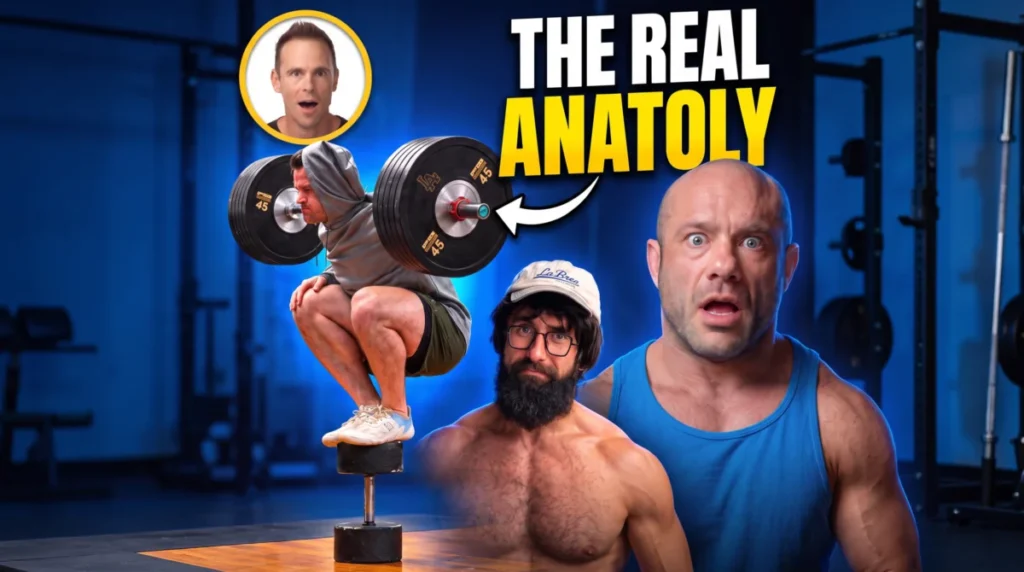
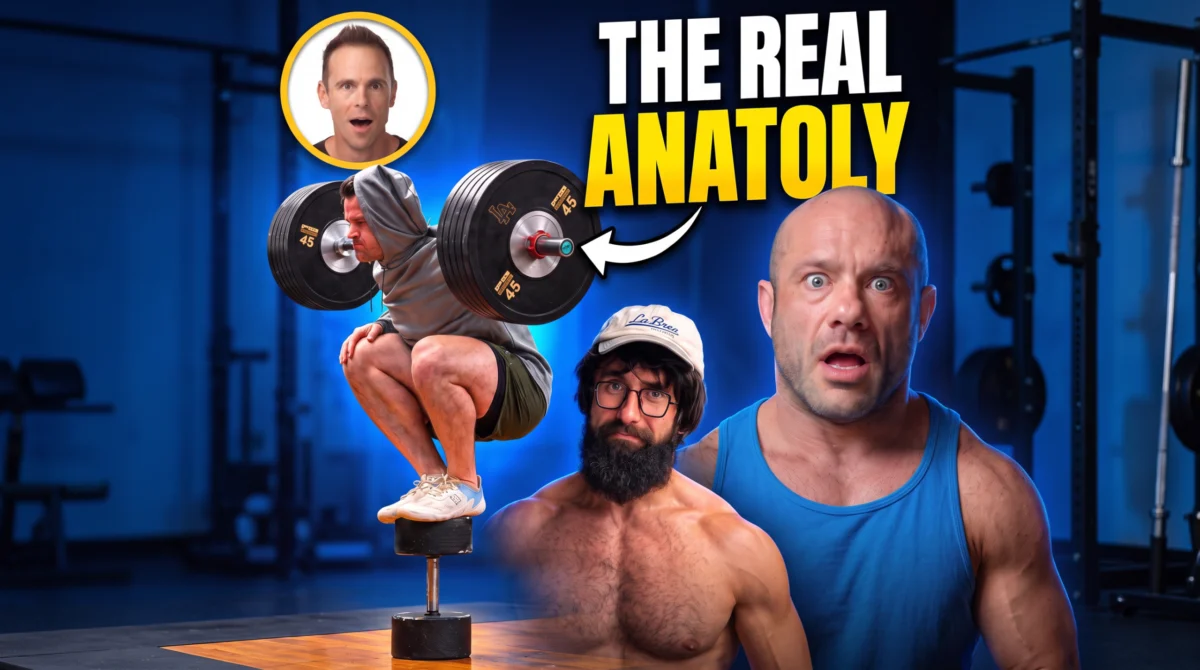
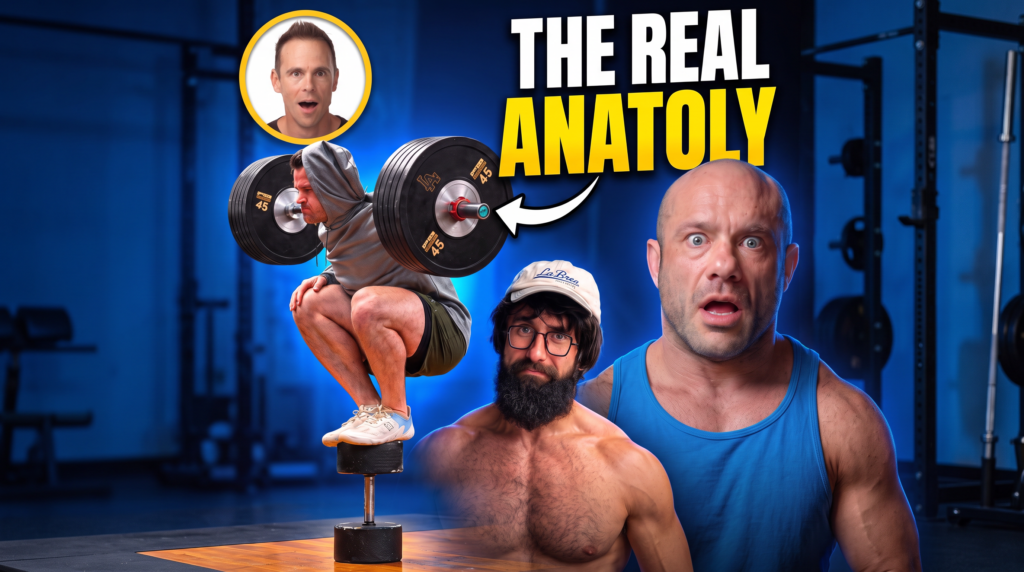
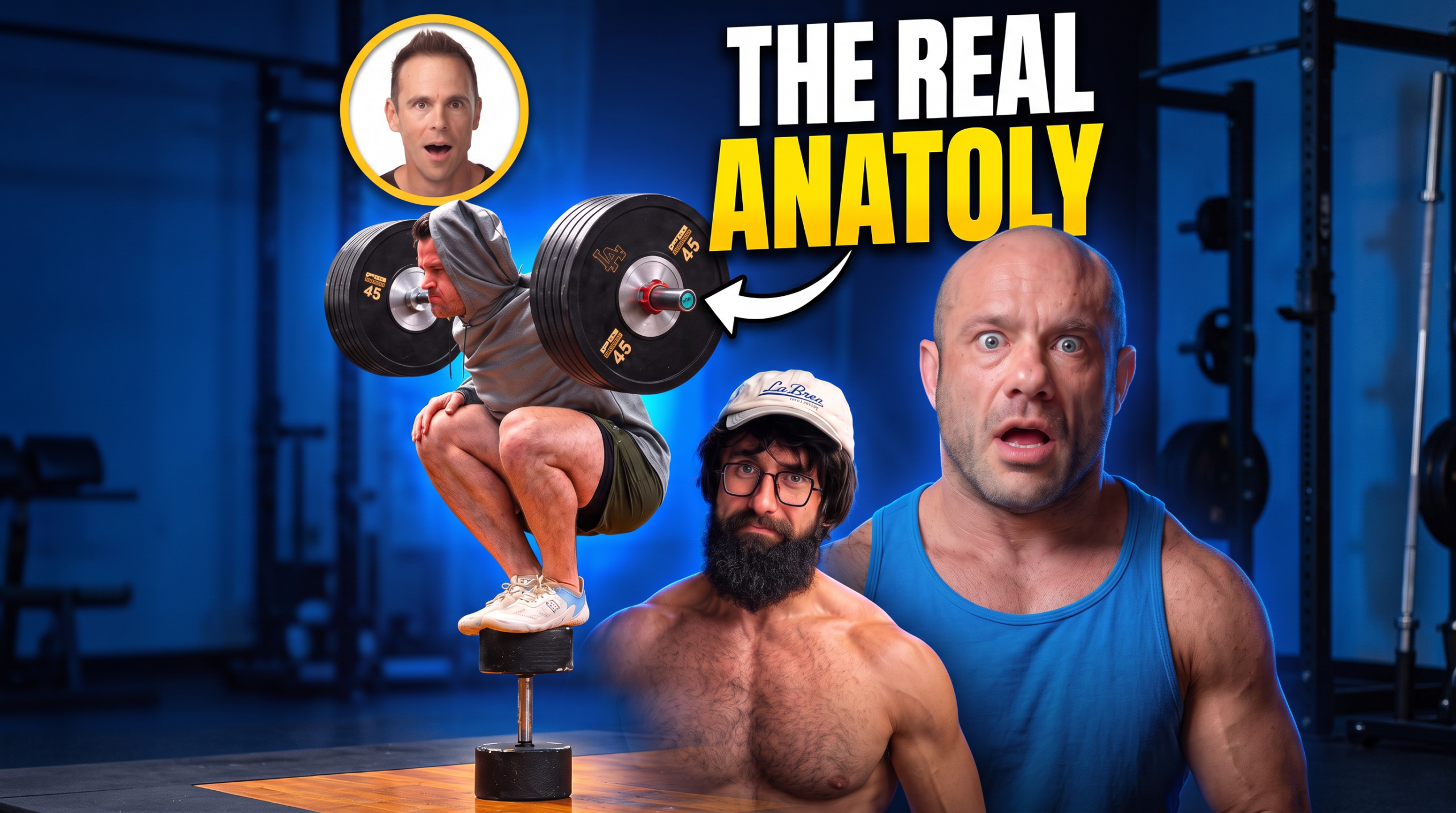
Pushing the boundaries of stability even further, another clip showed Stott standing atop a vertically oriented dumbbell with his heels nearly touching, a loaded barbell resting across his upper back, and proceeding to execute a deep squat. Having experience with narrow-stance squats in heavy ranges himself, Dr. Mike admitted that he would categorically refuse such a dangerous variation, stating that he would immediately question the sanity of anyone suggesting it.
Planks, Grip Feats, and Connective Tissue of Steel
Beyond traditional barbell movements, Stott’s repertoire includes isometric strength displays and specialized grip challenges that highlight unusual physiological adaptations. One such test involved a 408-pound plank where additional weight plates were actively loaded onto his body while he maintained his position.
Following the core endurance test, Stott demonstrated extraordinary grip and hand strength by crushing glassware and driving a bare finger directly through an apple. Dr. Mike observed that such feats transcend traditional muscular strength, pointing instead to rare, elite connective tissue integrity. Comparing it to his own experience closing an IronMind 2.5 gripper—a level of grip strength he estimates represents roughly one in a thousand men—Dr. Mike noted that even elite benchmarks appeared modest next to Stott’s displays.
A Deadlift Worth Copying
Among the more practical training demonstrations analyzed in the video, Stott performed a 555-pound snatch-grip deficit deadlift while gripping the specialized loops on the weight plates. Dr. Mike praised the exercise as a phenomenal movement for overall physical development. The combination of a wide grip and a standing deficit forces multiple muscle groups to work in unison under severe mechanical disadvantage. According to Dr. Mike, an athlete capable of performing this specific movement safely with heavy weight for multiple repetitions builds a level of resilience that protects the lower back against almost any conceivable injury scenario, provided grip strength does not become the primary limiting bottleneck.
Push-Ups on Quarters
In another display of localized tension and friction, Stott executed close-grip push-ups while balancing his weight on small stacks of quarter coins held together solely by hand pressure. While the physical mechanics of a push-up are standard, the execution required Stott’s hand squeeze to generate enough frictional force to outweigh his entire descending bodyweight. Dr. Mike likened the requirement to isometrically suspending the top of a fly trap utilizing the entire musculature of the body.
Does Lifting Heavy Make You Athletic?
Transitioning from specific stunts to broader physiological concepts, Dr. Mike examined the eternal debate surrounding the relationship between heavy resistance training and athletic performance. He defined true athleticism as the ability to translate a movement concept conceived in the mind into a physical action within a competitive sporting context, with overall success serving as the primary measurement.
According to this framework, three core ingredients dictate an individual’s athletic ceiling, while weak athletes are frequently held back simply by their own relative bodyweight limitations. Conversely, athletes who possess immense strength but lack explosive speed often encounter performance ceilings of a different nature. Dr. Mike explained that if raw strength happens to be an individual’s primary limiting factor, systematically increasing that strength will yield a massive corresponding boost in overall athleticism. This underlying physiological logic drives approximately ninety percent of modern athletic strength and conditioning programs.
Addressing the phenomenon of larger, exceptionally strong individuals who nonetheless move poorly, Dr. Mike attributed the discrepancy to genetic variations in speed and coordination, or a simple lack of targeted practice in those specific motor patterns. Proposing a simple diagnostic test, he suggested observing how an athlete’s functional athleticism degrades further if their strength levels are intentionally reduced. In Stott’s specific case, his raw sprint speed and agility are driven primarily by elite genetic traits and a high concentration of fast-twitch muscle fibers, while his exceptional strength serves to amplify those natural attributes.
What You Should Actually Do
While exotic strength stunts make for compelling internet content and showcase extraordinary human capabilities, Dr. Mike emphasized that foundational training methods deliver the vast majority of practical strength gains. Standard compound exercises performed for moderate sets of three to six repetitions, executed with maximum neurological intent to accelerate the weight upward on the concentric phase, remain the primary drivers of athletic development.
Ultimately, Dr. Mike concluded that the elaborate tricks showcased by athletes like Quinn Stott serve primarily as a means of expressing established strength rather than building it from scratch. For everyday fitness enthusiasts considering replicating such extreme displays for recreational purposes, Dr. Mike offered a characteristically pragmatic piece of advice: ensure the gym waiver is signed, understand the immense assumption of risk involved, and perhaps keep hands away from sharp objects. His final verdict on Stott remained succinct, describing the athlete not as an ordinary human, but rather as an unyielding machine and an immortal physical force.