

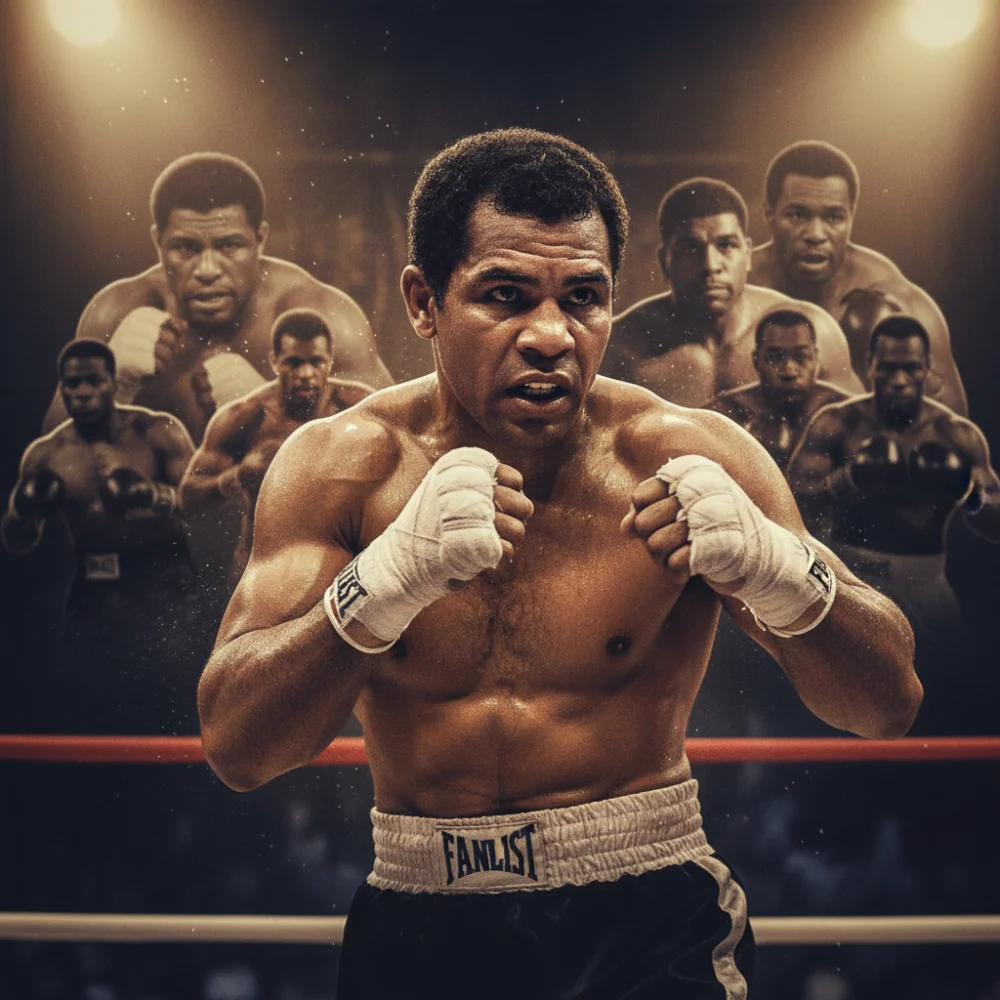
In the annals of boxing history, few names evoke a visceral sense of danger quite like Roberto Durán. Known universally as Manos de Piedra (Hands of Stone), the Panamanian legend was not merely a champion; he was a force of nature that transcended the traditional boundaries of weight classes. While most fighters lose their effectiveness as they climb the scales, Durán carried an aura of menace from lightweight all the way to super middleweight, spanning a professional career that lasted an incredible five decades.
To understand why Durán was so feared, one must first look at his origins. Born in the slums of El Chorrillo, Panama, Durán fought out of necessity before he fought for sport. This background instilled in him a primal hunger that never seemed to dissipate, even after he achieved wealth and fame. Inside the ring, he didn’t just want to win; he wanted to hurt his opponents. This psychological edge was palpable, often winning him fights before the opening bell even rang as opponents withered under his cold, shark-like stare.
The Greatest Lightweight of All Time
Durán’s initial reign of terror began in the lightweight division (135 lbs), where many historians consider him the greatest to ever lace up gloves. During the 1970s, he was virtually untouchable. He combined blinding speed with crushing power, decimating champions and contenders alike. His record during this period was a testament to his dominance, characterized by a relentless pressure that suffocated opponents, leaving them no room to breathe or think.
His victory over Ken Buchanan in 1972 to capture the WBA Lightweight title showcased his raw aggression. However, it was his subsequent title defenses that solidified his reputation. Durán didn’t just knock people out; he broke their wills. Fighters knew that stepping into the ring with the lightweight version of Durán meant signing up for physical trauma, making him one of the most avoided fighters of his generation.
More Than Just a Brawler
A common misconception about Durán is that he was simply a savage brawler who relied solely on power. This could not be further from the truth. Durán was a defensive genius and a master technician. He possessed an uncanny ability to slip punches by mere millimeters, rolling with shots to minimize their impact while staying in the pocket to deliver devastating counters. His head movement was subtle but effective, allowing him to stand toe-to-toe with larger men without absorbing unnecessary punishment.
His mastery of infighting is perhaps his most enduring technical legacy. While most boxers clinch when they get too close, Durán thrived in that space. He understood leverage, head placement, and how to create angles for short hooks and uppercuts that others couldn’t see coming. This technical brilliance allowed him to dismantle physically larger opponents who assumed they could bully him on the inside.
Conquering the Welterweights
The true test of Durán’s fear factor came when he moved up to welterweight (147 lbs) to challenge the golden boy of boxing, Sugar Ray Leonard. The “Brawl in Montreal” in 1980 remains one of the most significant fights in history. Despite giving up natural size and reach, Durán dragged Leonard into a street fight, utilizing psychological warfare to goad the American into trading blows. Durán’s victory in that bout proved that his power and skill translated perfectly to higher weights.
It wasn’t just that he beat Leonard; it was how he did it. He stripped Leonard of his boxing ego, forcing him to fight Durán’s fight. This ability to impose his will on a larger, faster, and technically superb opponent sent shockwaves through the boxing world. It signaled that Durán was not defined by his weight class, but by his ferocity and ring IQ.
The Destruction of Davey Moore
As Durán aged and moved up to Junior Middleweight (154 lbs), critics believed his time was up. He silenced them in brutal fashion against Davey Moore in 1983. Moore was younger, undefeated, and naturally bigger. Yet, on his 32nd birthday, Durán delivered a beatdown so severe that the fight had to be stopped. The image of Durán battering Moore with thudding right hands showcased that his “Hands of Stone” were still lethal against much larger men.
Standing Toe-to-Toe with Hagler
Perhaps the most impressive display of Durán’s fearlessness was his bout against Marvelous Marvin Hagler for the Middleweight championship. Hagler was a terrifying puncher who had destroyed the division. Durán, a natural lightweight, went 15 rounds with Hagler—the only man to do so during Hagler’s championship reign. While he lost a close decision, Durán proved he could absorb the firepower of a undisputed middleweight great and fire back, cementing his toughness in boxing lore.
The Miracle Against Iran Barkley
In 1989, at the age of 37, Durán achieved the impossible by challenging Iran Barkley for the WBC Middleweight title. Barkley had just knocked out Thomas Hearns, the only man to truly devastate Durán. The size difference was comical; Barkley looked like a giant next to Durán. Yet, in what was the Fight of the Year, Durán rolled back the years.
He utilized his veteran savvy, slipping Barkley’s bombs and countering with precision. In the 11th round, Durán landed a combination that dropped the giant Barkley, sealing a split decision victory. This fight encapsulates why he was feared: even as an “old man” giving up massive weight advantages, Durán possessed the skill and power to humble giants.
Key Elements of Durán’s Aura
To summarize why Roberto Durán was a nightmare across divisions, we must look at the synthesis of his attributes:
- Psychological Dominance: He made opponents feel like prey.
- Defensive Mastery: His ability to slip and roll allowed him to stay in range against longer fighters.
- Body Punching: He sapped the energy of larger opponents with relentless body attacks.
- Adaptability: He could box, brawl, or counter-punch depending on the opponent.
Ultimately, Roberto Durán was feared because he represented the chaotic, violent essence of prizefighting. He did not care about the scale; he only cared about the fight. His legacy is not just written in titles won in four weight classes, but in the respect and fear he commanded from the best fighters of his era, regardless of their size.