
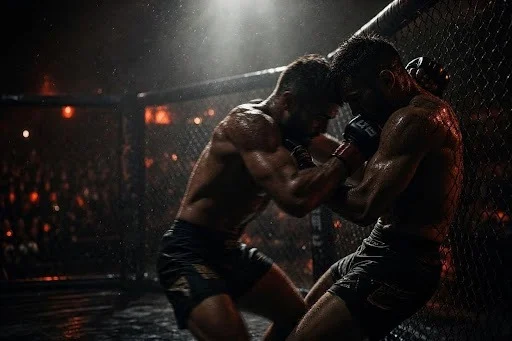
To the casual observer, mixed martial arts can sometimes appear to stall against the perimeter of the chain-link enclosure. Two fighters can appear entirely motionless, pressed chest-to-chest against the fence, while a complex, high-stakes tactical exchange shifts underneath them entirely out of plain view. A single wrist becomes trapped in a two-on-one grip, a head slips inside the shoulder line to compromise posture, or a defender manages to turn just one hip away at a precise angle to thwart a deep-running takedown attempt. These microscopic movements are the underlying currency of the sport. They help explain whether forward pressure is actively producing a damaging offensive sequence or simply keeping both elite athletes locked in place to burn clock.
In the modern era of sports entertainment, digital services compete aggressively for viewer attention throughout the duration of a fight card. From real-time live results feeds to dedicated betting-related platforms and portals, these supplementary applications have become a permanent fixture of the contemporary viewing experience. However, achieving a genuine understanding of a complex cage exchange requires keeping eyes fixed squarely on the athletes themselves. Access to an additional digital platform or rapid-fire data feed adds very little analytical value if the decisive grip change, the subtle shift in weight distribution, or the critical elbow frame happens while a viewer’s attention is momentarily diverted elsewhere.
The Positions That Decide Cage Exchanges
To properly decode these intricate grappling sequences, an analyst must begin with the fundamental deployment of the hands and arms. Securing an underhook places one fighter’s arm directly beneath the opponent’s armpit, establishing a powerful lever that helps influence the upper body and dictate posture. Pummelling, meanwhile, represents the relentless, often exhausting physical work of repeatedly swimming the arms inward to secure a more advantageous inside position.
Crucially, an underhook is merely an initial advantage to be actively developed rather than an automatic, guaranteed ticket to a successful takedown. An astute viewer must watch whether the offensive fighter successfully combines that underhook with proper structural posture, disciplined foot placement, and immediate control over the opponent’s opposite arm. Conversely, a savvy defender who manages to free a trapped wrist or aggressively insert a forearm frame can instantly disrupt that attacking combination, turning a dominant position into a neutral scramble.
Head position supplies yet another vital analytical clue during close-quarters fence battles. A fighter can actively leverage head placement directly against the opponent’s upper body, chin, or neck to compromise posture and severely limit comfortable movement. The most useful diagnostic question to ask in these moments is whose structural alignment is actually permitting the next progressive action, rather than simply judging whose forehead happens to look busier or more active to the naked eye.
Shifting attention downward to the hips and feet reveals the physical foundations of the struggle. A defender facing a deep shot or a heavy clinch may widen their base, drive their hips backward away from the attacker’s center of gravity, or pivot sharply so the offensive wrestler can no longer securely connect their hands around the body. A successful reversal fundamentally changes which fighter is being pinned against the fence, but the immediate follow-up action dictates whether that reversal actually translates into meaningful, scoring offense or merely buys temporary relief.
Control, Effective Offense, and Visible Progress
When evaluating how these positional battles translate into the broader context of a championship bout under the Unified Rules of Mixed Martial Arts, spectators and analysts alike must check the specific version of the rules adopted for the athletic commission overseeing the event. The Ultimate Fighting Championship consistently identifies the Unified Rules as its primary governing framework, and the Association of Boxing Commissions current judging guidance provides a strict hierarchy for scoring criteria.
According to this established framework, judges are instructed to prioritize effective striking and effective grappling above all else. Effective aggressiveness is only factored in when the first category is determined to be completely even, and fighting-area control is considered last, invoked only if both of the earlier categories cannot separate the competitors.

This rigid statutory hierarchy renders a simple stopwatch an incomplete and often misleading judging tool. Merely holding an opponent against the wire of the fence does not automatically outweigh clean, damaging legal strikes or effective, submission-oriented grappling executed elsewhere in the duration of the round. In the exact same vein, a takedown should be carefully assessed through the actual offensive threat, advancement, and structural impact it produces upon execution, rather than being treated as a fixed, arbitrary points award simply for changing elevation.
The championship-level clash between Ronda Rousey and Sara McMann at UFC 170 vividly illustrates the profound difference between mere cage location and genuine, impactful offense. Contemporary reporting from the promotion details McMann fiercely resisting Rousey’s initial takedown attempts while both athletes engaged in a ferocious exchange of close-range strikes right against the cage wall. Rousey then landed a devastating, perfectly placed knee to the body that immediately dropped McMann to the canvas, followed up with a rapid flurry of punches that prompted an immediate referee stoppage at the 1:06 mark of the opening round.
The instructive sequence in that bout centers on the defended takedown, the continuation of grinding clinch striking, and a final impact strike with a visibly devastating effect. Remaining upright and fighting off the initial shot had not entirely resolved McMann’s defensive responsibilities. This historic example demonstrates an undeniable attacking consequence, operating entirely on the reality of a definitive finish without requiring any retrospective speculation about how judges might have scored a protracted, unfinished round under later interpretive guidance.
A second compelling episode of cage control and rule enforcement materialized during the third round of the trilogy bout between Leon Edwards and Kamaru Usman at UFC 286. Official records from the event document a crucial point deduction assessed against Edwards by the referee for deliberately grabbing the safety fence with his fingers to prevent a clean takedown attempt by the challenger. The apparent defensive success displayed by the champion in that fleeting moment consequently included both an illegal mechanical action and a separate, formal scoring penalty.
When reviewing and analyzing that specific moment in isolation, an observer must watch the gripping hand just as closely as the explosive takedown entry itself. It serves as a stark reminder to sharply distinguish between legal positional defense—such as heavy hips and active framing—and physically halting a momentum-driven action by illegally clasping the structural mesh. A stopped takedown achieved through illegal means does not remotely tell the complete, honest story of the underlying athletic exchange.
What to Watch When the Action Looks Static
To break down a seemingly stagnant grappling battle, an analyst should follow one singular positional question right through to its logical conclusion. Does the hard-earned inside arm lead directly to a pivotal turn, a tight body lock, or a clean, unhindered strike? Or does the defender successfully execute an escape, complete a dramatic position reversal, or merely manage to postpone the inevitable next offensive attempt?
When betting markets form a part of the viewing experience for enthusiasts, it is important to remember that commercial operator margins inherently build a long-term mathematical advantage, meaning financial losses remain a very real possibility. Maintaining responsible boundaries requires setting strict, predefined spending and time limits, and aggressively avoiding the common psychological pitfall of chasing past losses.
Ultimately, the complex landscape of the MMA cage becomes significantly easier to read when an observer learns to track physical position, transitional movement, and ultimate impact all at once. Sustained pressure can certainly create a high-level opportunity, but that opportunity still demands an effective follow-up action to matter in the eyes of judges and competitors alike. Keeping a sharp focus on the placement of the hands, the rotation of the hips, and the initiation of the next tactical attack remains essential, even when the live broadcast picture appears deceptively still.