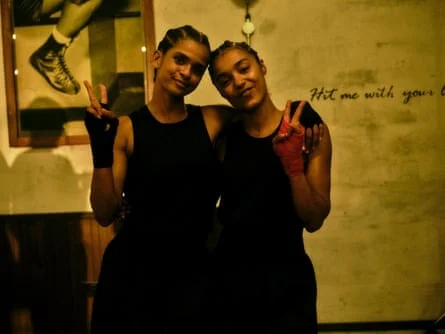
Ramla Ali sweeps into the green room of a West End cinema, tiny in a frothy dress with a huge skirt of cascading black feathers. It is an absolute showstopper. She has just introduced the premiere of a new film about her life, a project that has drawn text messages to her phone from high-profile figures such as Bear Grylls and Malala Yousafzai, both of whom sat in the audience watching the screening unfold.
Yet, amidst the glamour and the celebrity well-wishes, the person who matters most to Ali is her mother, who is watching the biographical feature for the fourth time. Asked what her mother thinks of the production, Ali replies quietly, "She loves it."
The film, titled In the Shadows, is directed by Anthony Wonke and stars Top Boy actor Jasmine Jobson. It chronicles Ali’s extraordinary, turbulent journey to the 2021 Olympics in Tokyo. And what a journey it has been.
Ali was born in Somalia. When she was still a baby, her older brother, Abdulkadir, was killed in an explosion while playing outside. In the wake of the tragedy, the family made the perilous decision to flee war-torn Somalia, undertaking a dangerous crossing by boat to Kenya before finally arriving in the United Kingdom as refugees.
Growing up in east London, Ali was bullied at school about her weight, prompting her to join a boxercise class at a local gym. When she eventually started boxing seriously, she kept it hidden from her family. As a Muslim girl, boxing was not considered an acceptable path. Furthermore, she knew that her mother had moved heaven and earth to get the family away from violence and would be utterly devastated to see her daughter willingly putting herself in harm’s way. Today, however, her mother is the very first person Ali calls after a fight.
The seed for the film was planted eight years ago. Ali’s husband, Richard Moore, who used to be her coach and now serves as an executive producer on the film, explains that one of the most pressing reasons for pitching the project back in 2018 was entirely practical: they were broke.
"We were down to our last hundred quid. We were lucky at that time, we had friends who took us in and housed us," Moore recalls. For a period, the couple lived in a home owned by actor Idris Elba and his wife, Sabrina. "They were our saviours. Then we got Covid and had to stay for ages," Ali giggles, reflecting on the challenging chapter of their lives.

Reflecting on the decision to bring her life story to the screen, Ali admits she had initial doubts. She nods when asked if she hesitated, noting, "Yes. I wasn’t sure I wanted to be so vulnerable, to sit down with a writer and tell her everything about my life, things I haven’t shared before." There was also the heavy burden of her family’s past trauma to consider. "I remember thinking, how is it going to affect my mum? It’s my story, but it’s her story as well. When I talked to my family, none of them were really up for it."
In the end, it was her mother who unexpectedly came around first. Her mother also proved to have strong opinions about the script itself. "My mum was adamant that the scene when my brother got killed be included. It had to be in," Ali says. Moore believes that insisting on the scene was a way of keeping Abdulkadir alive—"remembering him, and making his death mean something bigger."
Ali grows quiet for a moment before noting that Abdulkadir’s death set in motion a devastating sequence of events that permanently altered the trajectory of everyone in her family. "His death is the ripple effect," she says. "If my brother hadn’t died, we wouldn’t have come to the UK. I wouldn’t have taken up boxing. I wouldn’t have met Richard. My life would be so different."
While she notes that the film is not intended as a overt pro-immigration statement, it deliberately offers an alternative perspective to the prevailing fearmongering surrounding migrants arriving on boats and the rhetoric that they are stealing British jobs.
"It’s depicting a human migrant story," Ali explains. "Immigration has been weaponised politically to drive division in this country. Positive migrant stories don’t sell newspapers in the same way, so they rarely get told. But they are far more representative of the people who come here and build lives, families and careers. If audiences walk out seeing a person rather than a headline, the film has done its job."
Ali stands as living proof of a positive migration narrative. In 2015, she made history by becoming the first Muslim woman to win an English amateur boxing title. Six years later, she competed at the Tokyo Olympics as the first boxer ever to represent Somalia. Beyond the ring, she has built a diverse profile: she has modelled, appearing on the cover of a British Vogue issue guest-edited by the Duchess of Sussex; in 2018, she established the Sisters Club, a charity providing free boxing classes to vulnerable women; and she serves as a Unicef ambassador.
Far from being a passive subject, Ali worked intensely behind the scenes of In the Shadows, reading every draft of the script and remaining on set every single day of the shoot. "Some exec producers just write their names on the film. But I worked for that title. I earned it," she insists, noting that she even served as a body double during the boxing scenes.
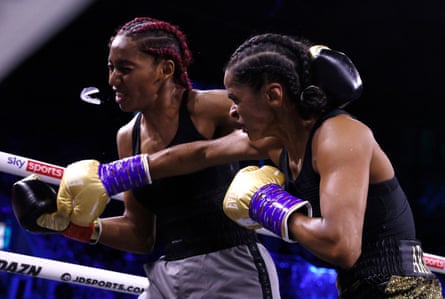
Looking ahead, Ali has begun contemplating life after boxing. She and Moore have already written and directed a comedy film together titled Not Like Us, and Ali has begun dipping her toes into acting.
"Boxing’s not for ever. There comes a day where you think: It’s time," she says. "Everyone laughs at me, but I keep saying it’s very similar to boxing. The dedication you’ve got to put into your boxing will show on the night in the ring. It’s the same with filmmaking. The level of dedication you’ve got to put in will show on screen."
As for the stories she hopes to tell in the future, Ali looks toward representation. "I feel like in America there are so many films made for Black people. I would love to be able to be in a position to tell more stories focused on the Black British experience."
That dedication to storytelling and performance is mirrored by Jasmine Jobson, the actor who portrays Ali in the feature film. Jobson, who took over the role after Letitia Wright was initially attached to the project, arrived at the BFI Southbank for an interview on a sunny afternoon accompanied by a full entourage consisting of a publicist, makeup artist, and hairdresser. "There’s not one part of my team that can be missing," she remarks while striding across the room in Louboutin heels.
Looking in remarkably fit shape, Jobson attributes her physique to physical therapy rather than ongoing boxing training. "Thank you. No. I haven’t continued boxing. I do need to get back into it," she says, explaining that she has been focusing on rehabilitation for an old shoulder injury sustained years ago at the gym when she was training to be a personal trainer. "I just pulled a bit too much weight down on a lat-pull."
Despite not keeping up with the sport, Jobson adapted quickly to the physical demands of the role. When asked if she found it easy to get into the swing of boxing, she responds, "Yeah. Straight in. When I was young, I did karate, kickboxing, things like that. But I only had two weeks to prepare for this job. Literally two weeks to become a champion." She spent eight hours a day training, adding, "I absolutely loved boxing. I just don’t like getting my face touched. No one’s allowed to get my face. This is my money maker."
Jobson shares that she fell in love with Ali the moment they met for coffee. "We had a nice little chat and got to know each other on a bit more of a deeper level. She’s overcome so much. To come out the other side, and to be an international success, to be able to change perceptions…" Jobson pauses before continuing, "Something might feel distant, or not necessarily accepted. But if you are passionate about it, and you are very good at it, if it’s your talent, go for it. You can be a success story no matter what your dream is. She’s a testament to that. Kudos to her, man."
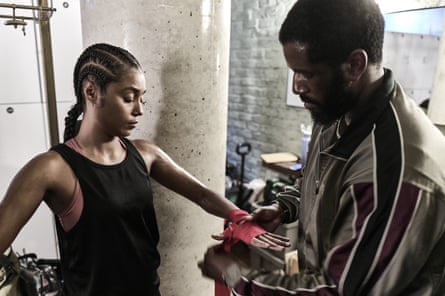
Asked if it felt intimidating to portray a living person, Jobson is unfazed. "No. Not all. Any role I’ve played, I’ve incorporated myself into it."
Like Ali, Jobson’s own background involved navigating early childhood adversity that makes her achievements all the more striking. While her parents initially encouraged her talent for performing, social services became involved with the family during her secondary school years. Jobson eventually moved out of her mother’s house to live with her grandmother before making the independent decision at age 14 to place herself in foster care.
"I had to do a very very deep dive within myself and take myself away from bad crowds, and figure out what my destiny was," Jobson reflects. "My brain got a little bit clouded, and I had to find Jasmine again."
A family friend eventually suggested she audition for The Big House, a north London theatre company working with care leavers, where she successfully secured an agent. Much like Ali, Jobson is a dedicated worker, going so far as to learn lines in Somali for In the Shadows. Reciting a phrase, she translates: "It means: I just want you to be proud of me. That’s all I’ve ever wanted—for my family and everybody to be proud of me."
Reflecting on how much of herself she invested into the character, Jobson concludes, "Oh, 100%. But at the same time, I had to make sure it was authentically Ramla." She acknowledges the parallels between their paths: "It’s not that we’ve had the same life experiences, but we both had struggles and we both had a dream."