To millions of sports fans around the globe, Mike Tyson remains one of the most iconic, electrifying, and feared heavyweights in the history of professional boxing. During the height of his powers in the late 1980s, Tyson was a force of nature unlike anything the sport had ever witnessed. Blessed with explosive, concussive power, blistering hand speed, and a terrifying psychological aura that often defeated opponents before they even stepped foot inside the squared circle, "Iron" Mike captured the imagination of the public. He shattered records by becoming the youngest heavyweight champion in boxing history at just 20 years old, eventually unifying the division and establishing a reign of dominance that seemed virtually unbreakable.
Yet, the trajectory of a combat sports career can change drastically over time, and few stories in boxing are as complex or melancholic as the final chapter of Tyson’s initial professional run. By the mid-2000s, years of well-documented personal turmoil, legal battles, financial distress, and intense public scrutiny had taken a severe and visible toll on the legendary champion. The aura of invincibility that once surrounded him had long since faded, replaced by the reality of an aging athlete trying to recapture the magic of his youth while facing the inevitable decline of his physical faculties.
In June 2005, a veteran Tyson stepped into the ring for what would famously mark the final professional bout of his career—setting aside, of course, his later exhibition comeback against internet personality-turned-boxer Jake Paul. His opponent that evening at the MCI Center in Washington, D.C., was Irish-American journeyman Kevin McBride. At the time, the matchup was viewed primarily as a showcase or a stepping stone for Tyson to work his way back into championship contention. While Tyson was visibly past his athletic prime, he still commanded massive global attention as a marquee name, whereas McBride was largely unknown to the broader mainstream sports public.
Examining McBride’s professional resume prior to the fight reveals a fighter who was far from elite. He carried no major marquee victories over top-tier contenders and had already accumulated several losses on his record. Throughout his career, McBride operated firmly in the tier of a durable, hard-working journeyman. Ultimately, he would retire from professional boxing in 2011 with a modest, unglamorous record of 35 wins, 10 losses, and 1 draw, having never fought for a major world title. However, boxing matches are rarely decided on paper alone, and on that particular summer night, McBride possessed critical advantages that would prove decisive: youth, immense physical size, and endurance.
As the opening bell sounded, the contest initially played out much the way traditionalists and Tyson loyalists expected. Tyson started the fight strong, demonstrating flashes of his trademark technique. He utilized aggressive head movement to slip punches and bullied McBride in the early rounds with heavy, powerful combinations. For a brief moment, it appeared that the former undisputed king might overwhelm the larger, slower opponent through sheer intimidation and offensive output.
However, as the fight wore deeper into the middle rounds, the stark reality of Tyson’s physical exhaustion became impossible to ignore. The former champion visibly faded, his breathing grew heavy, and the
explosive bursts that defined his early career were replaced by labored movements. As fatigue set in, Tyson’s discipline began to slip, leading to increasingly sloppy tactics inside the ring. In a desperate bid to survive the onslaught of fatigue, he leaned heavily on the much larger McBride to sap his energy and even attempted unorthodox and illegal measures, including trying to force a break in McBride’s arm during a clinch.
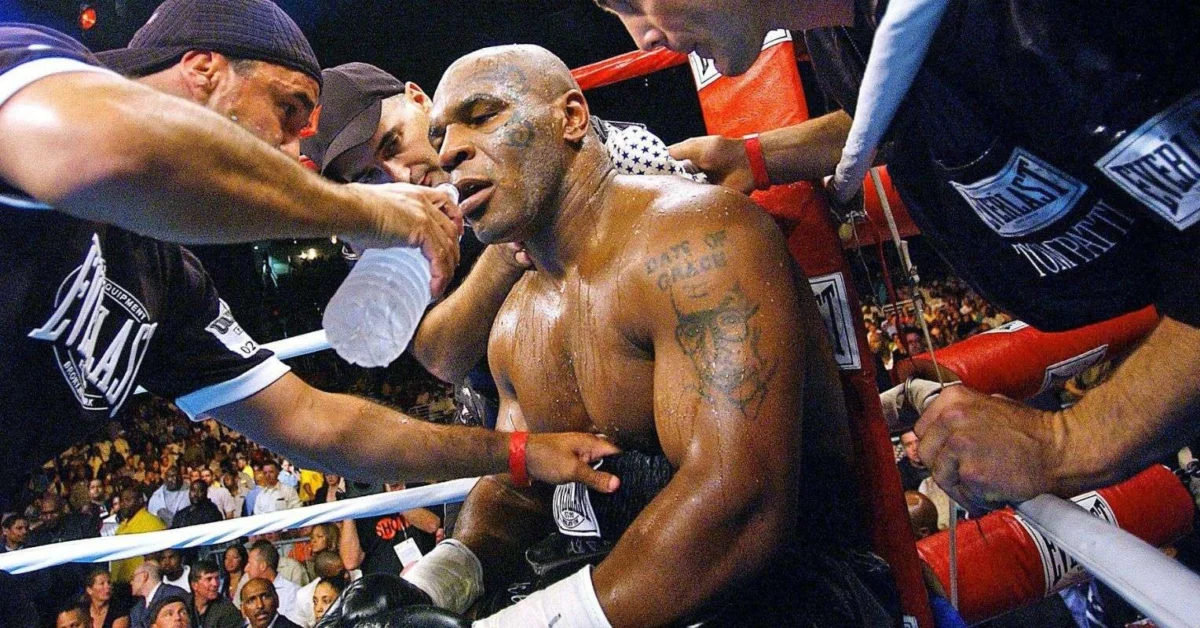
The turning point of the dramatic evening arrived at the conclusion of the sixth round. Rather than standing up to answer the bell for the seventh frame, Tyson sat heavily on his corner stool and informed his handlers that he refused to continue. The sudden stoppage stunned the arena and sent shockwaves through the global boxing community, abruptly signaling the end of an era for one of the sport’s most dominant figures.
In the immediate aftermath of the bout, standing in the center of the ring under the glaring television lights, Tyson offered a brutally honest and emotionally raw assessment of his performance. Stripped of the bravado that typically accompanied his pre-fight personas, he admitted plainly that he no longer possessed the competitive desire or the psychological drive required to compete at the professional level. He confessed that financial necessity, rather than competitive ambition, had been the primary motivating factor drawing him back into the ring.
Reflecting on his internal state, Tyson delivered an honest appraisal of his mindset during the post-fight interview.
"I got the ability to stay in shape, but I don’t got the fighting guts I don’t think anymore… I’m just sorry I let everyone down, I don’t have this in my heart anymore," Tyson stated candidly.
He went on to elaborate on the shifting priorities in his life, acknowledging that the fierce, destructive instincts that once made him the most dangerous man on the planet had been replaced by a different perspective centered on his family and personal well-being.
"I’m just fighting to take care of my bills basically, I don’t have the stomach for this anymore, I’m more conscious of my children and those guys, I’m looking at my opponents, I just don’t have that ferocity, I’m not an animal anymore," he shared.
With those sobering words, Mike Tyson walked away from active competition for nearly two decades, leaving behind a complicated, monumental legacy as a cautionary tale of athletic decline, personal redemption, and the ultimate realization of when it is time to lay down the gloves.