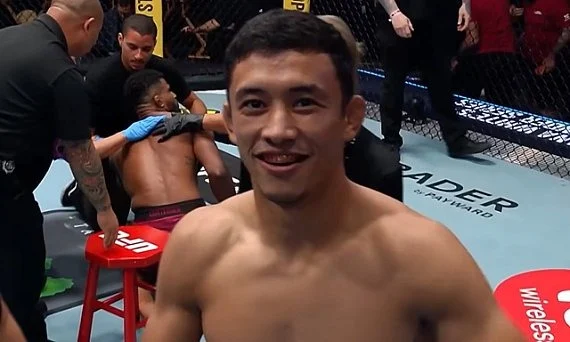

In the modern landscape of mixed martial arts, few athletes arrive on the sport’s biggest stage with a background as richly layered as Jean-Paul Lebosnoyani. Having recently broken through to capture the attention of the Ultimate Fighting Championship audience, the rising competitor has quickly demonstrated that his presence inside the Octagon is backed by both a lifelong immersion in combat disciplines and a colorful, highly contemporary personality. In a comprehensive reflection on his journey, Lebosnoyani revisited the formative moments that shaped his craft, most notably the eye-opening experience of sharing training mats with former two-division champion Conor McGregor while still just a teenager.
For any young fighter aspiring to reach the upper echelons of professional fighting, crossing paths with an athlete of McGregor’s stature is a defining benchmark. During his teenage years, Lebosnoyani found himself in an environment where he was able to test his burgeoning skills alongside the Irish superstar, observing firsthand the speed, precision, and commanding presence that turned McGregor into the most commercially successful fighter in the history of the sport. Looking back on those intense sessions, Lebosnoyani noted that sharing that space at such an early age demystified the aura of world-class competition. Rather than being intimidated by the magnitude of McGregor’s profile, the young martial artist absorbed vital lessons on timing, psychological fortitude, and the relentless commitment required to operate at the peak of combat athletics.
Those sessions with McGregor served as an early validation of Lebosnoyani’s potential, reinforcing his belief that his lifelong preparation had positioned him to compete with anyone. That early confidence has become increasingly evident as he makes an immediate splash in the UFC. Entering the premier mixed martial arts organization can often overwhelm newcomers, yet Lebosnoyani has transitioned into the promotion with an ease that suggests he has prepared for this platform since infancy. His comfort under the bright lights of the Octagon stems not from sudden fortune, but from decades of immersion in an environment where martial arts was not merely an extracurricular pursuit, but a foundational way of life.
Lebosnoyani’s lineage within the combat sports community traces directly back to the foundational eras of modern mixed martial arts. Long before the UFC evolved into a global entertainment giant, his father played a substantial and historic role behind the scenes of the sport’s genesis. Most notably, his father worked closely with UFC Hall of Famer Royce Gracie, preparing the Brazilian Jiu-Jitsu pioneer during an era when pure fighting styles collided inside the Octagon without weight classes or modern judging criteria. Growing up under the guidance of a patriarch who helped sharpen the techniques of the very man who proved the supremacy of ground fighting to the world provided Lebosnoyani with an almost unmatched pedigree. The principles of leverage, discipline, and strategic patience were passed down naturally, providing him with a martial arts education that began practically before he could walk.
This deep family devotion to the mats was not an individual undertaking. Martial arts formed the core of the entire household, a dynamic highlighted by his sister’s parallel journey through combat sports. Growing up alongside a sibling who was equally dedicated to the rigors of martial training created an atmosphere of mutual accountability, constant technical refinement, and shared passion. In detailing his sister’s martial arts background, Lebosnoyani underscored how having a training partner within his own home cultivated an environment where dialogue around technique, conditioning, and martial philosophy was perpetual. The collaborative family dynamic insulated him from the usual burnout associated with youth sports, grounding his competitive drive in familial support and shared accomplishment.

Despite carrying an old-school lineage that ties directly back to the earliest chapters of the UFC, Lebosnoyani represents a modern breed of fighter who completely embraces digital culture. He openly describes himself as chronically online, fully attuned to the rapid-fire ecosystem of internet humor, community memes, and social media trends that dominate contemporary fight discourse. In a sport where many athletes struggle to bridge the gap between their athletic output and public engagement, Lebosnoyani navigates the digital world with authenticity. His ability to reference popular combat sports memes and banter directly with fans reflects an athlete who was not only raised on the mats, but also raised within the digital communities that follow the sport. This duality makes him a distinct figure in the current UFC roster: an athlete who carries the heritage of the Gracie era while communicating fluently in the vernacular of modern social platforms.
This unique combination of heritage and charisma is encapsulated in his fighting moniker, "Mufasa." Derived from the iconic fictional lion king, the nickname carries profound symbolic weight for Lebosnoyani. Rather than adopting an aggressive or purely intimidating handle, the moniker speaks to concepts of regal authority, family legacy, leadership, and protection. For a fighter whose entire identity has been molded by the guidance of his father and the strength of his family unit, embracing a name that evokes the idea of a proud, legacy-driven patriarch reflects the standard he sets for himself. Inside the cage, it represents an assertive, calculated dominance; outside the cage, it mirrors his dedication to honoring the bloodline and knowledge passed down through generations of martial artists.
With momentum building rapidly around his early UFC appearances, Lebosnoyani has already turned his attention toward orchestrating the next phase of his career trajectory. Far from sitting back and waiting for assignments, he has taken a proactive stance in dictating his path by issuing a focused callout of UFC welterweight veteran Jake Matthews. The callout represents a deliberate and shrewd piece of matchmaking logic. Matthews, who himself entered the UFC at a remarkably young age as a teenage prospect, has spent roughly a decade developing into a seasoned, durable, and well-rounded test for anyone moving up the ranks.
Targeting an experienced campaigner like Matthews signals Lebosnoyani’s desire to prove that his rapid ascent is anchored by legitimate substance rather than temporary promotional novelty. A matchup against an established veteran provides the ideal platform to validate his grappling lineage, showcase his striking maturity, and determine whether his high-level pedigree can consistently solve the challenges posed by long-tenured Octagon regulars. For Lebosnoyani, calling for difficult tests is the natural continuation of an upbringing that saw him spar world champions in his youth and train under a family legacy deeply rooted in the history of the cage.
As he continues to build his standing in the promotion, Jean-Paul Lebosnoyani finds himself at the intersection of mixed martial arts tradition and modern entertainment. His ability to recount teenage sparring sessions with Conor McGregor highlights a past spent learning alongside the highest tier of talent, while his family connection to Royce Gracie anchors him in the sport’s deepest roots. Combined with an effortless command of modern online culture and an ambitious approach to matchmaking, Lebosnoyani is rapidly carving out a singular identity within the UFC, focused firmly on transforming early promise into lasting Octagon success.