

When it comes to dialing in a resistance training regimen, few things feel quite as satisfying as stepping up to a barbell loaded with heavy weighted plates. For many fitness enthusiasts, however, the prospect of balancing a completely free-hanging weight can feel deeply intimidating. Furthermore, various factors such as mobility restrictions, past injuries, or simply a lack of foundational lifting experience can present serious obstacles in the free-weight zone. Fortunately, building an elite physique does not exclusively rely on traditional barbells and dumbbells. Proof of this can be seen in the phenomenal, highly sculpted physique of fitness icon and IFBB Pro Anita Herbert, who has successfully incorporated the often-misunderstood Smith machine into her core training rotation to achieve extraordinary results.
The Hungarian fitness star, widely recognized as a transformative coach and the driving force behind the "Fit Queen Army," recently took to social media to share her secrets with her dedicated following of more than 150,000 users. Demonstrating that advanced muscle hypertrophy does not always require an arsenal of complex free-weight setups, Herbert outlined a targeted upper-body routine centered entirely around the Smith machine. In her recent Instagram post, she encouraged her followers to bookmark the routine for their next scheduled upper-body training day, offering a streamlined yet intensely effective approach to targeting the back and shoulders using just a single piece of gym equipment.
While machines are occasionally dismissed by purists in favor of free weights, experts and elite athletes alike recognize that the Smith machine remains an exceptionally powerful tool for achieving progressive overload. By providing a fixed track for the barbell, the apparatus allows lifters to focus entirely on muscular contraction and force output without needing to expend stabilizing energy on lateral balance. Herbert’s carefully curated session is stacked with challenging, high-intensity repetitions designed to place the body into a state of optimal hypertrophy, forcing physiological adaptations that help rebuild muscle fibers stronger and denser than before.
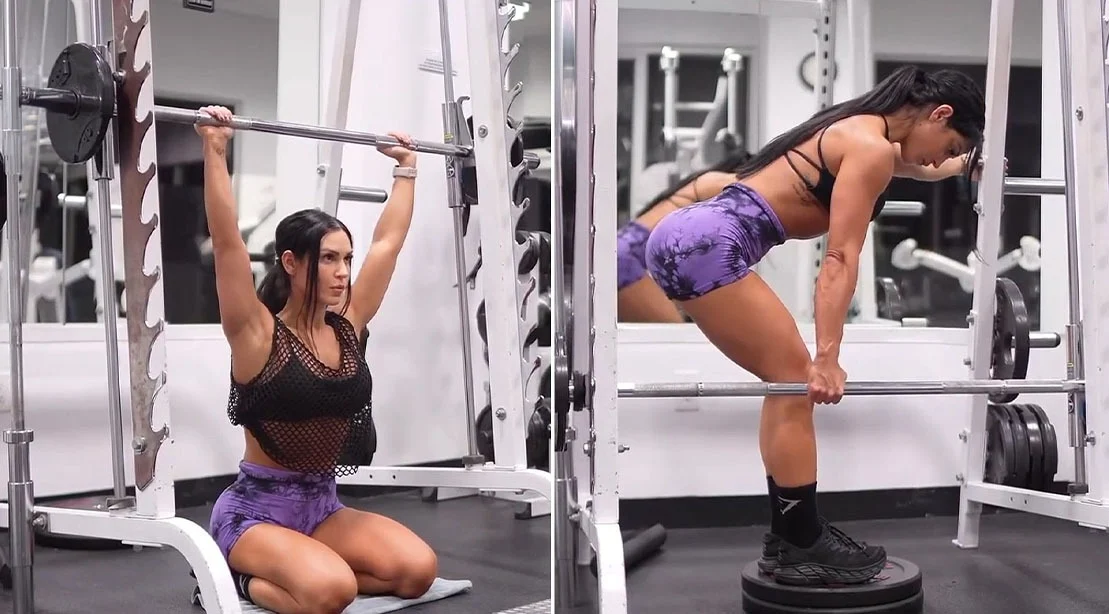
To maximize efficiency and intensity, Herbert structures her workout around a series of demanding supersets. In her first superset grouping, which she performs for three total rounds, the Fit Queen kicks off the movement sequence with the Smith machine shoulder press. This compound exercise primarily targets the anterior deltoids located at the front of the shoulders while simultaneously recruiting the upper back, triceps, and stabilizing core muscles. Immediately following the press, without taking a prolonged rest, she transitions to the inverted row utilizing a supinated, underhand grip. This second movement places heavy demands on the mid-back, lats, and rear deltoids, ensuring a comprehensive upper-body stimulus that covers both pushing and pulling mechanics.
Moving into the second superset block, which calls for two completed rounds, Herbert introduces a variation of the traditional pull-up that makes the movement accessible to athletes of varying fitness levels. By performing the movement from a seated position beneath the Smith machine bar, lifters can utilize their feet for additional stabilization and assistance as needed. Using a wide grip, Herbert emphasizes a deliberate, brief pause at the peak of the lift. This strategic hesitation significantly increases the time under tension for the working muscles, intensifying the contraction across the latissimus dorsi, rhomboids, and upper trapezius. She cautions trainees to remain mindful of their form during this phase, advising them to avoid shrugging the shoulders and instead concentrate on maintaining a smooth, controlled range of motion throughout.
This wide-grip seated pull-up is immediately paired with the single-arm shoulder press. This unilateral variation serves a dual purpose within the routine: it helps identify and correct any underlying muscular or strength imbalances between the left and right sides of the body while providing a secondary, concentrated burst of activation to the front deltoids.
The third and final superset sequence, performed for three rounds, shifts the primary focus back toward posterior chain development and upper body thickness. It begins with the single-arm Smith machine row, an exercise that hits the lats, traps, and rear deltoids while heavily engaging the deep muscles of the rotator cuff and the forearms. To execute this movement effectively, Herbert stresses the importance of keeping the core tightly braced, maintaining a strict focus on back engagement, and driving the elbows closely past the torso. The final movement of the routine is the upright row, a classic mass-builder utilized to sculpt prominent, well-defined shoulders. In addition to delivering intensive work to the lateral and anterior deltoids, the upright row engages the triceps and upper back while simultaneously challenging and improving overall grip strength.
Although the Smith machine is widely praised for its ability to stabilize loads and reduce the overall risk of acute injury, many lifters are frequently surprised to discover that the weight on a Smith machine can often feel deceptively heavier than an equivalent load on a standard free-weight barbell.
Elaborating on this phenomenon for her curious and deeply impressed followers in the comments section, Herbert shed light on the mechanical differences that influence how resistance is perceived. The movement can indeed feel heavier than free weights, she explained, particularly when performing upper-body exercises, primarily because Smith machines feature varying built-in bar weights, internal counterbalance systems, and distinct resistance profiles depending on the specific manufacturer. Furthermore, she noted that the fixed bar path fundamentally alters the neuromuscular feel of the exercise compared to the untethered trajectory of a traditional barbell.
For those looking to learn more about her training philosophies, nutrition advice, and ongoing fitness content, Anita Herbert remains active across her digital platforms, welcoming new members to join her growing fitness community online.