
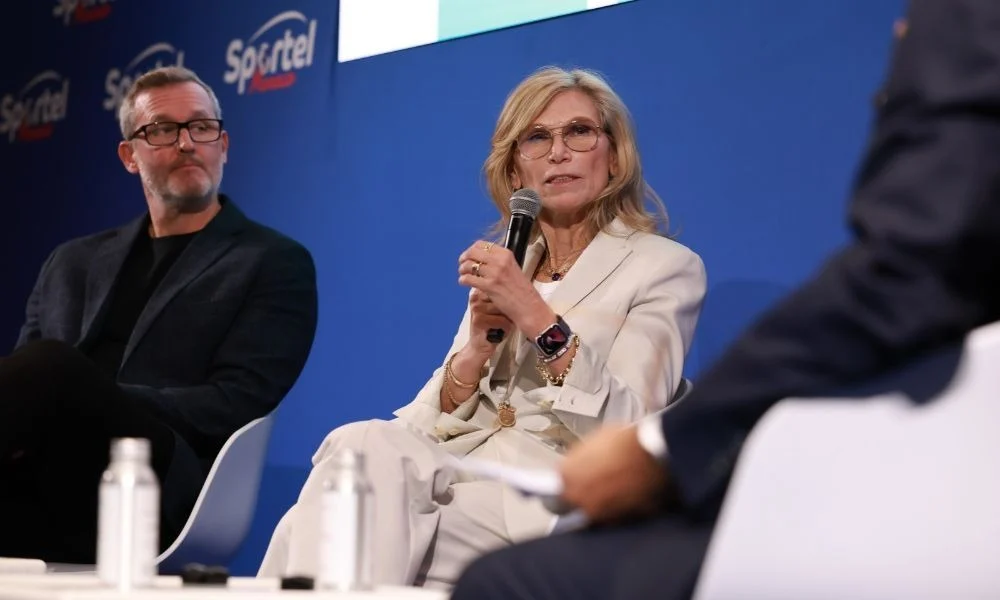
Now in its 36th edition, the annual Sportel conference in Monaco remains one of the foundational fixtures on the global sports business calendar. While it continues to serve as an indispensable forum for media rights negotiation and distribution, the event has increasingly transformed into a major showcase for cutting-edge sports technology, as well as a vital platform for both new and established properties to connect, collaborate, and share their latest strategic updates.
At this year’s gathering along the Mediterranean coast, attendees heard from a stellar lineup of industry leaders. LaLiga president Javier Tebas shared his candid perspectives on soccer governance and Manchester City, executives from Mediapro explained the strategic rationale behind their recent corporate rebranding, and representatives from The Overlap discussed their meteoric rise to become one of the most influential digital content platforms in modern soccer. Across three intensive days of panels, presentations, and networking, several distinct storylines emerged, highlighting the rapid evolution of the sports ecosystem. Among them, five major trends stood out as defining the current trajectory of the industry.
Premium Rights Keep Rising While the Middle Gets Squeezed
The changing dynamics and underlying economics of the global sports media market have been apparent for some time, but the polarization of the industry is accelerating. The proliferation of streaming services has allowed broadcasters to become much more data-oriented in how they evaluate and acquire rights. Consequently, media companies are increasingly prioritizing big-ticket properties that reliably drive customer acquisition and retention, while also benefiting from the massive live audiences necessary to deliver substantial advertising revenue.
This structural shift has heavily favored premier global properties such as the National Football League (NFL), the National Basketball Association (NBA), and English soccer’s Premier League. These powerhouse organizations have continued to secure significant, record-breaking increases in the financial value of their media rights deals. However, as these elite competitions command an ever-larger proportion of broadcasters’ overall sports rights budgets, competing properties are left scrambling for a much smaller piece of the remaining financial pie. This reality has resulted in stagnant or even contracting media revenues for a wide swath of sports organizations caught in the middle.
During the discussions at Sportel, multiple speakers emphasized that while media rights will continue to provide vital income for properties capable of commanding premium fees, organizations across the board must actively cultivate alternative sources of revenue moving forward to ensure long-term financial stability.
"I think properties are seeing that you cannot depend entirely on your media deal to drive your property," said Hillary Mandel, executive vice president and head of Americas rights at IMG. "The dollars are incredibly important, but the ecosystem that sits around that… you’ve got to own it yourself."
Jeff Roth, a founding partner at Bruin Capital, echoed these sentiments regarding the market pressures facing mid-tier properties. "I agree with the middle squeeze, and if you’re in that middle, it just becomes more important to focus on match day, sponsorship, streaming, kind of businesses that we invest in," Roth noted. "It’s even more important for the folks that cannot rely on doubling your media rights every seven years when you go to market."
Creators Are Now Partners, Not a Threat, as Sport Expands Beyond the Live Event
YouTube maintained a significant and highly visible presence in Monaco throughout the conference, sharing the stage with prominent organizations such as The Overlap, the International Olympic Committee (IOC), and LiveMode. The prevailing industry consensus across these sessions was clear: while live broadcast rights remain the foundational lifeblood of sports media, content creators and digital influencers are playing an increasingly crucial role in driving audience engagement and generating new revenue streams across the entire sector.
"Live is the most important thing. Live drives everything," explained Scott Melvin, chief executive of The Overlap. "Rights, whilst they are king, are becoming prohibitively expensive… Very few creators, if any, will ever be able to afford Premier League rights. So, the opportunity is owning… If you can’t own the rights, own the conversation, and be 24/7."
Pedro Pina, vice president of YouTube EMEA, agreed with this assessment, pointing to empirical data showing that roughly 80 per cent of all World Cup content viewership on YouTube actually takes place in the days and weeks between matches.
Fans love to know what happened in between matches, want to comment, and desire a continuous conversation mediated by their own chosen influencers and creators, Pina added. He warned that rights holders and traditional broadcasters who fail to embrace this cultural shift face a potential value leak as younger generations of viewers simply bypass official, legacy channels altogether.
"It’s not about creators. It’s about viewers… It’s very, very difficult and very unsustainable to force viewers to have a behavior that they don’t want to have," Pina said. "Water finds its way, and viewership is the same thing."

One prominent way rights holders are reacting to this insatiable demand for supplementary content—while simultaneously navigating stagnating traditional media rights values—is through non-exclusive partnerships with creator-led channels that serve highly targeted audiences.
The Overlap is a prime example, having recently been awarded Bundesliga soccer rights, while agency LiveMode is building upon the substantial success of sublicensing World Cup matches from ESPN in Brazil. LiveMode has expanded this model by streaming selected Premier League and Champions League fixtures for free on its YouTube channel in Portugal.
"When we started in Portugal, I think everyone in the industry was very concerned about our entry, with the mindset of a zero-sum game," explained Thiago Tourinho, a partner at LiveMode. "I think after the World Cup, everyone realized that it’s complementary, and we can add audiences… So after the World Cup, we did a deal with DAZN in which we have one match of the UEFA Champions League, one match of the Premier League every round. We are able to increase the revenue of DAZN and of us as well."
Tourinho emphasized that legacy broadcasters retain all their matches under such frameworks. "They have all the matches. They still have all the matches. Our match is not exclusive, so they also have it… So overall, we are increasing the revenue pool."
Could AI Be What Immersive Sport Has Been Missing?
Just half a decade ago, the metaverse was the dominant buzzword in technology and media circles, supercharged by Facebook’s multi-billion-dollar corporate rebrand to Meta and the fervent enthusiasm of cryptocurrency advocates who predicted a near future defined by a Web 3.0-enabled universe of transportable digital identities and virtual assets. Yet, despite immense financial and engineering resources committed to establishing a viable hardware ecosystem, constructing sprawling digital environments, and developing immersive software applications, that utopian vision has largely failed to achieve mainstream commercial fulfillment.
Nevertheless, proponents of immersive sporting experiences remain firmly convinced that a robust market exists for services capable of bringing fans closer to the action. Their optimism is now sustained by genuine technological leaps, including vastly improved local processing power, more socially acceptable and desirable consumer hardware such as smart glasses, and a steadily growing consumer appetite for augmented experiences.
The XR Sports Alliance—an industry collaborative body comprising hardware manufacturers, software developers, broadcasters, and rights holders—believes that artificial intelligence (AI) is the missing catalyst. AI is viewed as the key enabler behind a new wave of practical applications that will genuinely appeal to everyday consumers, whether they are engaging from the comfort of their living rooms or attending live events inside packed stadiums.
"For us, AI is really kind of one of the answers that we have for immersive technologies to succeed. It’s one of the reasons now," explained Jose Somolinos, a solutions strategist and XR lead at Accedo. "I’ve been 12 years working on these technologies, and every time I ask, ‘Would you like to have a headset?’ The answer is ‘No’."
Somolinos pointed to the evolution of user interfaces as a turning point. "The perfect user experience for that is going to be the new interface that we’re going to be using, because we are much more used to talking with Large Language Models with our natural voice, right? And the idea that when you will be able to wear these glasses, enter in an event, and have all the information about the map of all the different venues, and they guide you to go there… this is going to help you to enjoy the sport much better."
Industry partners share this bullish outlook on the hardware horizon. "We see the trends for AI glasses taking off," added Patrick Costello, senior director of business development at Qualcomm. "I think just in 2025 alone, Meta shipped over seven million devices… This is colliding now with the availability of agentic AI."
"At some point—we may not realise it now—we’re all going to have AI agents working in the background and available as interfaces on these devices," Costello noted. While the primary constraint for truly immersive, first-person sports viewing has historically been the high cost of specialized cameras, industry experts believe this hurdle, too, will be systematically dismantled by cheaper hardware components and advanced AI processing in the near future.
The Value of Tech in Pioneering New Formats
The ongoing struggle of athletics and track-and-field properties to maintain mainstream relevance and commercial visibility during the long periods between major global championships is well documented. A convoluted international schedule and the persistent difficulty in getting the sport’s biggest global stars to compete head-to-head on a regular basis have historically impacted public visibility and meaningful competition.

However, the enduring success of the Paris 2024 Olympic Games, combined with the emergence of a fresh wave of young, digitally-native athletes and the timeless appeal of witnessing superhuman athletic achievements, has provided a significant vote of confidence for the sport’s potential.
World Athletics’ latest strategic initiative to capitalize on this momentum is the Ultimate Championship, a high-stakes, season-ending invitational event restricted exclusively to reigning Olympic champions, world champions, Diamond League winners, and top-ranked global athletes, backed by a lucrative US$10 million prize fund. By design, this structure guaranteed an elite, high-quality field and imbued every race and competition with immediate significance for viewers.
Crucially, the primary priority for World Athletics was maximizing the commercial and engagement opportunities of the event. The organization achieved this by deploying sophisticated broadcast technology designed to enhance the visual spectacle across multiple platforms and actively help viewers comprehend the nuances of what they were watching in real time.
For the first time, World Athletics captured entirely new categories of performance data, launched a dedicated mobile app designed to deliver a genuine second-screen experience rather than merely mirroring the official website, and completely overhauled its on-screen graphics package. These innovations included advanced visual data representations, live win-probability predictions, and a centrally positioned on-screen clock rather than the traditional corner placement.
"The clock in the centre—that was designed to support vertical videos… which cut out the clock," explained Cristiano Coraglia, senior product and project manager at World Athletics. "If there’s a world record, you will not see the time. Having the clock always at the centre allows you to help people understand the performance."
Coraglia reported that the revamped format was an overwhelming operational success, marked by sold-out sessions, highly positive feedback from participating athletes, and robust early interest from international broadcasters looking to secure rights for the next edition scheduled in two years. By that time, World Athletics hopes to be even more adept at transforming raw biometric and positional data into compelling narrative insights—tools capable of converting casual viewers who tune in only once every four years into dedicated, year-round fans of the sport.
"Fans don’t want to see simply a record, a number. They want to understand the story behind it. So our challenge is: how do we surface those stories?" Coraglia added. "The avid user will be happy no matter what. But if we keep presenting data like we did ten years ago then we will have the core fans, that represent 0.01 per cent of the potential audience, and we will not engage with the new fans."
US Money Is Driving Growth
The escalating financial valuation of sports franchises across the globe has served as a consistent overarching theme at major industry gatherings throughout the year, and Sportel proved to be no exception. In North America, major sports leagues have increasingly approved minority investments from private equity firms, enabling franchise owners to successfully unlock equity. Combined with skyrocketing media rights values, this influx of institutional capital is exerting a profound impact on the domestic US market.
However, these financial dynamics are also compelling North American investors to cast their gaze across the Atlantic toward European sports teams—particularly traditional soccer clubs. Because the immense cost of acquiring majority stakes in major North American franchises makes majority ownership all but unattainable for most investors, Europe offers a more accessible entry point.
"The US leagues don’t allow private equity to own a majority… So it’s still very much a wealthy individual game in the US," observed Bruin Capital’s Jeff Roth. "Because they can’t own a majority in the US, you also then see a lot of US investors, particularly in NFL and Major League Baseball clubs, looking to own soccer teams on a majority basis… that trend, I think, will continue."
Highlighting this cross-border capital flow, Roth pointed out the strategic focus of his own firm: "80 per cent of the investments we made on the Bruin side have been in businesses outside of the US, even though we’re all located in the US."