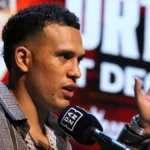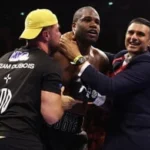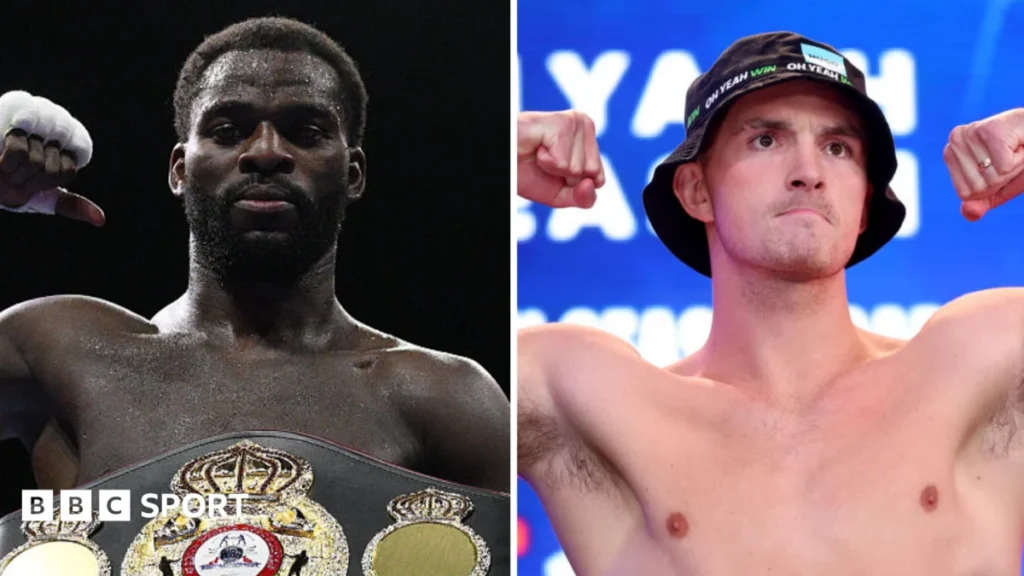
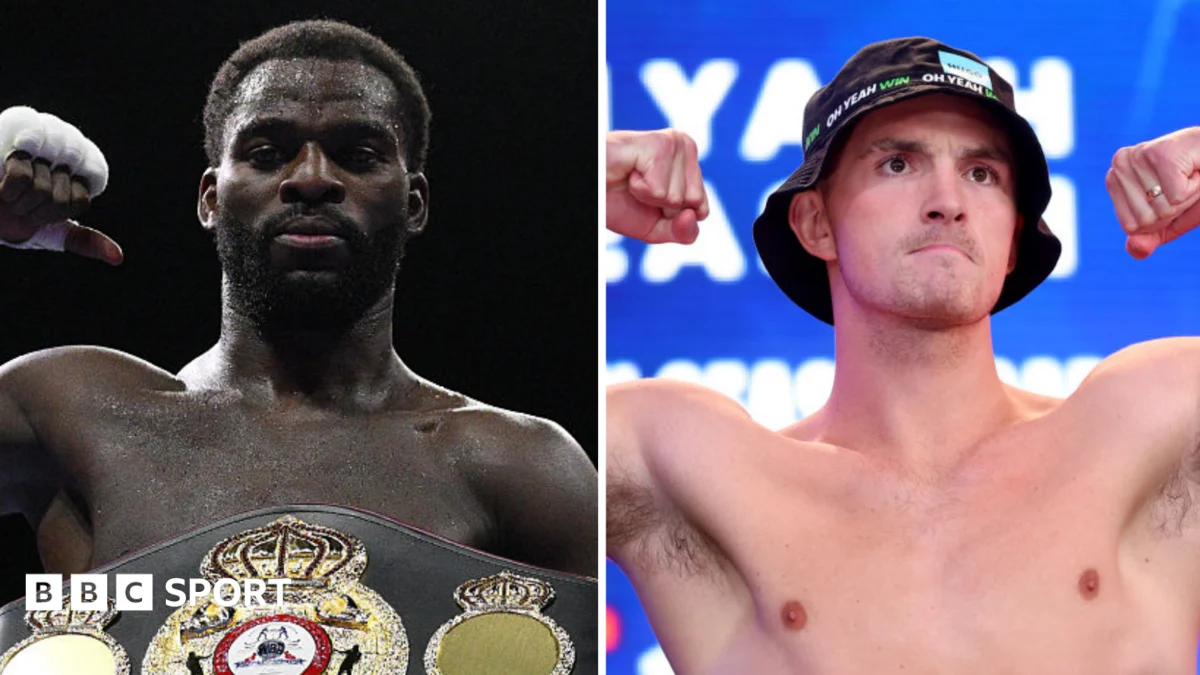
The landscape of contemporary British boxing reached a monumental crescendo at Wembley Stadium in September 2025, when Daniel Dubois delivered a stunning stoppage victory over Anthony Joshua to retain his IBF heavyweight title. While the dramatic heavyweight main event captured international headlines, the night was equally defined by a spectacular undercard that delivered high-octane drama from top to bottom. Chief among those supporting contests was a fiercely contested light-heavyweight clash between Joshua Buatsi and Willy Hutchinson, a bout that lived up to its intense build-up and set an exceptionally high bar for the rest of the evening at the national stadium.
From the opening bell, Buatsi and Hutchinson set the tone for what turned out to be a classic night of boxing. Neither fighter showed any willingness to cede territory, meeting directly in the center of the ring and refusing to take a single step backward. The early action was characterized by fast-paced exchanges and a high level of technical intensity, with both men attempting to dictate the tempo in front of tens of thousands of cheering fans beneath the Wembley arch.
Hutchinson started the bout strongly, displaying sharp footwork and crisp jab combinations that kept Buatsi at range during the opening frames. However, the dynamics of the fight underwent a drastic turn in the fifth round. During a close-quarters exchange, an accidental clash of heads resulted in a significant cut opening up on the side of Hutchinson’s right eye. The sudden injury altered the rhythm of the contest, as blood began to obstruct Hutchinson’s vision, forcing him to adapt under immediate pressure.
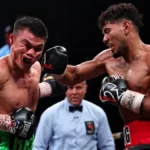
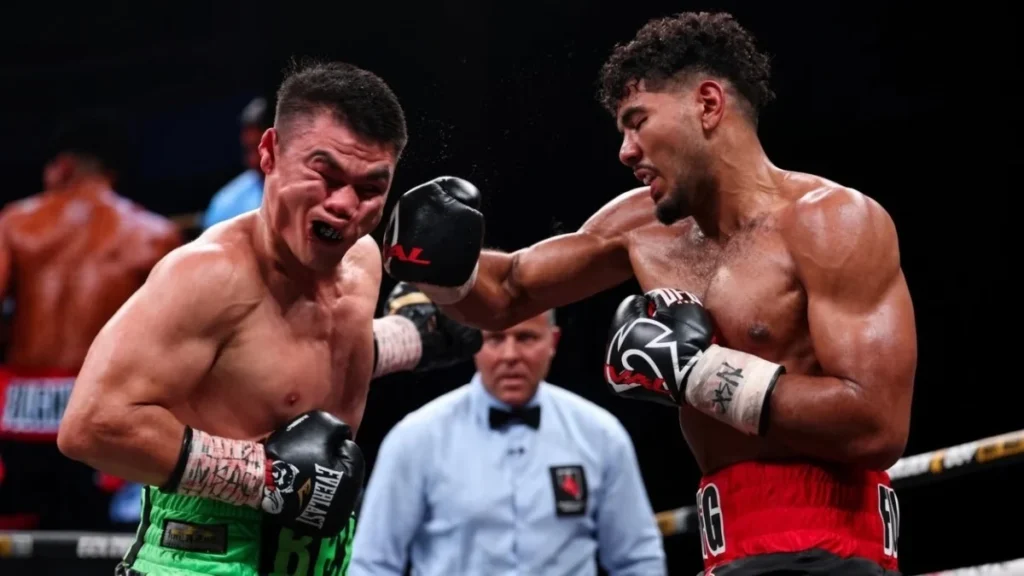
Buatsi swiftly capitalized on the shift in momentum during the sixth round. Pressing forward with increased aggression, Buatsi landed a clean, powerful right hand directly to the target, knocking Hutchinson to the canvas for the first knockdown of the fight. Hutchinson displayed notable resolve by beating the referee’s count, but his troubles continued to mount as the bout moved into the seventh round. As the physical intensity inside the ring boiled over into a gritty battle, the referee stepped in to deduct a point from Hutchinson for the improper use of his head.
Recognizing that he was trailing significantly on the official scorecards, Hutchinson elected to throw caution to the wind in the ninth round. Pushing forward aggressively in a bid to swing the fight back in his favor, Hutchinson opened himself up to dangerous counterattacks. Buatsi met his opponent’s advance with a devastating body shot that sent Hutchinson down to the canvas for the second time in the night.
Despite taking heavy damage to both head and body, Hutchinson showed extraordinary toughness. He once again pulled himself up from the canvas, beat the referee’s count, and managed to survive the relentless pressure from Buatsi to make it all the way to the final bell.
When the contest went to the official scorecards, the judges offered a divided perspective on the twelve rounds of action. One judge rendered a tight card of 113–112 in favor of Hutchinson, recognizing his early work and late bravery. However, the other two judges scored the bout decisively for Buatsi, handing down totals of 117–108 and 115–110 to ensure a clear victory for Buatsi.
The post-fight punch statistics provided a detailed picture of Buatsi’s efficiency and power throughout the grueling contest. Buatsi connected on 264 of the 600 total punches he threw across the twelve rounds, establishing a solid overall connection rate. His precision was particularly pronounced in power punches, where he landed 191 out of 380 attempts, meaning that over half of his power shots found their mark. Hutchinson posted a slightly lower overall output, connecting on 209 of his 566 total thrown punches, and finding the target with 157 of his 385 attempted power punches. While Hutchinson maintained a competitive output, Buatsi’s superior precision and explosive knockdowns proved decisive in securing the victory on the big stage.
The dramatic events at Wembley Stadium highlighted the high-stakes environment currently governing the upper divisions of British boxing, a dynamic that is equally evident in the cruiserweight weight class where former world champion Chris Billam-Smith and top contender Cheavon Clarke find their careers intriguingly intertwined.
The rivalry between Billam-Smith and Clarke traces its origin back nearly a decade to their time in the amateur circuit. The two fighters first shared a ring back in 2016, going head-to-head in the high-stakes final of the ABA Championships. On that occasion, it was Clarke who came out on top, claiming national amateur honors and setting the stage for a long career in the sport.
Following his victory over Billam-Smith in the amateur ranks, the Jamaican-born British fighter built an impressive international pedigree. Clarke earned a silver medal at the 2017 European Championships, representing his country with distinction before following up with a bronze medal capture at the 2018 Commonwealth Games. His amateur achievements culminated in his selection for Team GB at the Tokyo Olympics in 2021. Although Clarke did not take home an Olympic medal from Tokyo, his vast international experience prepared him for a seamless transition into professional boxing, which he launched in 2022 at the age of 35.
Upon turning professional, Clarke embarked on an impressive undefeated run, winning his first 10 contests in convincing fashion. Along the way, he demonstrated notable punching power by stopping seven of his opponents, an impressive streak that earned him the prestigious British cruiserweight championship.
However, Clarke’s rapid rise hit unexpected turbulence in 2024. He suffered the first loss of his professional career when he was defeated by Leonardo Mosquea. The setback was quickly followed by another blow in his subsequent outing, as Clarke lost his British cruiserweight title when he ended up on the wrong side of a judges’ decision against Viddal Riley.
Faced with consecutive setbacks, Clarke responded with determination to get his professional journey back on track. Back-to-back victories in his recent outings have breathed new life into his career, bringing his overall record to 12 wins and two defeats. Despite his recent resurgence, Clarke faces a steep path back to the top of the domestic division, particularly with seasoned competitors like Billam-Smith looming as stern benchmarks.
While Clarke worked his way up through the domestic ranks, Billam-Smith accumulated elite experience against world-class opposition. The 36-year-old Billam-Smith also holds two losses on his professional record—winning 22 of his 24 total contests—but he has consistently operated at a higher competitive level over recent years.
Billam-Smith built a formidable championship resume by conquering the regional scene, reigning as both European and Commonwealth champion before stepping up to the world stage. His crowning achievement came in 2023 when he produced a career-best performance to defeat Lawrence Okolie and capture the WBO cruiserweight world title.
As WBO champion, Billam-Smith recorded two successful title defenses. His second defense proved particularly meaningful, as he secured a victory over Richard Riakporhe—avenging the first loss of his professional career, which Riakporhe had handed him in 2019. Billam-Smith’s championship reign eventually came to an end in 2024 when he stepped into a high-stakes unification contest against Gilberto Ramirez, surrendering the WBO belt in a hard-fought defeat.
Refusing to let the loss to Ramirez derail his long-term career goals, Billam-Smith has successfully rebounded with back-to-back victories in his last two fights. With ambitions focused firmly on returning to world level and fighting for high-caliber titles once again, Billam-Smith remains one of the premier figures in the cruiserweight division, maintaining a path that continues to run parallel to competitors like Clarke as both men fight to maintain their standing among the sport’s elite.