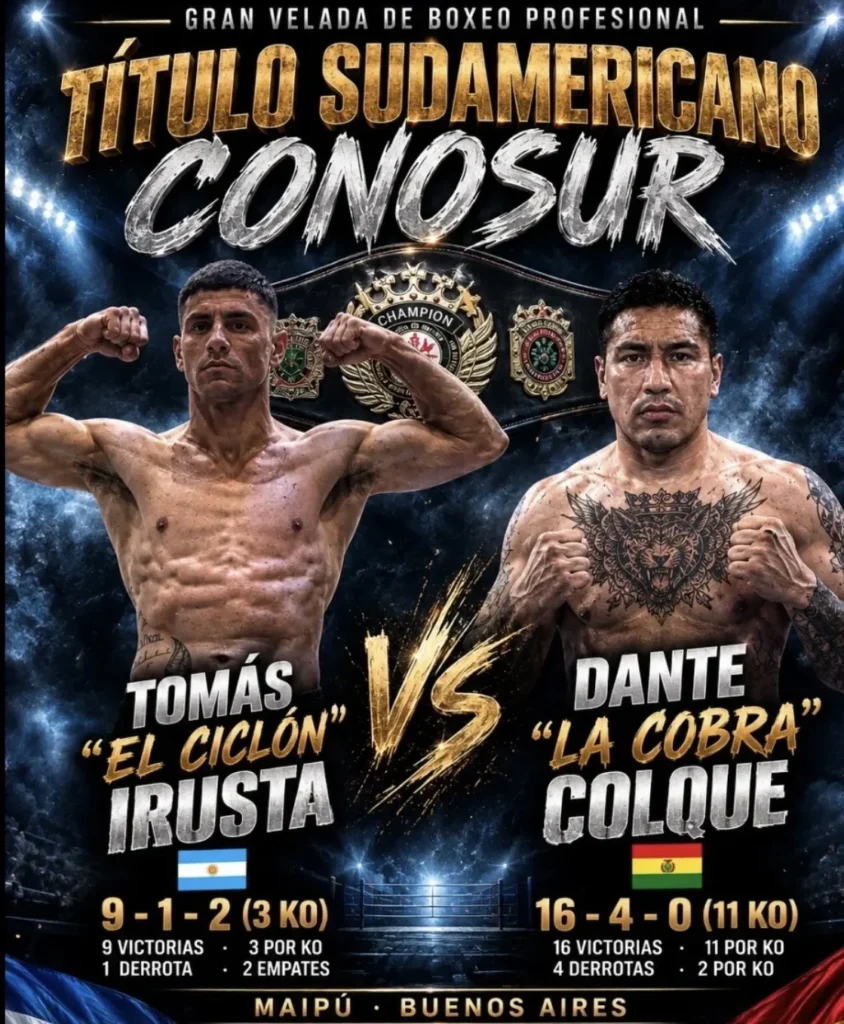

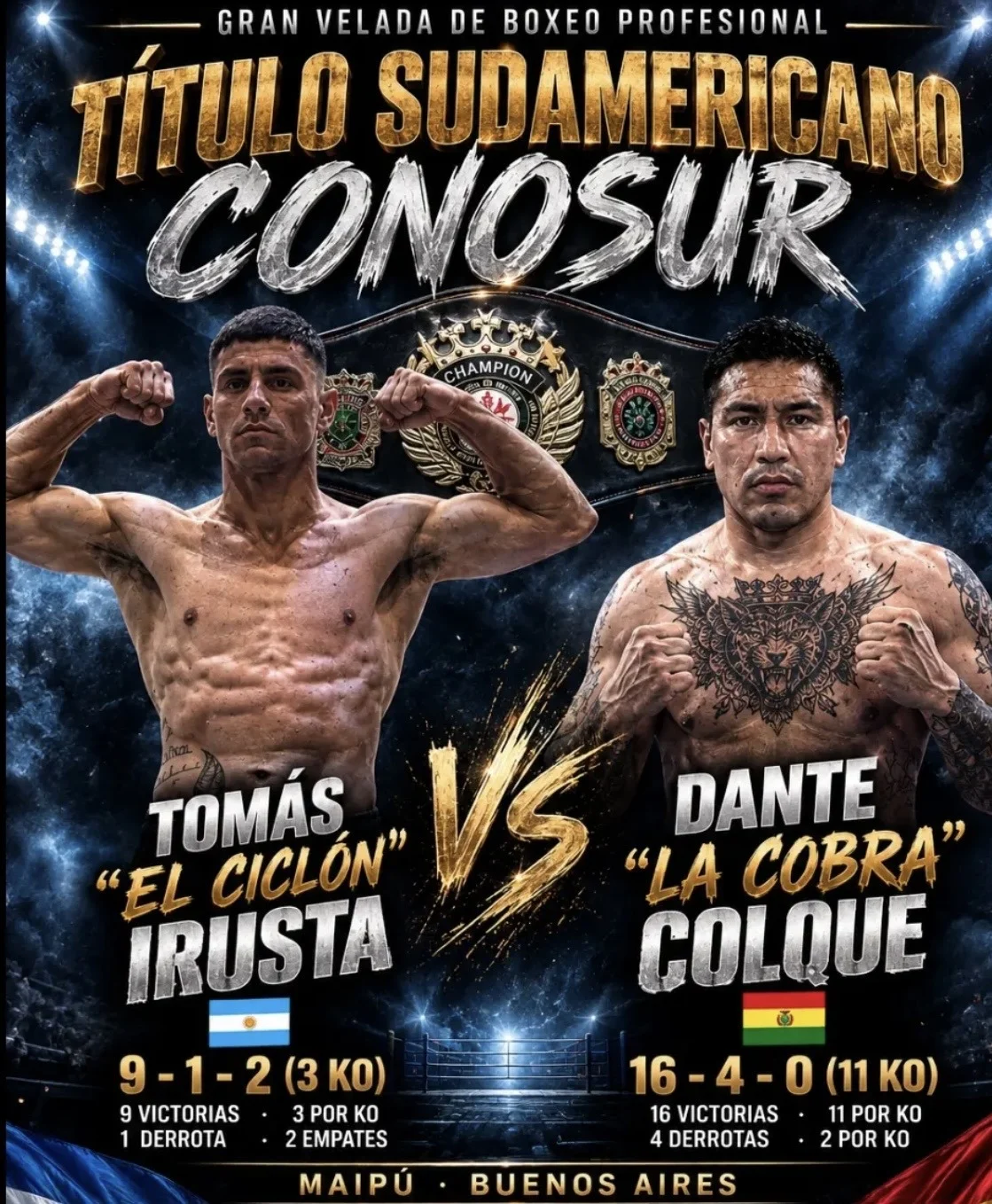
Super lightweight contenders Tomás Fermín Irusta and Dante Colque are set to square off in an action-packed regional championship showdown this Friday, October 16, at Club Jorge Newbery. The vacant World Boxing Association (WBA) Fedelatin Southern Cone super lightweight title will be on the line as both fighters step into the ring at the 140-pound limit. With a compelling contrast in boxing philosophies, tactical approaches, and fight temperaments, the clash presents a classic confrontation between a composed technician and an unrelenting pressure fighter, with significant regional career momentum hanging in the balance.
The scheduled contest marks a critical opportunity for both combatants as they compete for the vacant WBA Fedelatin Southern Cone crown. The 140-pound super lightweight weight class remains one of the most dynamic and competitive divisions in modern combat sports, demanding a blend of speed, stamina, power, and sharp tactical awareness. Competing under the banner of the World Boxing Association—the sport’s pioneering sanctioning body—the title match offers more than just a belt; it represents a major opportunity for the victor to solidify his standing within the organization’s regional infrastructure and potentially position himself for greater advancement on broader competitive stages.
Club Jorge Newbery will serve as the host venue for this high-stakes evening of professional boxing. Known for hosting compelling sports gatherings, the club provides an intimate and focused environment for a fight of this magnitude. The atmosphere inside the venue is expected to be charged with energy as fans gather to witness two skilled contenders with contrasting styles vie for control over 140 pounds of championship space. For both Irusta and Colque, navigating the surroundings and maintaining composure will be just as essential as executing their respective strategic game plans once the opening bell rings.
In one corner, Tomás Fermín Irusta enters the contest with a clear determination to capitalize on this championship platform and elevate his standing within the sanctioning body. Irusta has developed his profile around a composed, disciplined boxing style that prioritizes defensive stability, spatial awareness, and calculated offensive execution. Rather than engaging in reckless exchanges, Irusta routinely relies on solid fundamental mechanics, using his balance and posture to minimize defensive vulnerabilities while systematically looking to establish authority from the center of the canvas.
Central to Irusta’s tactical blueprint will be the consistent deployment of his jab. In professional boxing, the jab functions as both a primary weapon of distance management and an essential measuring stick for timing and range. For Irusta, establishing a steady rhythm behind the jab will allow him to dictate the tempo of the bout, keep Colque at the outer edge of punching distance, and prevent his opponent from settling into a comfortable offensive rhythm. By occupying the center of the ring, Irusta can force Colque to cover additional ground across the canvas, neutralizing forward momentum before close-range attacks can materialize.
Beyond his jab, Irusta’s success will heavily depend on fluid lateral movement and sharp combination punching. Recognizing that Colque will attempt to press forward with aggressive intent, Irusta must avoid remaining stationary along linear paths. By employing precise footwork, pivoting off angles, and constantly resetting the distance, Irusta can disrupt Colque’s forward advances and create vacant lanes for counter-attacks. When openings present themselves through the middle of his opponent’s guard, Irusta’s strategy centers on unleashing straight-punch combinations, exploiting any defensive lapses that occur as Colque works to force his way inside.
Directly opposing Irusta’s structured and technical methodology is Dante Colque, a fighter whose approach is defined by an aggressive temperament, high-volume pressure, and a proven appetite for hard, physical fights. Colque is not a boxer who contents himself with operating at a distance or engaging in prolonged perimeter boxing. Instead, his fighting identity relies on steady forward movement, physical harassment, and a willingness to engage in heavy exchanges to secure dominant positioning inside the ring. Colque seeks to impose his will early, attempting to make opponents uncomfortable through persistent presence and high work rate.
Colque’s strategic objective will focus on closing the distance as efficiently as possible, cutting off the ring, and compelling Irusta to trade punches in close quarters. To achieve this, Colque must effectively cut off avenues of escape rather than simply following Irusta around the canvas. Once inside, Colque excels at short-range combat, where long-limbed, technically sound boxers often struggle to find room to extend their punches clean. By crowding Irusta’s space and smothering his range, Colque aims to neutralize the technical advantages that Irusta brings into the match.
A cornerstone of Colque’s offensive arsenal is his relentless attack to the body, particularly his heavy hooks. Body punching is a proven tool for slowing down swift footwork and sapping stamina over the course of a long contest. Colque’s willingness to step into close quarters to land hooks to the ribs and midsection could play a decisive role in shaping the contest. If Colque can consistently connect to the body during inside exchanges, he may gradually diminish Irusta’s mobility, making it increasingly difficult for the tactical boxer to maintain lateral movement and stay off the ropes as the fight progresses.
The ultimate outcome of this championship bout will fundamentally depend on which fighter successfully enforces his preferred range and rhythm. This classic battle between a technical out-boxer and an aggressive inside-swarmer offers an intriguing strategic dynamic. Irusta seeks a clean, structured contest conducted at long range where timing, defensive fundamentals, and straight punching hold sway. Conversely, Colque seeks a rugged, continuous fight on the inside where physical strength, pressure, body hooks, and short-range exchanges dominate. The fight for control of the canvas in the opening rounds will offer early signals as to which strategic philosophy is gaining traction.
For Irusta to maintain control, tactical discipline will be paramount throughout the fight. Facing an aggressive pressure fighter demands constant focus, as a single lapse in distance control can allow a determined opponent to penetrate the guard and inflict heavy damage. Irusta must avoid being drawn into frantic exchanges, resisting any temptation to trade heavy blows at close quarters. If he remains patient, relies on fluid footwork, keeps his guard secure, and continuously works behind a stiff jab to disrupt Colque’s forward movement, the fight could gradually tilt in his favor as the rounds accumulate.
Conversely, the fight could shift dramatically if Colque manages to back Irusta toward the ropes or pin him in the corners. When a pressure fighter forces a movement-based opponent against the canvas boundaries, the tactical boxer loses the space required to circle out and maintain distance. If Colque succeeds in turning the contest into a toe-to-toe battle along the ropes, the outcome could become highly unpredictable and electrifying. In those confined spaces, Colque’s relentless aggression and hooks to the body can alter the pace, neutralizing technical polish with pure physical pressure.
As the championship bout approaches, endurance and adaptability will inevitably come into focus at Club Jorge Newbery. The 140-pound super lightweight division requires high work rates, and both athletes will need to manage their output effectively. For Irusta, the key challenge involves maintaining crisp footwork and sharp jab execution without tiring under constant pursuit. For Colque, the challenge lies in absorbing incoming straight punches while continuing to march forward without running out of energy or leaving himself vulnerable to precise counters through the center of his guard.
The vacant WBA Fedelatin Southern Cone super lightweight title represents a valuable achievement for both contenders, serving as a sign of accomplishment and a pathway toward higher standing in regional boxing. The recognition from the World Boxing Association provides the winner with enhanced visibility and prestige within the sport’s landscape. For the victor on Friday night, capturing this belt at 140 pounds will mark an important milestone in his career, validating his strategic approach and opening doors for future opportunities under the sanctioning body’s umbrella.
With Friday, October 16 approaching, anticipation continues to build for what promises to be a memorable evening of championship boxing at Club Jorge Newbery. Whether the night ultimately highlights Tomás Fermín Irusta’s composed, technical boxing from distance or Dante Colque’s relentless, high-pressure attacks on the inside, fans can expect an engaging contest for the vacant WBA Fedelatin Southern Cone super lightweight title, with both fighters possessing clear, contrasting paths to victory.