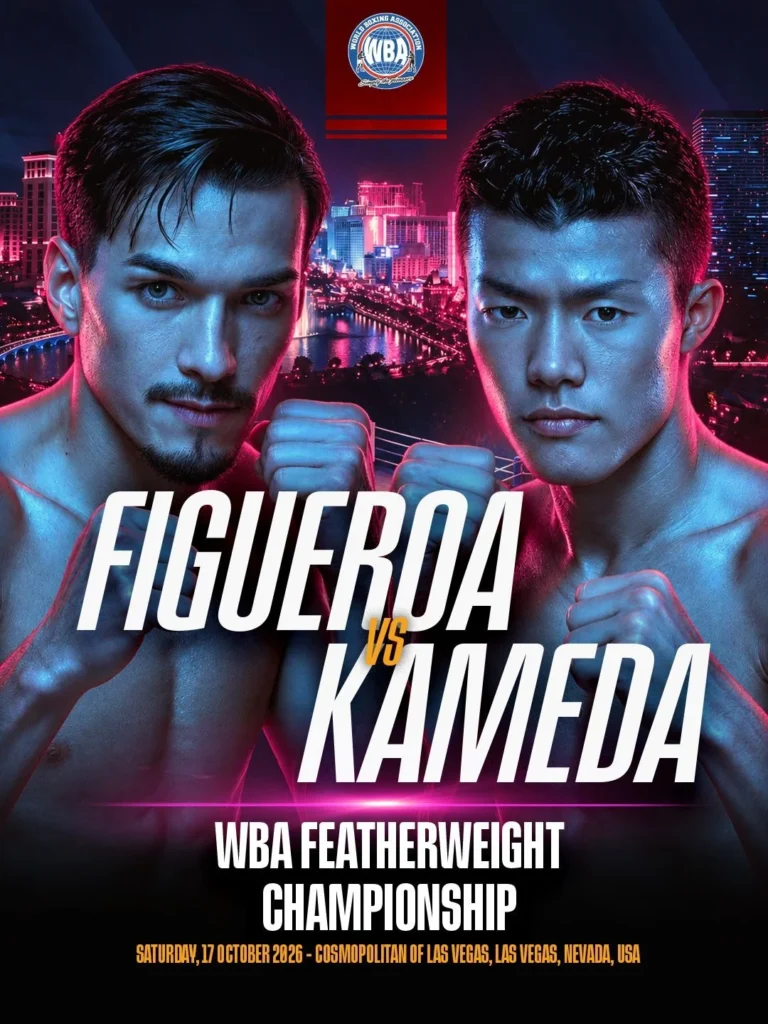
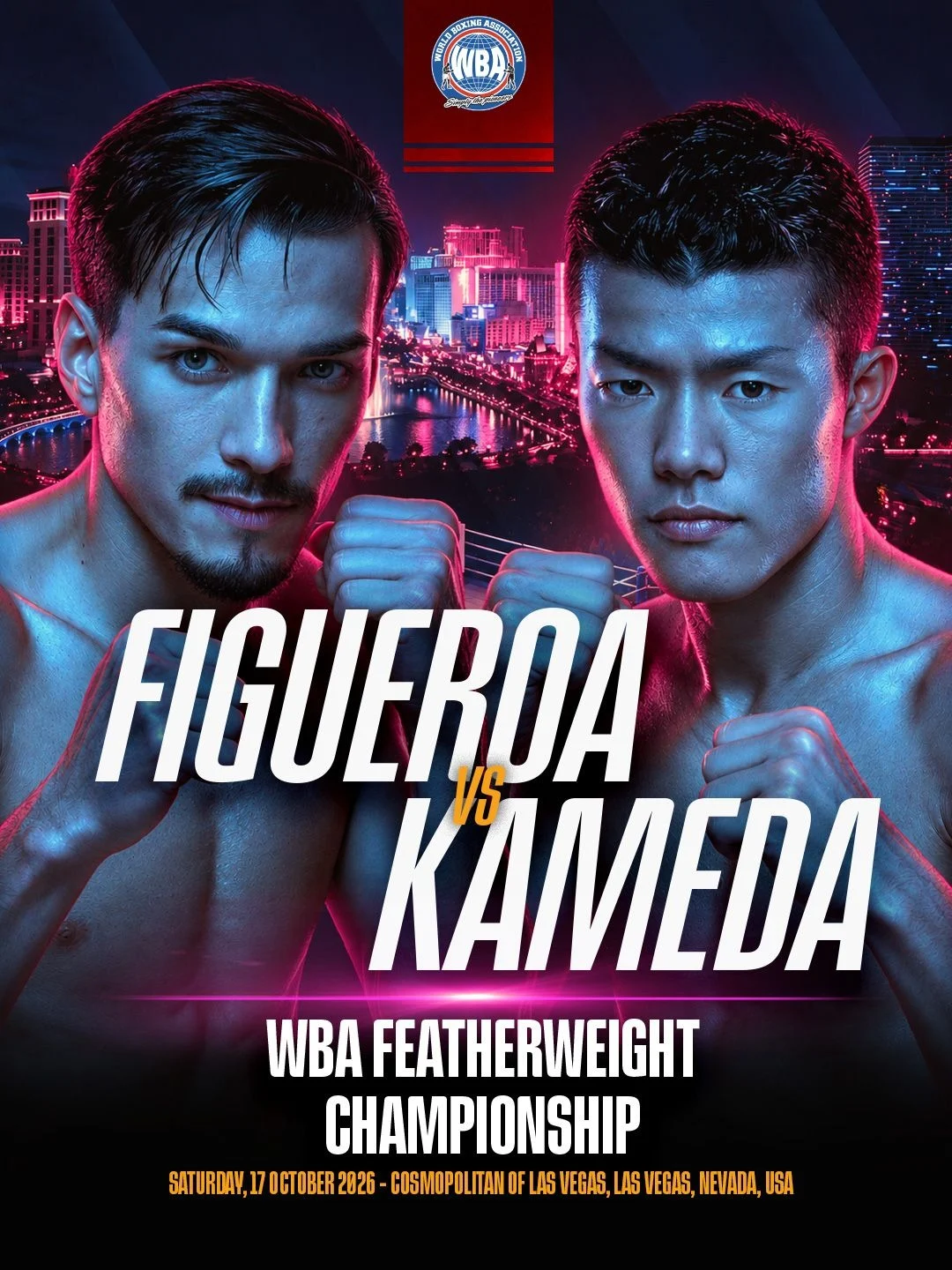
Las Vegas is set to become the epicenter of the boxing world this Saturday, October 17, as The Cosmopolitan hosts a highly anticipated world championship showdown between two contrasting stylists at the top of their game. American standout Brandon “The Heartbreaker” Figueroa will square off against seasoned Japanese contender Tomoki “El Mexicanito” Kameda in a battle for the World Boxing Association (WBA) World Featherweight Championship. The bout brings together two distinct boxing philosophies, pitting relentless forward pressure against refined technical skill on one of the sport’s premier stages.
The choice of venue at The Cosmopolitan in Las Vegas underscores the high-stakes nature of this championship contest. Known for hosting major fight nights, the venue provides an electric atmosphere tailored for world-class boxing. As fight fans and observers turn their attention to Nevada, the scheduled twelve-round contest represents a classic confrontation of fight styles. On one side stands a champion determined to impose his size and work rate, while on the other stands a well-traveled contender relying on speed, timing, and ring generalship to claim world title honors.
For Brandon Figueroa, the Texas native who has earned widespread recognition for his fan-friendly, non-stop offensive assault, this fight represents a critical opportunity to solidify his standing at the elite level of the division. Known affectionately as "The Heartbreaker," Figueroa has forged a distinct fighting identity rooted in an unwavering refusal to take a backward step. Inside the ring, his strategy revolves around forcing his opponents into uncomfortable brawls, relying on an engine that allows him to throw punches continuously without sacrificing power or intensity as the rounds add up.
Central to Figueroa’s tactical approach is his physical build and unique technical versatility. Possessing noticeable height and reach advantages over most rivals in the featherweight class, the American fighter utilizes his physical frame in an unconventional manner. Rather than remaining at long range to pick opponents apart from the outside, Figueroa routinely uses his length to smother fighters, crowding their space and forcing exchanges at close quarters. His ability to fluidly switch stances from orthodox to southpaw and back again mid-fight creates unpredictable punch angles, making it difficult for defenders to anticipate where the next blow will land.
Entering Saturday night’s main event, Figueroa’s primary objective will be to establish his dominance from the very first bell. Recognizing the technical skill of his challenger, the Texan will look to immediately close the distance and cut off the ring. By staying in Kameda’s face, Figueroa aims to neutralize the Japanese fighter’s footwork and disrupt his ability to set a firm base. A key element of Figueroa’s blueprint involves a relentless body attack. By continuously digging heavy shots to the midsection, the champion intends to sap Kameda’s endurance, slowing down the challenger’s legs and rendering him increasingly stationary in the second half of the contest.
On the opposite side of the ring, Tomoki Kameda brings a rich and fascinating boxing heritage that distinguishes him from nearly every other contender in the weight class. Nicknamed “El Mexicanito,” Kameda’s approach to the sweet science is the product of a rare cross-cultural boxing education. The Japanese fighter spent key formative years immersed in the grueling gyms of Mexico, learning the subtle nuances, body mechanics, and defensive tricks of the traditional Mexican boxing style. Combined with the strict discipline, hand speed, and technical fundamentals inherent to Japanese boxing, Kameda has developed a hybrid style that makes him a formidable opponent for any pressure fighter.
Kameda’s readiness for a contest of this magnitude is bolstered by his vast operational experience in the ring. With more than 45 professional bouts under his belt, the seasoned veteran has seen virtually every tactical look a fighter can present. Having competed on major fight cards across international venues throughout his career, Kameda is well-acquustomed to the intense spotlight and high pressure that accompany a world title bout in Las Vegas. This deep reservoir of ring experience provides him with the composure needed to execute a precise tactical strategy without being overwhelmed by the occasion or his opponent’s aggression.
To succeed against a relentless volume puncher like Figueroa, Kameda and his corner must execute a disciplined game plan tailored to neutralizing forward momentum. The primary danger for Kameda will be getting backed against the ropes, where Figueroa is at his most destructive. Consequently, Kameda’s strategy will focus on maintaining center-ring positioning and employing sharp in-and-out movement. He will rely heavily on a crisp, hard jab to repeatedly puncture Figueroa’s guard, disrupting the champion’s rhythm and preventing him from walking forward unchallenged.
Beyond his jab, Kameda’s ultimate key to victory lies in his lateral movement and counterpunching instincts. As Figueroa charges forward, Kameda will look to utilize quick pivots to step off the centerline, forcing the champion to continuously turn and reset his feet. These subtle adjustments in footwork are designed to create passing angles that expose gaps in Figueroa’s offense. Operating with sharp defensive reflexes and precise timing, Kameda will aim to make Figueroa pay every time he commits to a heavy sequence, catching the aggressive fighter as he steps in and immediately exiting before a counter-assault can be launched.
This matchup sets up a captivating clash of boxing mentalities: relentless high-volume pressure against calculated counterpunching and footwork. Figueroa thrives when the fight devolves into a physical battle of attrition, where sheer willpower, body punching, and relentless volume break down an opponent’s resistance. Kameda, conversely, excels when he can control the distance, dictating the tempo through superior footwork, clean defensive evasion, and sharp counterpunches that score cleanly on the judges’ scorecards.
The tactical battle will extend to the physical and psychological conditioning of both men. For Figueroa, the challenge will be maintaining an unrelenting pace without running into sharp counters that could alter the momentum of the fight. For Kameda, the trial will be maintaining peak defensive focus and foot speed for twelve scheduled rounds while absorbing the unavoidable physical toll that comes with sharing the ring with a persistent pressure fighter. How effectively each man manages these physical demands will likely determine who controls the critical middle and late rounds.
As fight night approaches, the stakes could not be higher for both competitors. For Brandon Figueroa, victory would reinforce his status as a premier force in the division and further solidify his legacy as one of the most punishing pressure fighters of his generation. For Tomoki Kameda, capturing the WBA World Featherweight Championship in Las Vegas would represent the crowning achievement of a long, globetrotting career built on technical craft and international experience.
With both fighters boasting distinct advantages and iron wills, the stage is set for a memorable night of championship boxing at The Cosmopolitan. Whether decided by the suffocating inside work and body attack of Figueroa or the sharp footwork and precise counterpunching of Kameda, Saturday’s showdown promises to deliver a compelling answer to one of boxing’s classic stylistic debates.