
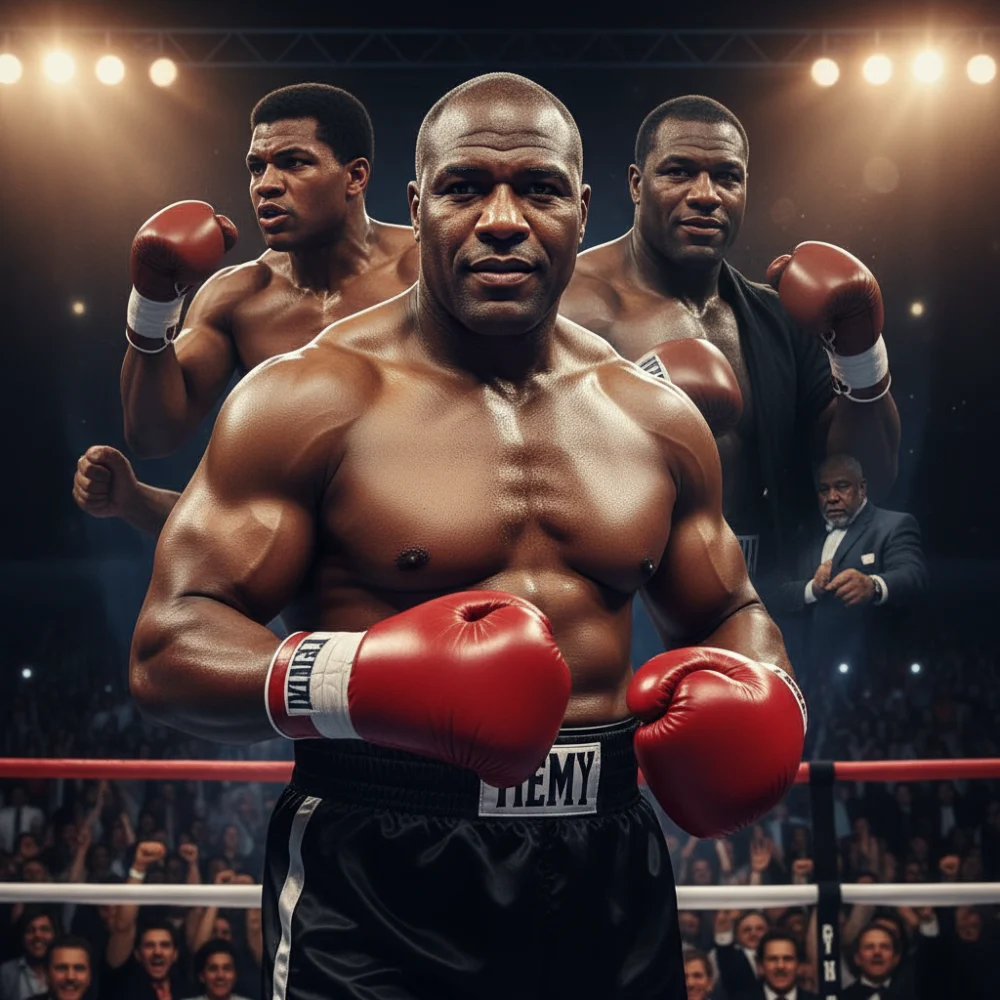
In the annals of boxing history, few figures cast a shadow as long, complex, and ultimately redemptive as George Foreman. His career is not merely a record of wins and losses, but a tale of two distinct lives lived within the confines of the squared circle. From a brooding, terrifying force of nature in the 1970s to a smiling, burger-grilling icon in the 1990s, Foreman’s journey represents the ultimate story of transformation and heavyweight longevity.
The Rise of a Heavyweight Menace
George Foreman’s early life was defined by anger and instability until he found direction in the Job Corps and, subsequently, boxing. His raw power was evident immediately. After a brief amateur career that culminated in a Gold Medal at the 1968 Mexico City Olympics, Foreman turned professional. He cut a swath through the heavyweight division, utilizing a style built on sheer brute strength and intimidation. He wasn’t a technical wizard; he was a demolition expert.
The world truly took notice in 1973 when Foreman stepped into the ring against the undefeated champion, Joe Frazier, in Kingston, Jamaica. Frazier was considered unstoppable, yet Foreman treated him like a ragdoll. The famous cry of "Down goes Frazier!" echoed as Foreman knocked the champion down six times in two rounds. This victory cemented Foreman as one of the most feared punchers in history, a reputation he solidified by annihilating Ken Norton shortly after.
The Rumble in the Jungle
Foreman’s aura of invincibility was shattered in 1974 during the most famous boxing match of all time: The Rumble in the Jungle against Muhammad Ali in Zaire. Foreman entered the ring as a heavy favorite, expected to crush the aging Ali. However, Ali’s legendary "Rope-a-Dope" strategy exhausted the younger champion. In the eighth round, Ali capitalized on a fatigued Foreman, knocking him out and handing him his first professional loss. This defeat haunted Foreman for years, driving him into a spiral of confusion and bitterness.
Following the loss to Ali, Foreman continued to fight, but the joy was gone. His career in the 1970s ended abruptly after a loss to Jimmy Young in 1977. In the dressing room after the fight, Foreman underwent a profound spiritual experience. He believed he had died and been reborn. He hung up his gloves, renounced boxing, and became an ordained minister, dedicating the next decade of his life to his church and his family in Houston, Texas.
The Improbable Comeback
Ten years later, in 1987, the world was shocked when a 38-year-old, visibly heavier George Foreman announced his return to the ring. Critics laughed, labeling it a publicity stunt or a desperate cash grab. However, Foreman insisted his goal was to raise money for his youth center. Unlike the scowling menace of the 70s, this version of Foreman was jovial, self-deprecating, and sold himself as the champion of the common man.
Foreman embarked on a methodical journey back to contention, fighting frequently to shed rust and weight. While he had lost some speed, his power—the last thing to leave a heavyweight—remained intact. He racked up knockout after knockout against journeymen, slowly winning over a skeptical public. His cross-armed defense and heavy jab became his new tools, compensating for his lack of mobility with ring IQ and efficient movement.
Battle of the Ages: Holyfield vs. Foreman
In 1991, at the age of 42, Foreman secured a title shot against the undisputed champion, Evander Holyfield. The "Battle of the Ages" was expected to be a mismatch. Instead, Foreman shocked the pundits by going the distance, absorbing tremendous punishment and rocking the younger champion on several occasions. Although he lost by decision, Foreman proved he belonged among the elite, earning immense respect from the boxing world.
Despite the loss to Holyfield and a subsequent defeat to Tommy Morrison, Foreman refused to retire again. He remained convinced that he could regain the title. His persistence paid off when he was granted a shot at the WBA and IBF heavyweight titles against Michael Moorer in 1994. Moorer was 26 years old, undefeated, and technically superior. For nine rounds, Moorer dominated the 45-year-old Foreman, outboxing him comfortably.
The Punch Heard ‘Round the World
Then came the tenth round. On November 5, 1994, George Foreman defied logic and time. He set a trap, landing a short, chopping right hand straight to Moorer’s chin. The champion collapsed and was counted out. In that moment, Foreman became the oldest heavyweight champion in history at age 45—a record that still stands today. He had regained the title he lost to Ali 20 years earlier, completing one of the greatest redemption arcs in sports.
Evolution of Style and Strategy
Foreman’s longevity was not just about genetics; it was about adaptation. In his prime, he was a swarmer who tried to end fights in the first round. In his comeback, he adopted the "Archie Moore" cross-armed defense, which allowed him to block punches effectively while conserving energy. He learned to pace himself, waiting for the perfect moment to unleash his heavy artillery rather than wasting energy chasing opponents.
His training methods also evolved. While he still chopped wood and pulled heavy objects, he placed a greater emphasis on relaxation and mental fortitude. The "Old George" understood that tension was the enemy of endurance. This wisdom allowed him to compete against athletes young enough to be his children, proving that experience and power could neutralize youth and speed.
The George Foreman Grill and Business Empire
Outside the ring, Foreman’s second act was equally successful. His transformation from a villain to a lovable father figure made him a marketing goldmine. This culminated in the launch of the George Foreman Lean Mean Fat-Reducing Grilling Machine. Foreman’s genuine pitch and charisma helped sell over 100 million units worldwide, earning him significantly more money than his entire boxing career combined.
Legacy and Impact
George Foreman’s legacy is multifaceted. To boxing purists, he is one of the top five hardest punchers of all time. To the general public, he is a smiling entrepreneur. His career statistics are staggering:
- Total Fights: 81
- Wins: 76
- Wins by KO: 68
- Losses: 5
But numbers alone do not capture his spirit. He taught the world that it is never too late to reinvent oneself.
Ultimately, George Foreman’s story is one of hope. He showed that failure is not final and that age is often just a number. By reclaiming the heavyweight championship two decades after losing it, he provided inspiration to millions of middle-aged individuals who felt their best days were behind them. Today, Big George stands as a monument to the power of persistence, faith, and a really good right hand.