
When fitness enthusiasts discuss resistance training, the description usually involves performing various exercises, either dynamically or statically, targeting specific muscle groups with adequate training volume, high effort, and consistency. On average, this serves as a representative explanation of what the majority of people do day in and day out. However, while conventional resistance training is predominantly performed dynamically through isotonic muscle actions, it can also be performed statically via isometric muscle actions.

When discussing which training modality builds more strength and size, a large portion of the fitness community defaults to dynamic training. Conventional wisdom has long suggested that isometric training simply is not as effective for building strength and hypertrophy compared to dynamic movements. When people think of isometrics, planks or wall sits usually come to mind because they are common prescriptions. While some muscle growth is likely to occur from planks, significant development is rare unless an individual is profoundly undertrained. This association has fueled general misconceptions regarding the effectiveness of isometric training as a whole. Emerging evidence, however, suggests that these assumptions do not entirely reflect scientific findings.

Understanding the full scope of isometric training requires examining different muscle actions and how they are defined in scientific literature, distinguishing between the different types of isometrics, reviewing the evidence regarding strength and hypertrophy alongside tendon rehabilitation and pain management, considering key programming variables, comparing isometric training to dynamic modalities, and looking at how isometrics can be practically applied.

Muscle Actions in Exercise Physiology
Before evaluating training modalities, it is helpful to review the primary types of muscle actions: isotonic, isometric, and isokinetic. These are referred to as muscle actions rather than contractions because, although "muscle contraction" is common in exercise physiology, contraction implies shortening from the Latin contrahere, which does not apply to all muscle actions.

Isotonic muscle actions are defined as those during which muscles maintain constant tension while undergoing changes in length during dynamic movements. However, because muscle length and joint angles constantly change, tension during dynamic movement is rarely truly constant. Some experts prefer the term isoinertial to describe movements where the resistance remains constant while velocity varies throughout the range of motion. Isotonic actions consist of two components: concentric and eccentric actions.

Concentric muscle actions involve the active shortening of a muscle, bringing two bones closer together as myosin heads interact with actin filaments to shorten the sarcomere. Curling a dumbbell upward exemplifies a concentric action. Conversely, eccentric muscle actions involve the lengthening of a muscle because the external forces acting upon it exceed the force produced by the muscle fibers. Lowering that same dumbbell demonstrates an eccentric action. When performed continuously, these phases make up dynamic range of motion under isotonic conditions.

Isometric muscle actions occur without a meaningful change in the length of the muscle-tendon complex. While popular definitions often state that isometrics involve zero change in length, muscles and tendons actually undergo slight internal shifts, such as fascicle shortening while tendons elongate. Research suggests that different muscle actions elicit specific morphological, neuromuscular, and performance adaptations. In terms of maximal force capacity, muscle actions roughly follow the order of eccentric, then isometric, and finally concentric.

Eccentric actions are more metabolically efficient due to a lower energy cost per unit force, partially because fewer cross-bridges are required and internal elastic structures like titin store and release energy. Additionally, eccentric actions often show lower voluntary activation than concentric or isometric actions due to spinal and supraspinal mechanisms that limit neural drive. Meta-analyses confirm that both concentric and eccentric training result in robust muscle hypertrophy.

Finally, isokinetic muscle actions involve performing a movement at a constant angular velocity, typically achieved using specialized dynamometers that adjust resistance to match user effort. While rarely used outside of rehabilitation settings and laboratory research, isokinetic testing allows for objective strength assessments while controlling for velocity variations.

A Brief History of Isometric Training
The origins of modern isometric training can be traced back to historical strongmen like Alexander Zass, known as The Iron Samson. Early accounts of his childhood training describe his stubborn attempts to move a heavy wooden tub rooted in the basement. Even though the tub remained motionless, Zass noticed that carrying heavy saddles and grain sacks became noticeably easier. He later wondered whether straining against immovable objects could increase strength, discovering through circus performances and military service that static muscle tension yielded immense power.

The earliest known scientific study on isometric training was conducted by Hettinger and Müller in 1953. Researchers had untrained male participants perform daily six-second isometrics at roughly 67 percent of maximal voluntary contraction across various muscle groups. Strength improved by about five percent per week on average, and researchers noted that strength and estimated cross-sectional area increased proportionally. This landmark study paved the way for decades of subsequent research.

The Distinct Types of Isometrics
Isometric training features two distinct categories: pushing (overcoming) and holding (yielding) isometrics. Pushing isometrics involve exerting force against an immovable object, representing an attempted concentric action that fails due to excessive external load. Holding isometrics involve maintaining a set joint angle against an external load, representing an attempted eccentric action where sufficient force is applied to prevent joint movement.

These two types possess unique characteristics and fatigability profiles. Research comparing pushing and holding isometrics at identical net muscle torques found that time to task failure was nearly twice as long during pushing conditions compared to holding conditions. Electromyography data shows that while muscle activation increases in both tasks, normalized activation at exhaustion is higher in pushing isometrics. Conversely, holding isometrics display greater fluctuations in stability, higher ratings of perceived exertion, increased mean arterial pressure, elevated heart rate, and greater cardiovascular strain.

These differences suggest that holding isometrics require greater central processing, including higher supraspinal and spinal activation, along with more complex sensorimotor modulation to manage external perturbations. While most applied research focuses on pushing isometrics, holding isometrics may be particularly relevant in sports rehabilitation, given that many non-contact injuries occur during muscle lengthening and deceleration.

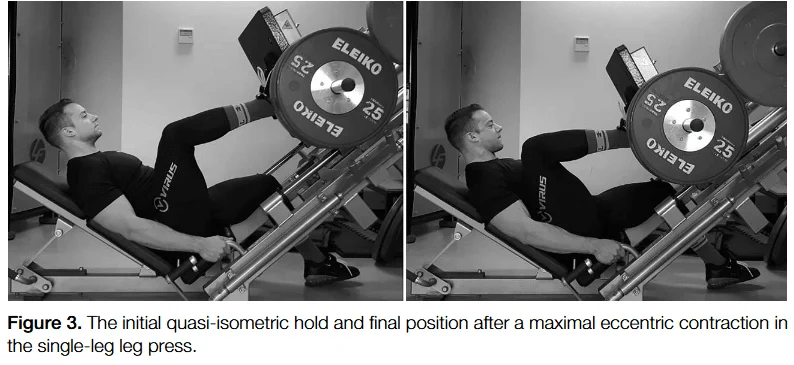
Researchers have also examined hybrid forms of isometric training known as eccentric quasi-isometrics. These begin as holding isometrics designed to resist lengthening, but as fatigue accumulates at shorter muscle lengths, holding failure occurs and transitions into a low-velocity, actively resisted eccentric action. While theorized to increase mechanical tension, time under tension, and subsequent hypertrophy, long-term comparative studies show that traditional resistance training often yields greater muscle thickness and estimated one-repetition maximum increases compared to eccentric quasi-isometrics, potentially due to challenges with progressive overload during home-based protocols.

Tendons, Pain, and Rehabilitation
Isometric training is frequently prescribed in rehabilitation settings to manage tendinopathies, reduce pain perception, and transition patients from passive recovery to dynamic movement. Tendons are viscoelastic structures that transfer force from muscle to bone, undergoing adaptation via collagen synthesis and turnover when exposed to mechanical overload. Regular mechanical loading increases tendon stiffness, Young’s elastic modulus, and cross-sectional area, all of which enhance force production and reduce injury risk.

While some early clinical trials suggested that isometric exercise produced superior acute pain relief compared to isotonic exercise in conditions like patellar tendinopathy, subsequent systematic reviews have found mixed results. Many studies exhibit high heterogeneity, small sample sizes, and low-to-moderate methodological quality. Nevertheless, isometrics remain a valuable clinical tool because they provide an efficient training stimulus with minimized joint stress, particularly at shorter muscle lengths where acute muscle damage is lower. Clinicians can gradually progress patients from short-length isometrics to long-length isometrics and eventually to dynamic movements as pain subsides and tissue tolerance improves.

Strength and Hypertrophy Outcomes
Although isometric training is rarely the primary modality chosen for bodybuilding, a substantial body of evidence confirms its effectiveness for muscle hypertrophy. Studies spanning six to 14 weeks consistently report notable increases in muscle cross-sectional area. The magnitude of these gains depends heavily on programming variables such as muscle length, contraction duration, training volume, and intensity.

Evidence indicates that isometric training performed at longer muscle lengths yields greater hypertrophy and more significant architectural changes, such as increases in fascicle length, compared to training at shorter lengths. Because muscle active force capacity peaks near the plateau region of the length-tension curve while passive tension rises sharply at longer lengths, the combined mechanical stimulus at extended lengths appears to trigger robust hypertrophic signaling. Furthermore, studies comparing sustained contractions to explosive short contractions generally find that sustained holds produce greater hypertrophy, likely due to prolonged time under tension and acute ischemic localized blood flow restriction.

When examining strength development, isometric training is highly task-specific. While strength gains are most pronounced at the exact joint angle trained, isometric training also promotes strength transfer across a broader range of motion, particularly when performed at longer muscle lengths. Meta-analyses comparing isometric training to non-training controls and dynamic training demonstrate that isometric training yields moderate to large increases in isometric and isokinetic strength.

Direct comparisons between isometric and dynamic training reveal remarkably similar outcomes regarding muscle growth. Across multiple studies spanning several decades, researchers have found that work-matched isometric and isotonic training regimens yield comparable increases in muscle volume and cross-sectional area. While dynamic training often shows superior transfer to dynamic one-repetition maximum tests due to movement specificity, isometric training proves equally effective for stimulating underlying muscle hypertrophy.

Ultimately, isometric training is a versatile and effective tool for both strength development and hypertrophy. By carefully managing training volume, maintaining adequate intensity, and emphasizing longer muscle lengths, practitioners can successfully integrate isometrics into a well-rounded resistance training program.