

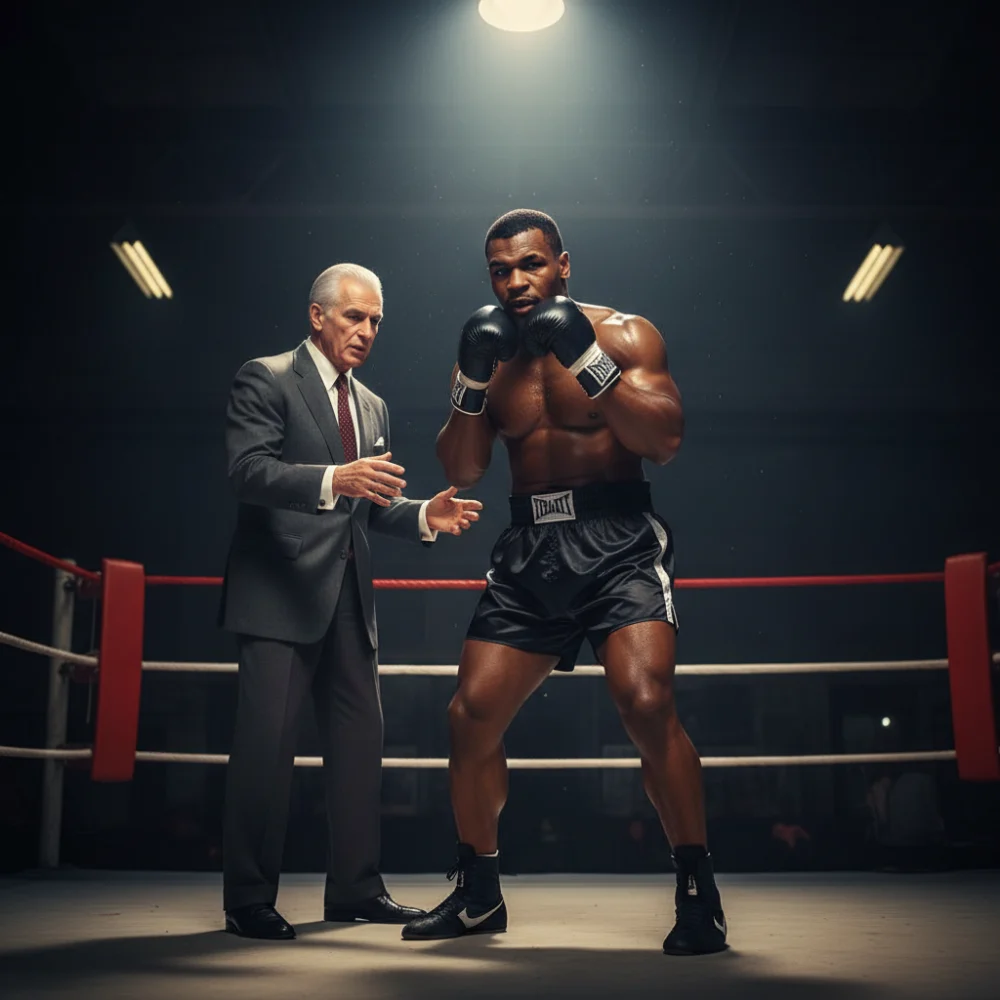
In the mid-1980s, a force of nature swept through the heavyweight division, dismantling opponents with a ferocity and precision that seemed almost superhuman. That force was Mike Tyson, and the engine behind his destruction was a sophisticated, high-energy boxing system known as the Peek-a-Boo style. While Tyson was the vessel, the architect was the legendary Constantine ‘Cus’ D’Amato, a trainer whose deep understanding of physics, psychology, and anatomy created a fighting style designed to neutralize size advantages and maximize explosive power.
The Visionary: Cus D’Amato
Cus D’Amato was not merely a boxing trainer; he was a philosopher of combat. Operating out of the Catskill Boxing Club in upstate New York, D’Amato believed that boxing was 80% mental and only 20% physical. His genius lay in his ability to deconstruct the sport into a science. He analyzed the movements of great champions and recognized that the traditional upright stance left fighters vulnerable. He sought to create a system where a fighter could remain elusive without retreating, allowing them to stay in the pocket and deliver punishment while remaining safe from harm.
The result of D’Amato’s obsession was the Peek-a-Boo style. The name derives from the defensive guard, where the boxer holds their gloves high against the cheeks—resembling a baby playing peek-a-boo—offering maximum protection to the chin and face. However, calling it just a defensive guard undermines the complexity of the system. It was a total offensive and defensive integration that required supreme conditioning, rhythm, and discipline.
The Mechanics of the Stance
At the core of the style is the stance. Unlike the traditional bladed stance, the Peek-a-Boo practitioner squares their shoulders more toward the opponent. The feet are parallel or slightly offset, providing a solid base for lateral movement. The gloves are held high, resting on the cheekbones, with elbows tucked tightly against the ribs. This positioning protects the body’s vital organs and the jawline, creating a fortress that is difficult to penetrate.
This squared stance serves a dual purpose. While it offers protection, it also allows the fighter to throw hooks and uppercuts with equal power from either hand without needing to shift weight drastically. For a shorter heavyweight like Tyson, who stood at 5’10”, this was crucial. It allowed him to generate tremendous torque and leverage, turning his lack of height into a devastating advantage by punching upward into his taller opponents.
The Pendulum: Head Movement is Key
The most recognizable feature of the Peek-a-Boo style is the constant head movement. D’Amato drilled into Tyson the concept that a moving target is harder to hit. This wasn’t just simple ducking; it was a rhythmic, side-to-side motion often described as a pendulum. Tyson would slip outside a jab, bob under a cross, and weave out of danger, all while closing the distance. This constant motion served to hypnotize opponents and load up Tyson’s hips for explosive counters.
Slip, slip, weave. This mantra was ingrained in Tyson’s muscle memory. By constantly moving his head after every punch he threw, Tyson ensured he was never a stationary target. The genius of D’Amato’s system was that the defensive slip was actually the first step of an offensive attack. Slipping to the right loaded the weight onto the right leg, coiling the body like a spring to unleash a right hook or uppercut.
Controlled Aggression: The Number System
To streamline communication in the corner and during training, D’Amato developed a unique numbering system for punches. This allowed for rapid-fire instructions that bypassed the delay of language processing. For example, a ‘7’ might be a jab, and an ‘8’ a body shot. This system turned combinations into reflex actions. Tyson didn’t have to think about the sequence; he simply reacted to the numbers called out by D’Amato or later, Kevin Rooney.
One of the most devastating tools in this arsenal was the ‘shift.’ This involved Tyson hopping to the side while throwing a punch, changing his angle of attack instantly. By shifting his feet, he could move from directly in front of an opponent to their blind side, landing a hook where they had no defense. This mastery of angles made Tyson appear to be everywhere at once, overwhelming the sensory processing of his adversaries.
Psychological Warfare: The Hero and the Coward
Cus D’Amato’s genius extended far beyond the physical mechanics. He was a master psychologist who understood the crippling nature of fear. He taught Tyson that fear was like a fire: ‘If you control it, it can cook for you and keep you warm. If you don’t control it, it will burn everything around you.’ D’Amato didn’t try to eliminate fear; he taught Tyson to acknowledge it and use the adrenaline it produced to heighten his reflexes and speed.
This psychological conditioning created the aura of invincibility that surrounded Tyson. D’Amato instilled a ‘character’ in Tyson—a gladiator who entered the ring with bad intentions. The Peek-a-Boo style, with its aggressive forward pressure, was the physical manifestation of this mindset. It was designed to break the opponent’s will. When a taller fighter threw their best shots and hit nothing but air, only to be countered by a sledgehammer blow, their spirit broke long before their body did.
Why It Worked for Tyson
The Peek-a-Boo style is notoriously difficult to master and requires a specific body type and athletic profile. It was perfect for Mike Tyson because of his low center of gravity and explosive fast-twitch muscle fibers. Tyson’s massive legs and thick neck were essential components. The neck, in particular, had to be incredibly strong to withstand the whiplash of constant head movement and absorb punches when the defense failed.
- Leverage: Tyson’s short stature allowed him to get ‘under’ punches and drive upward.
- Speed: The style relies on closing the gap quickly, requiring blinding foot speed.
- Endurance: The constant bobbing and weaving burns energy rapidly, requiring elite cardio.
Without these physical attributes, the style can be a liability. A taller, slower fighter attempting Peek-a-Boo would likely be exhausted by the third round and easily timed by an opponent. Tyson’s unique genetic gifts combined with D’Amato’s scientific approach created the perfect storm in the heavyweight division.
The Role of Kevin Rooney
While Cus D’Amato was the architect, credit must also be given to Kevin Rooney, who took over Tyson’s training after D’Amato passed away. Rooney was a former fighter under D’Amato and understood the Peek-a-Boo style implicitly. During Tyson’s prime years (1985-1988), Rooney ensured that the elusive head movement remained the priority. Boxing analysts often note that Tyson’s decline began when he separated from Rooney and stopped using the elusive head movement that defined the system.
The Legacy of Peek-a-Boo
Today, the pure Peek-a-Boo style is a rarity in professional boxing. It is physically demanding and difficult to teach, requiring a trainer who deeply understands the nuances of weight transfer and leverage. However, elements of D’Amato’s genius can be seen in various fighters who utilize high guards, shift angles, and emphasize head movement. The style proved that a smaller fighter could dominate giants through science, speed, and controlled aggression.
Ultimately, the collaboration between Mike Tyson and Cus D’Amato remains one of the most fascinating chapters in sports history. It was a meeting of a visionary mind and a prodigious talent. The Peek-a-Boo style was not just a way of fighting; it was a philosophy of survival and dominance, proving that with the right technique and mentorship, even the underdog can become the king of the world.