In the pantheon of boxing legends, few names evoke as much raw power, intimidation, and technical brilliance as Roberto Duran. Known worldwide by his moniker Manos de Piedra (Hands of Stone), Duran is widely regarded as the greatest lightweight of all time and one of the top fighters, pound-for-pound, in the sport’s history. His career spanned an incredible five decades, characterized by a ferocious fighting style that masked a sophisticated defensive intellect. This biography delves into the life of the man who became a national hero in Panama and a global icon in the ring.
Early Life in El Chorrillo
Roberto Duran was born on June 16, 1951, in the slums of El Chorrillo, Panama. The son of a Panamanian mother and an American father of Mexican descent who served in the U.S. Army, Duran grew up in extreme poverty. His father left the family early on, leaving Roberto to help support his mother and siblings from a very young age. The streets of El Chorrillo were unforgiving, and it was here that Duran learned to fight, shining shoes, selling newspapers, and dancing for change while developing the toughness that would define his career.
He dropped out of school at a young age to focus on survival and eventually found his way into a boxing gym. By the age of 16, Duran turned professional, driven by a hunger to escape poverty. His early bouts were fought in Panama, where he quickly built a reputation as a savage puncher. He won his first 21 fights, rarely letting opponents hear the final bell. His raw talent caught the eye of wealthy landowner Carlos Eleta, who became his manager and hired the legendary trainers Ray Arcel and Freddie Brown to polish the rough diamond.
The Rise to Lightweight Dominance
Duran’s first brush with international stardom came in 1972 when he challenged the Scottish champion Ken Buchanan for the WBA Lightweight title at Madison Square Garden. Buchanan was a skilled technician, but he was unprepared for the relentless aggression of the 21-year-old Panamanian. Duran swarmed him from the opening bell, turning the fight into a brawl. The match ended controversially in the 13th round due to a low blow, but Duran was awarded the TKO victory and the title. A new era in the lightweight division had begun.
Following his victory over Buchanan, Duran embarked on a reign of terror in the lightweight division that lasted nearly seven years. He made 12 successful title defenses, unifying the WBA and WBC titles by defeating Esteban De Jesus, the man who had previously handed Duran his first non-title loss. During this period, Duran was virtually untouchable, combining crushing power with underrated head movement and defensive skills. By the time he vacated the lightweight titles in 1979 to move up in weight, his record stood at an astonishing 72-1.
The Brawl in Montreal
The 1980s marked the era of the Fabulous Four: Duran, Sugar Ray Leonard, Thomas Hearns, and Marvin Hagler. Duran’s entry into the welterweight division set the stage for one of the most anticipated fights in history against the golden boy of American boxing, Sugar Ray Leonard. The bout took place on June 20, 1980, in Montreal. Duran engaged in psychological warfare leading up to the fight, insulting Leonard and his family to goad him into a brawl.
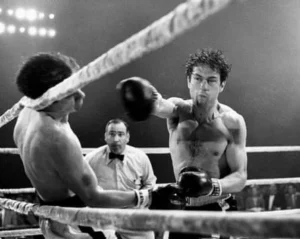
The strategy worked perfectly. Instead of using his superior speed and footwork, Leonard stood toe-to-toe with Duran. It was a tactical error that played right into Manos de Piedra’s hands. Duran battered Leonard continuously, slipping punches and landing heavy body shots. After 15 grueling rounds, Duran was awarded a unanimous decision victory, claiming the WBC Welterweight title and cementing his status as the best fighter in the world.
The No Mas Incident
The high of the Montreal victory was followed quickly by the lowest point of Duran’s career. A rematch with Leonard was scheduled for November 1980 in New Orleans, famously known as the No Mas fight. Duran, who had ballooned in weight while partying after his victory, was forced to cut weight rapidly. In the ring, a sharp and disciplined Leonard humiliated Duran, clowning him and using rapid-fire combinations that Duran could not catch.
In the eighth round, frustrated and exhausted, Duran turned his back to Leonard and waved his hand, signaling he wanted to stop. While he denies saying the specific words “No Mas” (No More), the sentiment was clear. He quit. The boxing world turned on him instantly. He was labeled a coward and a disgrace to his country. It seemed as though the legend of Roberto Duran had ended in shame.
The Road to Redemption
Rebuilding his reputation was a long and arduous road. Duran was written off by critics and fans alike. However, he possessed an indomitable will. He moved up to the junior middleweight division, aiming to capture a third world title. In June 1983, on his 32nd birthday, Duran faced the undefeated WBA Junior Middleweight champion Davey Moore at Madison Square Garden. In a brutal display of violence, Duran battered the younger Moore, stopping him in the eighth round. The crowd erupted; redemption had begun.
This victory set up a super-fight against the undisputed Middleweight champion, Marvelous Marvin Hagler, in November 1983. Although Duran lost a unanimous decision, he achieved a moral victory by becoming the first man to take Hagler the full 15 rounds during his championship reign. Duran proved that he was still an elite operator, capable of competing with the very best at higher weight classes.
However, the rollercoaster continued. In 1984, Duran faced Thomas “The Hitman” Hearns. It was a disaster for the Panamanian. Hearns’ speed and devastating right hand were too much, and Duran was knocked out cold in the second round. Once again, calls for his retirement grew loud. But Duran, driven by a love for fighting and financial necessity, refused to hang up his gloves.
The Miracle Against Iran Barkley
In 1989, at the age of 37, Duran produced one final masterpiece. He challenged Iran Barkley for the WBC Middleweight title. Barkley had just knocked out Thomas Hearns, the man who had decimated Duran. Few gave Duran a chance. Yet, in what was named the Fight of the Year, Duran rolled back the years. He used his veteran savvy to slip Barkley’s power shots and landed a knockdown in the 11th round. Duran won a split decision to capture his fourth world title in a fourth weight class.
Later Years and Legacy
Duran continued to fight well into his 40s and even his 50s, displaying remarkable longevity. While he never captured another major world title, he remained a competitive gatekeeper and a draw for fans who wanted to see a living legend. He finally retired in 2001 at the age of 50 following a car accident in Argentina, ending his career with a professional record of 103 wins and 16 losses.
Beyond the statistics, Duran’s legacy is defined by his fighting style. He was not merely a brawler; he was a master of the “sweet science” on the inside. His ability to roll with punches, his feints, and his counter-punching were textbooks examples of boxing excellence. He transformed from a street fighter into a ring genius under the tutelage of Ray Arcel.
Today, Roberto Duran is a member of the International Boxing Hall of Fame and is revered as a national treasure in Panama. His life has been the subject of documentaries and the feature film Hands of Stone. He remains a symbol of machismo, resilience, and the relentless spirit of a fighter who rose from nothing to conquer the world.