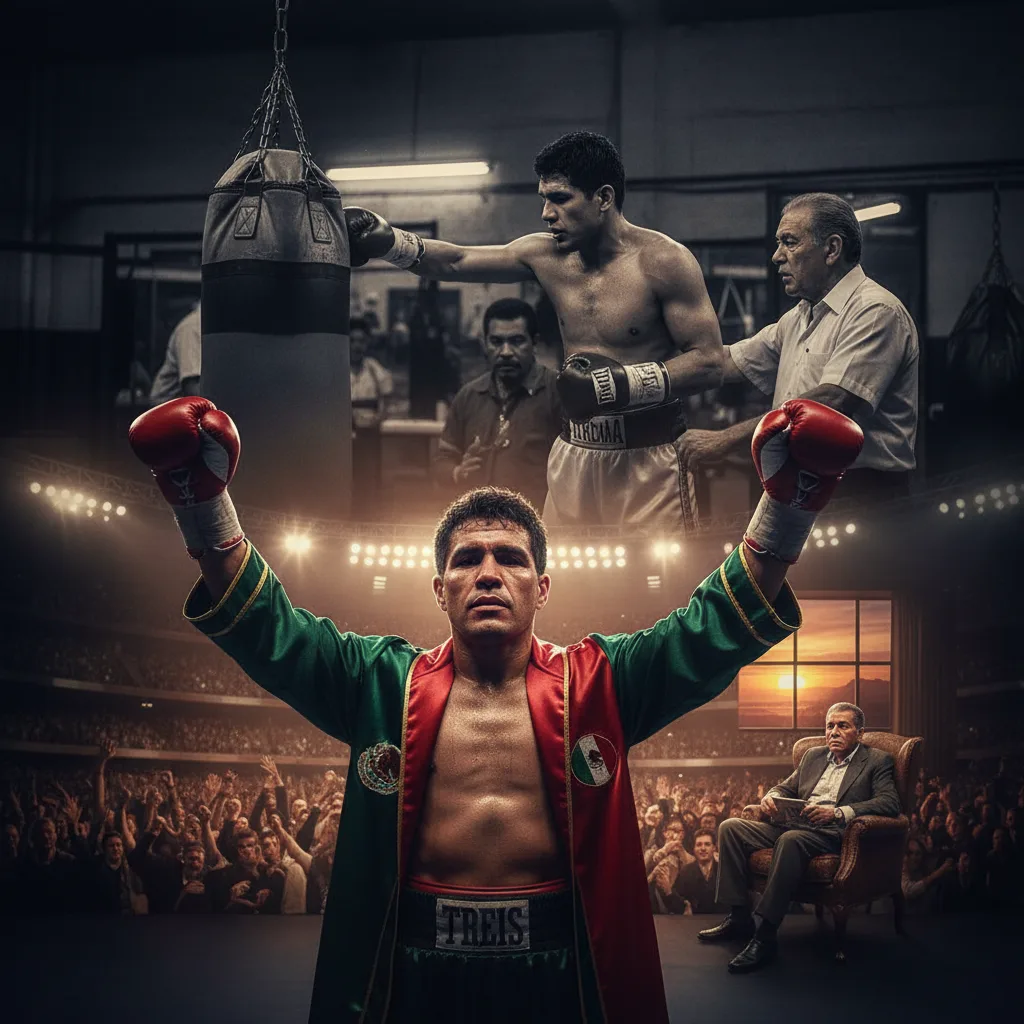
In the annals of boxing history, few names command as much respect and adoration as Julio Cesar Chavez. Often cited as the greatest Mexican fighter to ever lace up a pair of gloves, Chavez was not merely a champion; he was a national icon who embodied the fighting spirit of his country. With a career spanning over two decades, his relentless pressure style and legendary chin made him a formidable force across three weight divisions. This biography delves into the life, triumphs, and enduring legacy of the man known as ‘El César del Boxeo’.
Early Life and Humble Beginnings
Julio Cesar Chavez Gonzalez was born on July 12, 1962, in Ciudad Obregón, Sonora, Mexico. He was one of ten children born to Rodolfo Chavez and Isabel Gonzalez. His upbringing was defined by extreme poverty; the family lived in an abandoned railroad car, and his father worked for the railroad. These harsh conditions forged a hunger in young Julio, a determination to lift his family out of poverty that would later fuel his relentless drive inside the ring.
The family eventually moved to Culiacán, Sinaloa, a city that would become synonymous with his name. Although his brothers were involved in boxing, Julio initially hesitated to enter the sport. However, the financial necessity and the realization of his natural aptitude for fighting pushed him toward the amateur ranks. He began his amateur career at the age of 16, quickly displaying the raw talent that would soon captivate the world.
Professional Debut and Early Career
Chavez turned professional in 1980 at the age of 17. His early professional career was marked by a rapid succession of victories, primarily fighting in Mexico. He quickly built a reputation as a relentless body puncher. During this period, he maintained a busy schedule, often fighting once a month, which allowed him to refine his skills and build an impressive undefeated record that would stand for years.
First World Title: Super Featherweight
On September 13, 1984, Chavez finally got his shot at a world title. He faced fellow Mexican Mario ‘Azabache’ Martinez for the vacant WBC Super Featherweight title at the Grand Olympic Auditorium in Los Angeles. Despite being the underdog in betting circles, Chavez stopped Martinez in the eighth round via TKO. This victory marked the beginning of his reign as a world champion and signaled his arrival on the international stage.
Chavez defended his Super Featherweight title nine times. Notable victories during this period included wins over former and future champions such as Roger Mayweather and Rocky Lockridge. His ability to cut off the ring and wear down opponents with punishing body shots became his trademark, earning him the nickname ‘The Lion of Culiacán’.
Conquering the Lightweight Division
As his body matured, Chavez moved up to the Lightweight division. In 1987, he challenged WBA Lightweight Champion Edwin ‘Chapo’ Rosario. The buildup to the fight was intense, with Rosario threatening to send Chavez back to Mexico in a coffin. In what is considered one of his greatest performances, Chavez systematically dismantled Rosario, stopping him in the 11th round to become a two-division world champion. He later added the WBC Lightweight title by defeating Jose Luis Ramirez in 1988.
Light Welterweight Supremacy and Meldrick Taylor
Seeking greater challenges, Chavez moved up to the Light Welterweight division (140 lbs). He defeated Roger Mayweather for a second time to claim the WBC Light Welterweight title in 1989. However, the defining moment of his career came on March 17, 1990, against IBF Champion Meldrick Taylor. The fight, dubbed ‘Thunder Meets Lightning’, became one of the most controversial and famous bouts in history.
For 11 rounds, Taylor’s dazzling speed and combinations outscored Chavez, who relentlessly stalked his opponent, landing heavy blows. Going into the 12th and final round, Chavez was behind on the scorecards. In a dramatic turn of events, Chavez knocked Taylor down with seconds remaining. Referee Richard Steele stopped the fight with only two seconds left on the clock, awarding Chavez a victory by TKO. The win preserved his undefeated streak and unified the titles.
The Legend Grows: Haugen and Camacho
Chavez continued to dominate the early 1990s. In 1992, he faced the flamboyant Hector ‘Macho’ Camacho. The fight was viewed as a battle for national pride between Mexico and Puerto Rico. Chavez dominated Camacho, winning a unanimous decision and further cementing his status as the pound-for-pound king. His popularity was unrivaled.
In February 1993, Chavez fought Greg Haugen at the Estadio Azteca in Mexico City. Haugen had insulted Chavez’s record, claiming he fought ‘Tijuana taxi drivers’. The Mexican public responded by filling the stadium. A record-breaking crowd of 132,274 spectators watched as Chavez punished Haugen, stopping him in the fifth round. This event remains one of the highest-attended boxing matches in history.
The Streak Ends: Whitaker and Randall
By late 1993, Chavez possessed an astounding record of 87-0. He moved up to Welterweight to challenge Pernell Whitaker. The fight ended in a controversial majority draw, with many observers believing Whitaker had done enough to win. This was the first blemish on Chavez’s perfect record, though he technically remained undefeated.
The official end of the undefeated streak came in January 1994 against Frankie Randall. Chavez was knocked down for the first time in his career and lost a split decision. Although he regained the title from Randall in a rematch later that year due to a technical decision, the aura of invincibility had been pierced.
The De La Hoya Era and Decline
As age and years of ring wars caught up with him, Chavez faced the rising star Oscar De La Hoya in 1996 for the WBC Light Welterweight title. The fight was a symbolic passing of the torch. De La Hoya stopped a bloodied Chavez in the fourth round. They fought again in 1998, with De La Hoya winning via corner retirement after the eighth round.
Retirement and Professional Record
Julio Cesar Chavez continued to fight sporadically until 2005. He retired with a staggering professional record that reads:
- Total Fights: 115
- Wins: 107
- Wins by KO: 86
- Losses: 6
- Draws: 2
He holds the records for the most total successful defenses of world titles (27) and the most title fight victories (31). His record of 87 consecutive wins before a loss or draw is unlikely to be broken in modern boxing.
Personal Struggles and Redemption
Outside the ring, Chavez fought a difficult battle with drug and alcohol addiction, particularly during the latter part of his career. These struggles affected his performance and personal life, leading to financial and familial issues. However, demonstrating the same resilience he showed in the ring, Chavez sought help and has been sober for many years. He now dedicates time to helping others fight addiction through his rehabilitation clinics in Mexico.
Legacy and Hall of Fame
Julio Cesar Chavez was inducted into the International Boxing Hall of Fame in 2011. His legacy extends beyond statistics; he is remembered for his granite chin, his crippling body attack, and his warrior spirit. He inspired a generation of Mexican boxers, including his sons Julio Cesar Chavez Jr. and Omar Chavez, who followed him into the sport.
Today, Chavez is a revered elder statesman of boxing, working as an analyst and commentator. His life story serves as a testament to the power of perseverance, rising from the poverty of a railroad car to become a global sporting deity. To the people of Mexico, he remains simply ‘El Gran Campeón Mexicano’.