Throughout the storied and often brutal history of professional boxing, fans and historians have witnessed plenty of deeply sorrowful affairs inside the squared circle. Over the decades, certain mismatches and tragic twilight bouts have etched themselves into the collective memory of the sport for all the wrong reasons. Muhammad Ali absorbing a relentless and heartbreaking beating from Larry Holmes instantly springs to mind as a vivid example of a legend lingering far too long under the harsh arena lights. The more recent, one-sided beatdown delivered by Manny Pacquiao against an overmatched Oscar De La Hoya serves as another painful reminder of time catching up with greatness. But perhaps one of the gloomiest, most melancholic, and undeniably hard-to-watch fights that ever took place in the long history of the sport is the tragedy that unfolded exactly 75 years ago under the bright lights of Madison Square Garden.
The central figure of this sorrowful chapter was the great, beloved Joe Louis. Having ruled unequivocally as the heavyweight king of the world from 1937 to 1949—an unprecedented and glorious reign that made him a national hero and a cultural icon—Louis had long since hung up his gloves. Yet, he found himself forced back into the unforgiving environment of the prize ring not by a lust for glory or a desire to recapture his lost youth, but by a desperate, crushing effort to pay off staggering back taxes owed to the Internal Revenue Service.
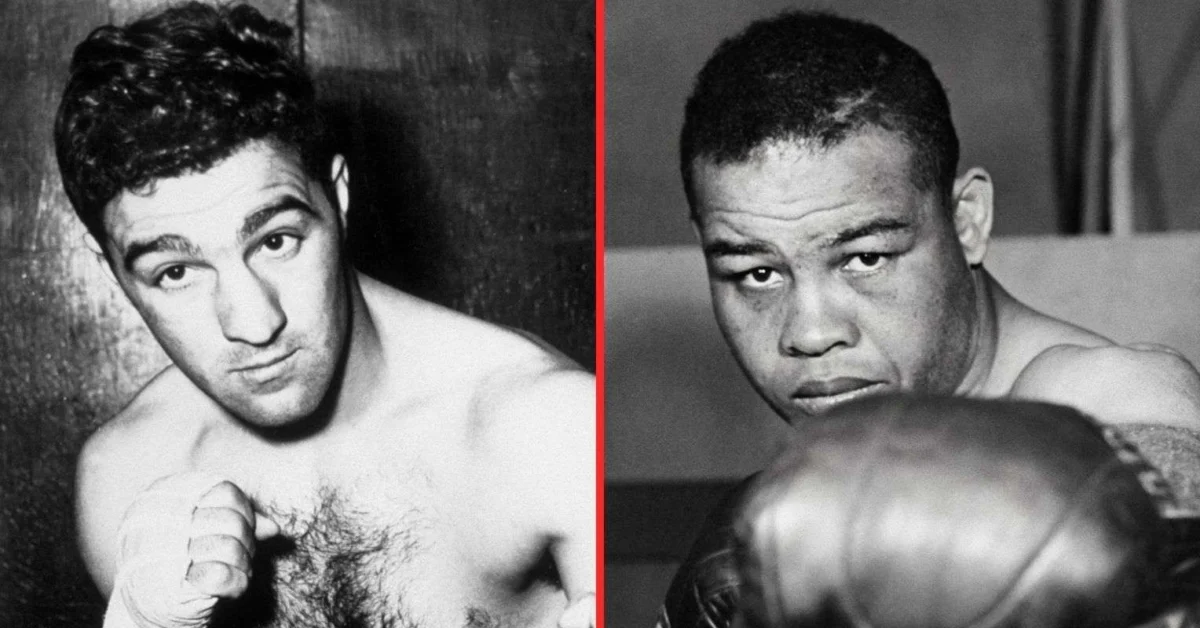
On this fateful night, the 37-year-old Louis—no longer the swift, devastating, and masterful "Brown Bomber" who had once struck fear into every heavyweight contender on the planet—climbed through the ropes at Madison Square Garden to face a terrifyingly formidable challenger: a 27-year-old Rocky Marciano who was rapidly approaching the absolute peak of his athletic powers.
The circumstances of Louis’s return to the ring were rooted in financial desperation rather than athletic ambition. Joe had originally returned to the squared circle after having retired as the undefeated, reigning champion in the summer of 1948, telling the media and his supporters that his primary intention in retirement was simply to "relax and play a lot of golf." But financial realities proved far more punishing than any opponent he had ever faced in his prime. Louis, visibly ageing, noticeably balding, and stripped of the blinding reflexes that had once defined his supremacy, had suffered a humbling decision loss to Ezzard Charles in his initial comeback bout.
Though he had managed to string together a sequence of eight consecutive victories since that sobering defeat to Charles, those wins could not turn back the clock. Now, he stood across the canvas from a younger, stronger, and infinitely more dangerous opponent known simply to the sports world as "The Rock."
Marciano entered the bout with a pristine, unblemished professional record, sitting at 37 victories and zero losses, with an astonishing 32 of those wins coming by way of knockout. He was young, relentlessly conditioned, and fiercely hungry for the world heavyweight crown that Louis had once dominated. Yet, the emotional stakes of the bout added a tragic layer of complexity to the matchup. Marciano actually held a profound personal admiration for Louis, looking up to him as an idol and a pioneer of the sport. Stepping into the ring to fight the man he respected above all others was a bitter pill to swallow, but professional reality left him with no choice if he wished to secure his own path to the championship. A massive crowd had packed into Madison Square Garden, paying handsomely to witness the historic collision of eras, but the majority of those passionate fans would leave the arena in a deeply depressed and somber state. The atmosphere was so heavy with melancholy that even the victor, Rocky Marciano, reportedly shed tears in his dressing room over the brutal reality of what had transpired between the ropes.
Despite his faded physical faculties and the vast gulf in age and stamina, Joe Louis demonstrated immense courage throughout the contest. In the early exchanges, the former champion actually managed to win a couple of rounds, proving that his ring IQ and technical brilliance had not entirely abandoned him. His legendary left jab, which had served as the foundation of his greatness for over a decade, still functioned with remarkable precision, snapping into Marciano’s face and briefly keeping the charging challenger at bay.
However, Rocky was as strong as a relentless bull, possessing an engine and a sheer physical resilience that simply could not be denied or broken down by technical skill alone. Steadily, methodically, Marciano began to wear Louis down, utilizing his sheer physical prowess alongside the devastating, bone-crushing power he carried in both fists. As the rounds progressed, the cumulative effect of Marciano’s relentless pressure proved to be far too much for this weathered, older version of Joe Louis to absorb.
The inevitable and stunning end came in the eighth round, unfolding with a dramatic finality that left the arena stunned into silence. Marciano caught the fading legend with a hefty, perfectly placed left hook to the head that sent Louis crashing to the canvas. Displaying the immense heart and warrior spirit that had defined his legendary career, Louis bravely hauled himself up from the floor, determined to beat the referee’s count and continue fighting. But there would be no miraculous escape or heroic comeback; he was soon to be put out of his misery in brutal, definitive fashion.
Wasting no time to capitalize on his wounded prey, "The Brockton Blockbuster" unleashed a monster right hand directly to Louis’s head—a thunderous punch that would soon become famous the world over under the moniker of the "Suzy Q." The impact of the blow was catastrophic, sending Louis staggering backward through the ropes and sprawling helplessly onto the apron of the ring. It was a ghastly, heart-wrenching sight for the thousands in attendance and the millions watching from afar to see the great former champion, a man who had once stood unrivaled atop the sporting world, laid out in such a defenseless and vulnerable position.
With this monumental yet sorrowful victory, Marciano had thoroughly earned his shot at the newly crowned heavyweight ruler, Jersey Joe Walcott, who had recently taken the title from Ezzard Charles in the final bout of their own hard-fought and punishing rivalry. Marciano would soon march forward to score another, even more memorable and far more celebrated knockout to officially become the king of the heavyweight division.
For Joe Louis, however, the chapter was closed forever. He never boxed again. His grueling, exhausting efforts at appeasing the Internal Revenue Service and satisfying his enormous tax debts would continue to haunt and torture him for some time to come, casting a long, dark shadow over his golden retirement years.
History records that Louis never came back to the ring to fight Marciano, or Charles, in pursuit of athletic glory or personal redemption; he simply had no choice in the matter. Joe desperately needed the money to survive the financial ruin that had engulfed him. When looking back at the entirety of his peerless career, it remains a testament to his durability that Louis was only ever stopped inside the distance by two men during his entire professional journey: the formidable Rocky Marciano on this gloomy night, and, years earlier before he had yet reached the summit as world champion, the great Max Schmeling.