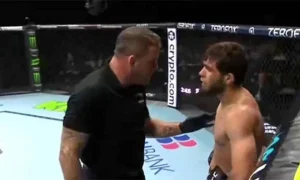


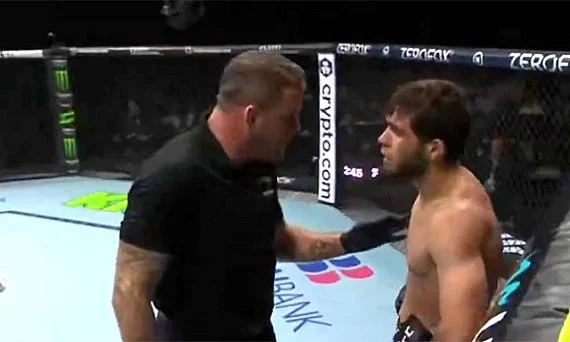
Referee Marc Goddard is sending an unmistakable message to mixed martial arts fighters around the globe: illegal tactics will no longer be tolerated without immediate and severe consequences. In a sport where the margins between victory and defeat are razor-thin, the enforcement of the Unified Rules of Mixed Martial Arts has often been a subject of intense debate among athletes, coaches, and fans alike. Historically, referees have frequently relied on verbal warnings or delayed interventions before taking a point away for infractions such as strikes to the back of the head, fence grabs, or accidental eye pokes. However, recent high-profile bouts officiated by the veteran referee suggest a significant shift toward immediate accountability inside the cage.
This stricter approach to officiating was prominently on display during the lightweight preliminary bout between Nurullo Aliev and Grant Dawson at UFC 333, which took place on Saturday at the Etihad Arena in Abu Dhabi. The matchup, featuring two elite competitors looking to make a statement on a major pay-per-view stage, quickly turned into a showcase not only of grappling and striking exchanges but also of how modern officiating handles illegal blows. The tone of the bout was altered significantly when disciplinary action became a central storyline of the contest.
Nurullo Aliev Penalized for Back-of-Head Strikes Against Grant Dawson at UFC 333
The tension in the Etihad Arena reached a boiling point in the opening frame of the UFC 333 preliminary clash. Nurullo Aliev had initially found success in the bout, managing to cleanly drop Grant Dawson with a heavy strike that sent shockwaves through the crowd and put the veteran grappler on the defensive. It was a dominant opening moment for Aliev, who was looking to cement his status as a rising threat in the lightweight division and maintain his unblemished professional record.
However, the momentum of the sequence shifted dramatically in the aftermath of the knockdown. As Aliev followed up with a flurry of ground strikes to capitalize on his advantage, several of his blows landed directly on the back of Dawson’s head, which is explicitly prohibited under the Unified Rules of MMA due to the severe neurological risks associated with strikes to the spine and the lower skull.
Recognizing the infraction instantly, referee Marc Goddard halted the action without hesitation. True to his reputation for enforcing the rules with strict consistency, Goddard immediately deducted a point from Aliev. In explaining his decision to the fighters and cage-side officials, the veteran referee noted that he had already issued prior warnings regarding similar infractions earlier in the sequence, leaving no room for further leniency.
The point deduction proved to be a pivotal turning point in the bout. Stripped of a point on the judges’ scorecards, Aliev faced an uphill battle as Dawson utilized his veteran savvy, relentless pressure, and high-level grappling pedigree to work his way back into the fight. Dawson rallied strongly in the subsequent rounds, neutralizing Aliev’s offense with smothering grappling and superior conditioning. When the final bell sounded, the judges awarded Dawson a unanimous decision victory. The hard-fought win not only kept Dawson’s momentum alive in the division but also handed Nurullo Aliev the first professional defeat of his mixed martial arts career, serving as a harsh lesson on the critical importance of rule adherence at the highest level of the sport.
The immediate deduction sparked widespread discussion across the mixed martial arts community, with fans and analysts taking to social media to praise the zero-tolerance stance. Among the reactions, a post on X (formerly Twitter) by Title Fight Media highlighted the swift enforcement: "Marc Goddard IMMEDIATELY took a point after Nurullo Aliev landed 3 back of the head shots on Grant Dawson at UFC 333. Referees are finally taking fouls seriously."
This heightened vigilance from Goddard is not an isolated incident, but rather part of a broader pattern of strict rule enforcement that has characterized his recent assignments inside the Octagon. Just weeks prior, a similar scenario unfolded at UFC Vegas 122, held on October 10, featuring a middleweight showdown between Christian Leroy Duncan and Brendan Allen.
During the UFC Fight Night 290 co-feature, Goddard found himself compelled to step in once again to penalize a fighter for illegal tactics. In the second round of the bout, Christian Leroy Duncan landed an accidental yet blatant eye poke on Brendan Allen. Much like the incident in Abu Dhabi, Goddard did not let the infraction slide with a mere warning. Following the foul, the referee explained that he had already explicitly warned Duncan about keeping his fingers outstretched and pointing toward his opponent’s face—a common posture that frequently leads to eye injuries in MMA striking exchanges.
Acting on his prior warnings, Goddard promptly deducted a point from Duncan, forcing the British middleweight to overcome a significant deficit on the scorecards. Despite the adversity and the point deduction, the fight continued at a high pace, with both athletes showcasing their respective skill sets. However, Brendan Allen’s grappling prowess ultimately proved to be the deciding factor in the later stages of the contest. Allen weathered the storm and capitalized on openings, eventually securing a submission victory over Duncan via a rear-naked choke in the fifth and final round.
The back-to-back instances at UFC 333 and UFC Vegas 122 underscore a noticeable evolution in how cage-side officials are approaching fouls in modern mixed martial arts. For years, fighters often pushed the boundaries of the rules, knowing that referees typically issued multiple verbal warnings before docking points, effectively granting a "free foul" in many high-stakes situations. By tightening the threshold for warnings and moving swiftly to point deductions, veterans like Marc Goddard are compelling athletes to adjust their techniques, keep their fingers closed, and maintain precise control over their strikes, even in the chaotic heat of combat. As fighters adapt to this stricter interpretation of the rules, the overarching hope within the sport is a reduction in dangerous infractions that threaten both fair competition and athlete safety.