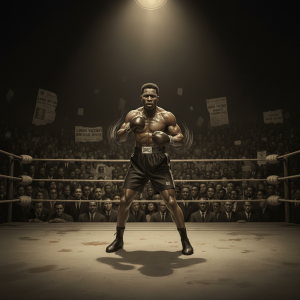

On November 22, 1986, the atmosphere inside the Las Vegas Hilton was thick with a specific kind of tension that only accompanies history in the making. The boxing world had seen hard hitters before, and it had seen young prodigies, but it had never seen anything quite like the 20-year-old wrecking ball from Catskill, New York. This was the night Mike Tyson faced Trevor Berbick for the WBC Heavyweight Championship, a bout labeled ‘Judgment Day.’ It was the night the prophecy of Cus D’Amato would finally be realized, and the night Mike Tyson truly became ‘Iron Mike.’
To understand the magnitude of this fight, one must understand the landscape of the heavyweight division in the mid-1980s. It was a fragmented era, cluttered with alphabet soup organizations and champions who lacked the global charisma of Muhammad Ali. Tyson was different. He was a visceral force of nature, a compact ball of muscle and rage who moved with the agility of a lightweight and hit with the impact of a freight train. He had torn through the rankings with a record of 27-0, with 25 knockouts, leaving a trail of unconscious bodies in his wake.
The Ghost of Cus D’Amato
The emotional narrative underpinning this fight was as powerful as Tyson’s right hand. Just over a year prior, Tyson’s mentor, father figure, and trainer, Cus D’Amato, had passed away. D’Amato had discovered Tyson in a juvenile detention center and molded him into a fighting machine, constantly whispering in his ear that he would be the youngest heavyweight champion in history. Entering the ring against Berbick, Tyson wasn’t just fighting for a belt; he was fighting to validate the life’s work of the man who saved him.
Trevor Berbick, the defending champion, was no stepping stone. He was a rugged, awkward, and physically strong Jamaican fighter who held the distinction of being the last man to defeat Muhammad Ali. Berbick was confident, perhaps to a fault, believing that his experience and physical strength would allow him to bully the younger, shorter challenger. He planned to drag Tyson into deep waters, testing the stamina that critics claimed was Tyson’s only weakness. However, Berbick severely miscalculated the speed at which Tyson closed the distance.
The Walk to the Ring
The contrast in the ring entrances set the tone for the violence to come. Berbick walked out with the pomp and circumstance expected of a champion. Tyson, conversely, emerged in his signature minimalist style: no robe, no socks, just black trunks and black boots. A towel with a hole cut in the center was draped over his neck. The sound in the arena shifted from cheers to a low, ominous rumble. Tyson paced the ring like a caged predator, his neck muscles bulging, staring through Berbick with a cold, dead-eyed intensity that unnerved even the most seasoned ringside observers.
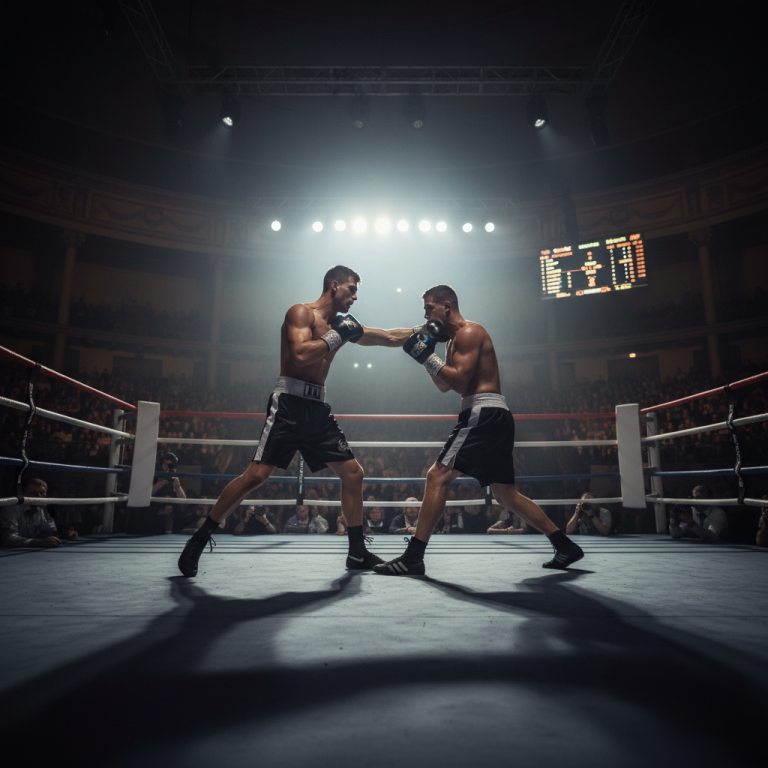
When the opening bell rang, Tyson did not waste a second. He exploded out of his corner, utilizing the ‘Peek-a-Boo’ style D’Amato had perfected. Hands high, head bobbing and weaving, Tyson slipped inside Berbick’s reach instantly. Berbick tried to stand his ground, opting to trade power shots rather than clinch or move—a tactical error that would prove fatal. Within the first minute, the difference in hand speed was shocking. Tyson landed thudding body shots that echoed through the arena, visibly sapping Berbick’s resolve.
Near the end of the first round, Tyson connected with a combination that sent Berbick reeling across the ring. The champion stayed on his feet, but his equilibrium was already compromised. Berbick’s strategy of intimidation had backfired spectacularly; he was not the bully, but the prey. As he walked back to his corner, the look on his face was not one of defiance, but of sudden, terrifying realization. He was in the ring with something he couldn’t control.
The Round That Changed History
Round two began with Tyson sensing blood. He didn’t just want to win; he wanted to destroy. He pressured Berbick immediately, landing a crushing right hand to the temple that sent the champion down. It was a flash knockdown, and Berbick rose quickly, nodding to referee Mills Lane to indicate he was fine. But Tyson was relentless. He swarmed Berbick, unleashing a barrage of hooks and uppercuts that were thrown with bad intentions and pinpoint accuracy.
Then came the finishing sequence, a moment etched forever in sporting lore. Tyson dipped low and exploded upward with a left hook to the liver, followed instantly by a left hook to the temple. The second punch didn’t look like a haymaker, but the torque generated from Tyson’s hips was devastating. Berbick collapsed to the canvas, his neurological system completely short-circuited.
What followed is often referred to as the ‘Chicken Dance.’ Berbick, exhibiting the heart of a champion but the motor control of a newborn, tried to stand up. He rose to shaky legs, stumbled across the ring, and fell again. He tried a second time, his legs betraying him as he crashed into the ropes. On his third attempt, Mills Lane stepped in and waved the fight off. It was over. At 2 minutes and 35 seconds of the second round, the era of Mike Tyson had officially begun.
The Coronation of a King
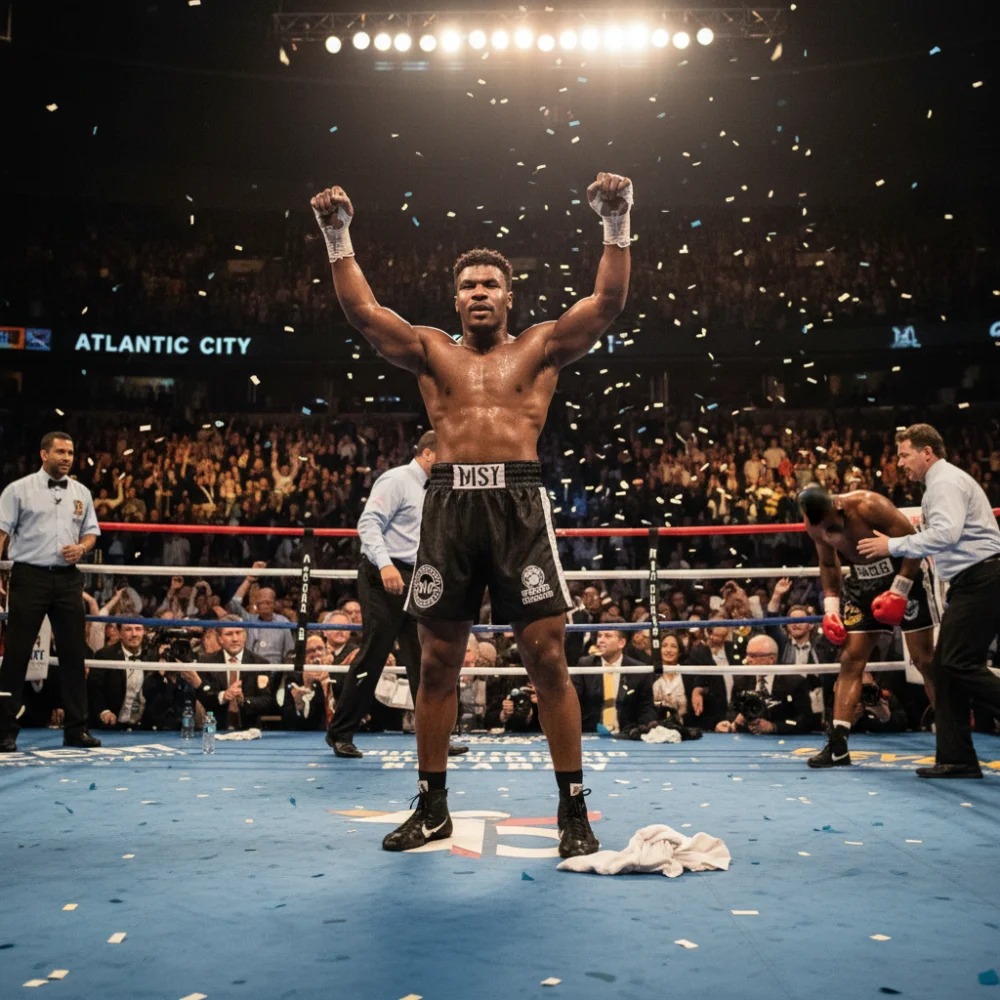
At 20 years, 4 months, and 22 days old, Mike Tyson became the youngest heavyweight champion in history, a record that stands to this day. The image of Tyson raising his hands, his face a mask of stoic triumph rather than jubilation, was chilling. In his post-fight interview, he dedicated the win to Cus D’Amato, his voice softening just enough to remind the world that inside the destroyer was still a young man grieving his father.
The victory over Berbick was more than just a title win; it was a paradigm shift in how heavyweights were viewed. Tyson proved that size was secondary to speed, leverage, and technique. His ability to slip punches by mere millimeters and counter with knockout power revolutionized the division. He wasn’t just a brawler; he was a highly technical counter-puncher disguised as a slugger.
Key factors in Tyson’s victory included:
- Head Movement: Tyson’s constant motion made him an elusive target, frustrating Berbick’s attempts to establish a jab.
- Leverage: Despite being shorter, Tyson generated immense power by punching upward from his legs.
- Psychological Warfare: Tyson’s aura of invincibility broke Berbick mentally before the first punch was thrown.
The aftermath of the fight saw Tyson unify the WBA and IBF titles shortly after, becoming the undisputed champion. However, the Berbick fight remains the purest distillation of his prime. It was Tyson at his absolute peak—focused, disciplined, and terrifyingly efficient. There were no distractions, no controversies, just pure athletic dominance.
For boxing historians, the night Tyson beat Berbick serves as the benchmark for heavyweight dominance. It represents the perfect storm of potential meeting opportunity. The visual of Berbick struggling to find his gravity remains one of the most visceral depictions of concussion and power in sports history, a testament to the heavy hands of ‘Iron Mike.’
Decades later, the legacy of that night in Las Vegas endures. It reminds us of a time when the heavyweight championship was the most coveted prize in sports and when a 20-year-old kid from Brownsville convinced the world he was the baddest man on the planet. On that night, Tyson didn’t just win a belt; he became a cultural icon.