

For anyone who holds a simultaneous, deep-seated passion for live sports, the performing arts, and classical music, discovering a masterpiece that unifies all three can feel like an incredible revelation. That sense of surprise is only heightened when the work in question is a forgotten classic by one of the defining voices of twentieth-century drama. Clifford Odets’s 1937 play Golden Boy presents precisely this fascinating convergence, yet it has remained largely hidden from British audiences, having gone unperformed in the United Kingdom for more than four decades. Its absence from the stage may well be tied to its extraordinarily unique and seemingly paradoxical premise: a story centered on a gifted young violinist in Depression-era America who discovers an explosive talent for professional boxing, ultimately abandoning his instrument to chase wealth and fame inside the ring.
Currently revived on the London stage, Golden Boy brings this high-stakes narrative to life through a commanding performance by Josh O’Connor. Cinema audiences recently watched O’Connor showcase his physical prowess as a boxer turned priest in Rian Johnson’s Wake Up Dead Man: A Knives Out Mystery, but his transition to the stage demonstrates that his ring work is far more than a cinematic trick. In the theater, O’Connor attacks the heavy bag with a ferocious, authentic power that makes onlookers genuinely fear for the safety of his character’s prized hands. The physical conditioning on display is unmistakable, proving that his athletic physique is the result of genuine grit rather than clever stage makeup.
At first glance, a drama built around a young man choosing between the delicate artistry of a classical musician and the bone-crunching violence of a professional prizefighter might sound implausible, perhaps even edging toward absurdity. Yet, inside the theatre, the tension feels profoundly real and intensely immediate. Odets, a foundational architect of modern American theatre, was writing out of the grim reality of 1930s New York. During the Great Depression, life was relentlessly unforgiving, economic opportunities were virtually nonexistent, and the brutal arena of professional boxing offered one of the few visible, albeit treacherous, escape routes from soul-crushing poverty.
Beyond its historic realism, the play operates as a poignant allegory. As the young protagonist gradually establishes his footing within the ropes, accumulating wins and public acclaim, he systematically strips away his softer, more empathetic self. In sacrificing his violin for boxing gloves, he trades the promise of quiet spiritual contentment for a lucrative but morally eroding path, demonstrating how the pursuit of financial survival can consume the human spirit.

This enduring friction between creation and destruction helps explain why boxing has supplied such endlessly rich material for dramaturges and filmmakers over the last century. Historically, Hollywood has produced more movies dedicated to boxing than to any other sport in existence. Playwrights, directors, and actors remain compulsively drawn to the ring, despite—or perhaps because of—the pervasive belief that a sensitive artistic nature stands in direct opposition to physical brutalism.
Part of the ring’s dramatic appeal lies in how a fighter isolated beneath the arena lights so closely mirrors the protagonist of a classic Greek tragedy. Stripped down to bare skin and basic instincts, the boxer becomes humanity reduced to its rawest, most vulnerable state—a solitary figure battling fate, testing the absolute boundaries of personal agency, and enduring physical agony in full view of a watching crowd. Simultaneously, boxing offers a hypnotic visual ballet. The canvas becomes a stage where bodies dodge, duck, pivot, and violently collide, creating a visceral choreography that naturally translates to stage and screen.
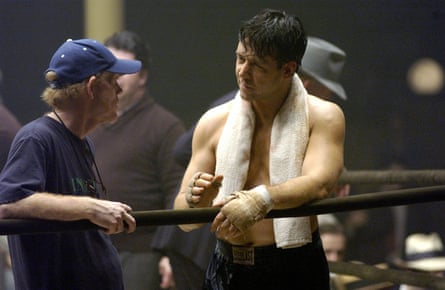
What makes the boxing motif so resilient is its remarkable narrative elasticity. Creators can load a fight story with almost any thematic subtext, psychological drama, or sociopolitical commentary they choose. Odets utilized the predatory, exploitative fight world of the 1930s to deliver an excoriating critique of American capitalism and the corrosive nature of the American Dream. Conversely, director Ron Howard took the exact same historical landscape in his 2005 film Cinderella Man and constructed a warm, feel-good fairytale. Starring Russell Crowe as real-life Depression-era heavyweight champion James J. Braddock during his legendary championship bout against Max Baer, Howard’s film reframed the brutality of the ring into an uplifting testament to family loyalty and muscular Christianity.
This complex, highly ambivalent relationship with morality is precisely what drew early cinema pioneers to the sport. Alfred Hitchcock, the undisputed master of suspense and moral ambiguity, possessed a lifelong fascination with boxing. Exactly ninety-nine years ago this month, Hitchcock released The Ring, the only film in his vast director’s filmography for which he held a sole writing credit. A silent, black-and-white feature marked by the stylistic hallmarks of its era—where female characters sport cloche hats and dramatic circular eyeliner while figures move with the characteristic jerkiness of early projection rates—the movie remains astonishingly modern in its depiction of combat. Hitchcock cast Carl Brisson, a real-life Danish and European boxing champion, in the lead role to ensure absolute authenticity in the fight sequences, while utilizing pioneering point-of-view camera work to visually convey the disorientation of a fighter slipping into a concussion.
By the 1940s, the dark corridors of professional boxing had become the ultimate setting for film noir, offering an ideal backdrop for stories exploring institutional corruption, systemic vice, and personal moral decay. Classics such as Body and Soul, Champion, and The Set-Up laid bare the shadowy underbelly of the sport. Stanley Kubrick tapped into this same gritty atmosphere for his second feature-length film, the 1955 noir Killer’s Kiss. The movie’s original promotional poster captured the melodramatic intensity of the subgenre, pulling no punches with its bold tagline: “Her Soft Mouth Was The Road to Sin-Smeared Violence!”
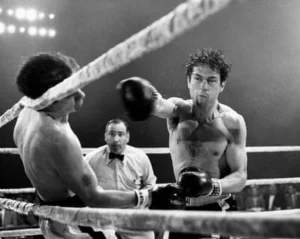
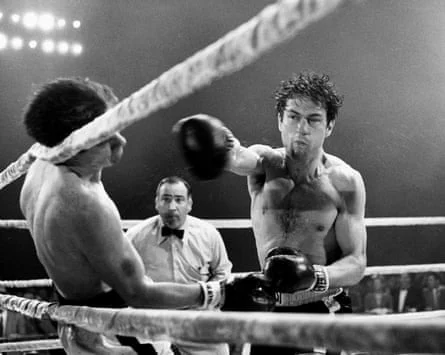
The absolute pinnacle of the boxing film genre arrived in 1980 with Martin Scorsese’s Raging Bull. Widely regarded as a cinematic masterpiece, the film presents an unsparing, deeply uncomfortable portrait of real-life middleweight champion Jake LaMotta, depicting him as an abusive, paranoid, and fundamentally pathological antihero. Interestingly, Scorsese was initially reluctant to make the movie. It was his close friend and collaborator, Robert De Niro, who became utterly obsessed with LaMotta’s self-destructive odyssey and the extreme physical transformation required to bring the troubled fighter to life on screen.
De Niro’s total commitment highlights another major reason for boxing’s incredible longevity in drama: it represents the ultimate physical and emotional crucible for an actor. On the unforgiving, high-definition canvas of modern cinema, it is impossible to fake the physique, movement, or stamina of a trained prizefighter. A long list of Hollywood elite—including Daniel Day-Lewis, Jake Gyllenhaal, Will Smith, and Hilary Swank—have willingly subjected themselves to months of brutal daily conditioning and exhausting sparring sessions to achieve authenticity. Mark Wahlberg, a lifelong boxing enthusiast, went so far as to build a full-sized ring inside his home, training rigorously for five straight years before cameras finally rolled on The Fighter—an effort that bore immense artistic fruit, even if his co-star Christian Bale ultimately walked away with the Academy Award.
For younger generations of actors, the physical demands of the ring serve as a form of immersive artistic catharsis. Michael B. Jordan, who headlined and later directed entries in the hit Creed franchise, has described the grueling preparation process as therapeutic because it requires total bodily immersion. Jordan noted that he actively embraced the physical toll, taking pride in living and training like a professional fighter, enduring broken hands, swollen joints, and late-night body aches just to capture the genuine reality of the sport. Sylvester Stallone’s lifelong artistic contribution to boxing narrative has been so profound that he was officially inducted into the International Boxing Hall of Fame.
The relationship between real-world combat and fictional representation has become entirely self-sustaining over the decades. Stallone’s iconic, Oscar-winning 1976 script for Rocky was directly inspired by the real-life 1975 heavyweight clash between heavy underdog Chuck Wepner and Muhammad Ali. Decades later, in 2016, actor Liev Schreiber portrayed Wepner himself in the acclaimed independent biopic The Bleeder. The narrative loop continues to turn, with Stallone’s own behind-the-scenes story taking center stage in the biographical drama I Play Rocky.
Ultimately, this ongoing dialogue between reality and drama underscores a fascinating cultural shift. Even as actual professional boxing has seen its mainstream cultural dominance recede compared to its mid-twentieth-century peak, its metaphorical grip on stage and screen remains completely unbroken. Whether serving as a critique of capitalist ambition in Clifford Odets’s Golden Boy or as an exploration of human redemption in modern cinema, the fight game continues to provide artists with an unparalleled landscape to examine the fragile, violent boundaries of the human condition.