
CrossFit athletes and coaches have long understood a fundamental truth of functional fitness: mobility can single-handedly make or break an athlete’s performance. Without adequate range of motion and joint health, complex movements like overhead squats, snatches, and heavy thrusters transform from fluid athletic displays into exercises that are not only profoundly difficult, but actively painful and risky.
Addressing this universal challenge within the functional fitness community, a CrossFit coach recently introduced a straightforward, 30-day mobility protocol designed to target the three most pervasive problem areas holding athletes back: restricted squat depth, compromised front rack positions, and unstable overhead mechanics. The most compelling aspect of the protocol is its accessibility. Each targeted daily drill takes just five minutes to complete and requires absolute zero specialized gym equipment, making it an easy addition for athletes working out at home or traveling.
According to the coach, who initially implemented this protocol as a community challenge within his gym, high-intensity functional training demands mobility across three critical anatomical junctions. Proper squat mobility allows athletes to hit optimal depth without falling back on mechanical compensations that can overload the lower back or knees. Overhead mobility ensures safe, rigid positioning during demanding movements such as snatches, overhead squats, and handstand push-ups. Meanwhile, front rack mobility dictates whether cleans and thrusters feel smooth and mechanically efficient or impossibly awkward and punishing on the wrists.
The common thread linking these struggles among modern athletes is not necessarily a lack of athletic potential, but rather the cumulative toll of sedentary lifestyle habits. The coach noted that many individuals struggle significantly with overhead, front rack, and squat positions because they sit for prolonged periods each day. When the human body gets locked into chronic sitting positions for hours on end, it adapts to those shapes, making it exceedingly difficult to break out of them when it is time to train.
Hours spent hunched over computer keyboards, scrolling through phones, and sitting behind the steering wheels of cars create posture and tissue adaptations that are the exact opposite of what CrossFit movements require.
The coach’s own personal mobility journey began in the wake of an injury—specifically, a high hamstring tear that left his knees feeling severely compromised and entirely unable to fully bend. Desperate for a solution to restore his leg function, he discovered a video from Olympic weightlifting coach Zack Telander highlighting the profound benefits of the five-minute deep squat hold. Intrigued by the concept, he began incorporating it into his daily routine, reporting that it completely transformed his mobility in the squat.
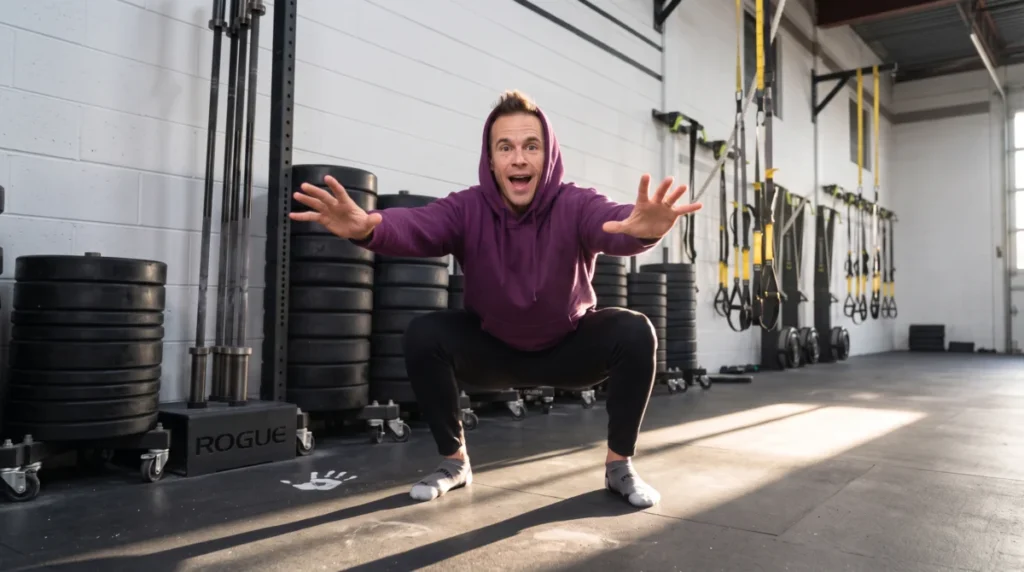
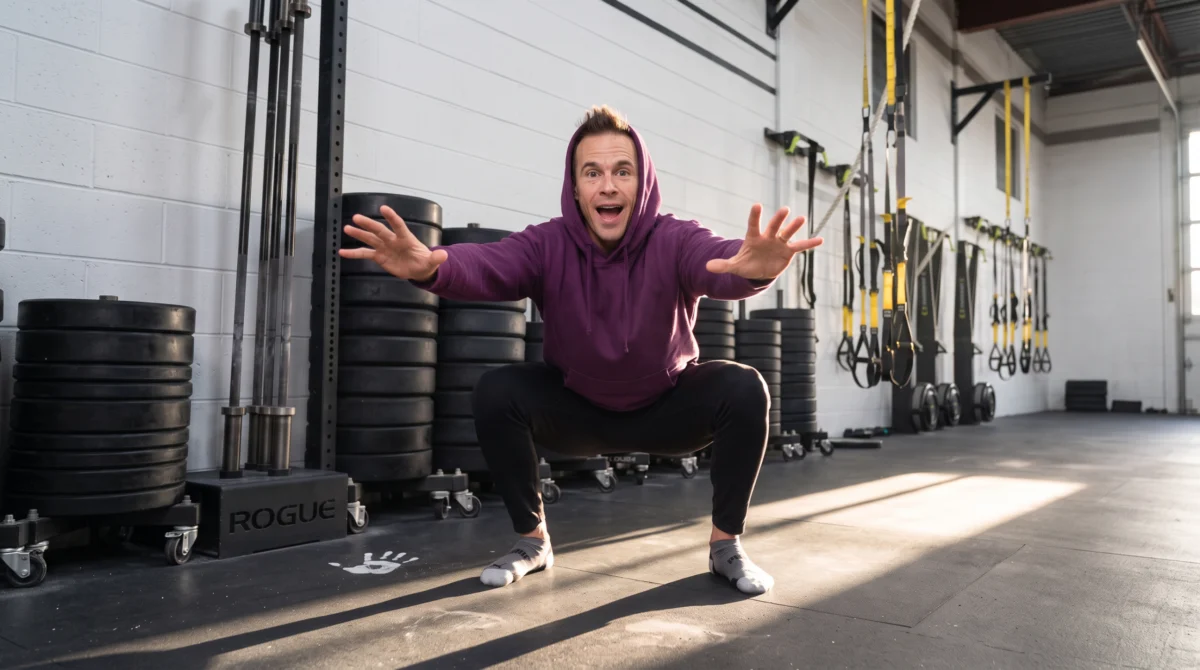
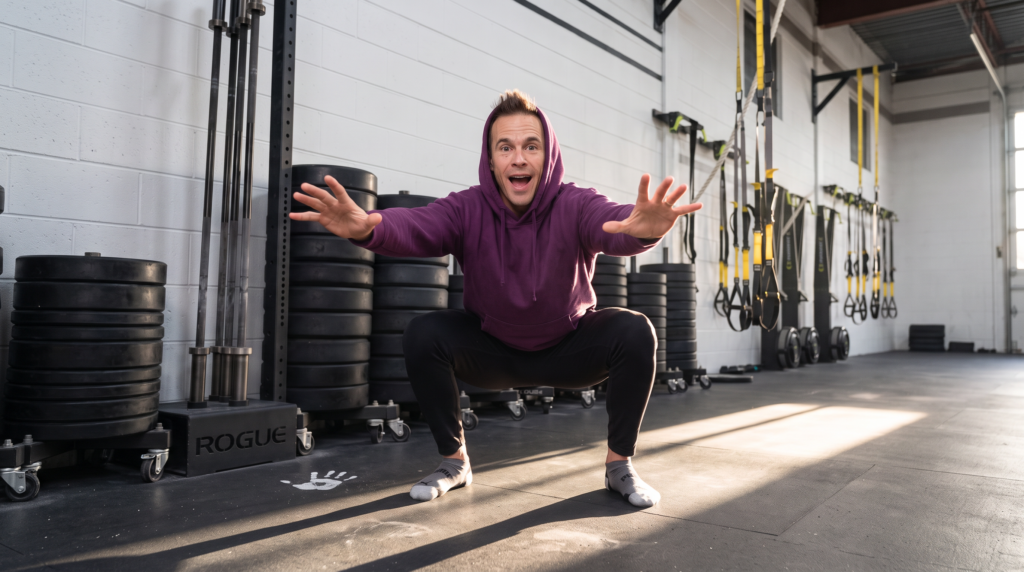
The underlying concept is brutally simple in execution: an athlete sets a timer for five minutes and remains in a deep, bottom-position squat for the entire duration without standing up. The protocol emphasizes quality over sheer punishment. Athletes descend into their absolute best possible squat position, ensuring that the big toe stays planted firmly on the ground to maintain proper foot pressure. Once settled in the bottom position, the primary goal is simply to stay there, embracing the discomfort and letting time under tension do the work.
This extended exposure forces neurological and structural adaptations in the ankles, hips, and thoracic spine that brief, sporadic static stretching simply cannot achieve.
As the protocol progresses into the second ten-day block, the focus shifts entirely toward opening up the front rack position. To understand why these specific stretches work, it is necessary to examine why the front rack feels so punishing for the average modern athlete. A truly solid front rack position requires three simultaneous qualities that contemporary posture actively works to destroy: adequate wrist extension, sufficient external shoulder rotation, and an open, mobile thoracic spine.
The coach points out that once again, routine life positions like typing, texting, and driving lock the body into a rounded, forward-shuffling shape. Consequently, it becomes remarkably difficult for athletes to wrap a full, secure grip around a barbell during cleans or front squats. To counteract this, the protocol employs two targeted drills during days eleven through twenty, each performed for two and a half minutes per side.
The first of these is the twisted cross, a movement specifically designed to counter the chronic forward-shoulder posture that plagues desk workers. Athletes lie face-down on the floor with both arms extended straight out in a classic T-position. From there, they drive the front shoulder firmly into the ground while placing the opposite hand in a standard push-up position. The leg on the reaching side then rotates up and over the body, with the foot attempting to touch the stabilizing hand on the floor.
The goal of this movement is to achieve ninety degrees of active torso rotation while keeping the front shoulder securely pinned to the floor. This position forces time with the arm positioned behind the body, creating a direct counterbalance to the habitual forward posture that ruins front rack mechanics.
The second front rack drill, introduced during the latter half of this ten-day block, utilizes a simple PVC pipe or broomstick to focus intensely on shoulder external rotation. Athletes are instructed to place the pipe squarely in their full palm—a detail the coach emphasizes as critically important—and position it behind the shoulder before grabbing the pipe in front of the body with the opposite hand. By sliding the lower hand down while pulling across the body, the athlete generates significant external rotation torque.
If an athlete’s hand slips during this process, the stretch loses its effectiveness entirely. Maintaining a full grip around the pipe ensures that the stretch targets the exact range of motion required to rack a barbell cleanly without dumping dangerous loads directly into the vulnerable joints of the wrists. In fact, the coach notes that athletes who successfully develop this shoulder mobility often see chronic wrist pain disappear altogether, as the weight of the barbell is successfully transferred down into the torso instead of collapsing into the hands.
The final ten days of the 30-day challenge transition into building robust overhead capacity through a deceptively challenging movement known as the wall hinge. This particular drill requires no equipment other than a plain wall, making it exceptionally accessible for home practice, though athletes quickly learn that simplicity does not equate to ease.
When beginning the wall hinge, athletes often report that it does not initially feel like much work is being done. However, as the continuous hold progresses, it frequently emerges as the most physically demanding drill of the entire month. To perform the movement, an athlete stands facing away from a wall, placing their hands against the surface at approximately ninety degrees with their arms fully extended and their torso hinged forward so that it is roughly parallel to the ground.
Rather than simply holding a passive position, athletes cycle through active phases throughout the duration of the drill, creating significant opening within the thoracic spine and the shoulder girdle—the exact physical attributes that overhead lifts demand. The coach issues one critical warning regarding this movement: athletes must exit the position slowly and deliberately, walking their hands toward the wall into a push-up position before standing upright, as the intense nature of the stretch makes sudden movements risky for unprepared muscles.
The defining characteristic that sets this protocol apart is not necessarily the novelty of the stretches themselves, but rather the commitment to five-minute durations. Most fitness enthusiasts perform mobility work in hurried bursts lasting anywhere from thirty seconds to a single minute. However, existing scientific research on static stretching indicates that longer duration holds, typically ranging from two to four minutes, produce significantly more profound and lasting changes in muscle length and overall joint range of motion.
A notable 2012 study published in the Scandinavian Journal of Medicine & Science in Sports demonstrated that stretch duration heavily influences flexibility gains, with extended holds yielding superior results. Furthermore, the coach’s heavy emphasis on daily consistency aligns directly with established evidence regarding neuromuscular adaptation. While sporadic stretching provides only temporary improvements in range of motion, regular, daily practice fosters permanent changes in tissue extensibility and motor control patterns.
Every single drill featured in this 30-day protocol is specifically engineered to counteract the physical consequences of excessive sitting. Prolonged sedentary behavior systematically shortens the hip flexors, rounds the thoracic spine, protracts the shoulders forward, and keeps the ankles locked in perpetual plantar flexion. These precise bodily adaptations are precisely what destroy an athlete’s squat depth, front rack integrity, and overhead stability.
A 2018 review published in the Journal of Sport and Health Science documented how prolonged sitting directly reduces hip extension range of motion and increases thoracic kyphosis, identifying both as major limiting factors for functional fitness movements. The solution proposed by the protocol is not merely telling people to sit less, though that remains beneficial, but actively and deliberately spending time in opposing physical positions. Deep squats, chest-opening shoulder stretches, and extended overhead reaches provide the essential counterbalance that modern sedentary life demands.
The ultimate success of this 30-day mobility challenge lies in its balance of simplicity and structure. A five-minute daily commitment is long enough to stimulate genuine physiological adaptation, yet short enough that athletes run out of excuses to skip it. The complete lack of equipment requirements removes barriers to entry, while dividing the month into distinct ten-day blocks provides clear mental progression and prevents routine boredom.
While this streamlined protocol is designed to address the most common mobility limitations shared by functional fitness athletes, the coach acknowledges that individual practitioners may occasionally require supplemental work. Restrictions in ankle mobility, for instance, may necessitate targeted calf and anterior tibialis exercises, while severe thoracic immobility can benefit from foam rolling or specialized extension movements. Previous injuries can also leave behind asymmetries that demand professional attention.
Ultimately, the five-minute daily practice serves to establish a solid movement foundation. For the vast majority of CrossFit athletes who find themselves struggling against basic movement positions in the gym, adopting a structured daily routine provides a direct pathway to addressing root mechanical causes rather than merely treating the physical symptoms.