


Youth sports coaching is undergoing a quiet evolution, with experienced trainers shifting away from rigid, overly specialized drills and returning to the natural power of play. Renowned performance coach Jeremy Frisch has long advocated for integrating dynamic games into youth training sessions, arguing that unstructured or semi-structured play remains the most effective vehicle for developing foundational athletic skills. By modifying rules, environments, and participant dynamics, coaches can target specific physiological and cognitive outcomes without sacrificing the innate enjoyment that keeps children engaged in sports.
From the perspective of a child, games represent the most natural, familiar, and entertaining form of activity. Given free time and open space, children naturally gravitate toward chasing one another or engaging in playful wrestling. From a coaching perspective, games are remarkably easy to introduce, inherently motivating, and instantly captivating for young athletes. Frisch emphasizes that altering the parameters of a simple game—such as expanding a playing boundary during a game of tag—forces players to cover greater distances, thereby enhancing conditioning, or conversely, shrinking the space to sharpen decision-making and rapid directional changes.

Ultimately, games serve as a vital mechanism for children to practice and expand their overall movement vocabulary. Long before the era of dedicated training facilities and travel teams, children across generations engaged in pickup games in backyards and local playgrounds. These self-organized activities, featuring player-created rules and minimal adult intervention, provided an ideal environment for testing and refining physical skills. Without coaches dictating technical perfection, children independently solved problems and developed high-level adaptability, traits that seamlessly transferred into complex, organized sports later in life.
In professional training facilities, foundational movement patterns such as sprinting, jumping, catching, and throwing form the bedrock of athletic development. While complete mastery is neither expected nor required from young athletes, establishing basic competence is essential. Coaches typically introduce these movements during warm-ups or targeted skill-development phases before placing children into open, chaotic environments. This is where games bridge the gap, allowing young participants to apply technical movements in dynamic, unpredictable scenarios. Frisch has curated a robust collection of favorite games that fulfill specific training objectives while maximizing engagement.
Flag-Tag
Tag remains arguably the simplest yet most athletically beneficial game for children, requiring nothing more than open space and an intuitive understanding of the rules. The activity naturally fosters decision-making, tracking, evasion, tactics, acceleration, deceleration, directional changes, and spatial awareness, all while delivering significant cardiovascular benefits.
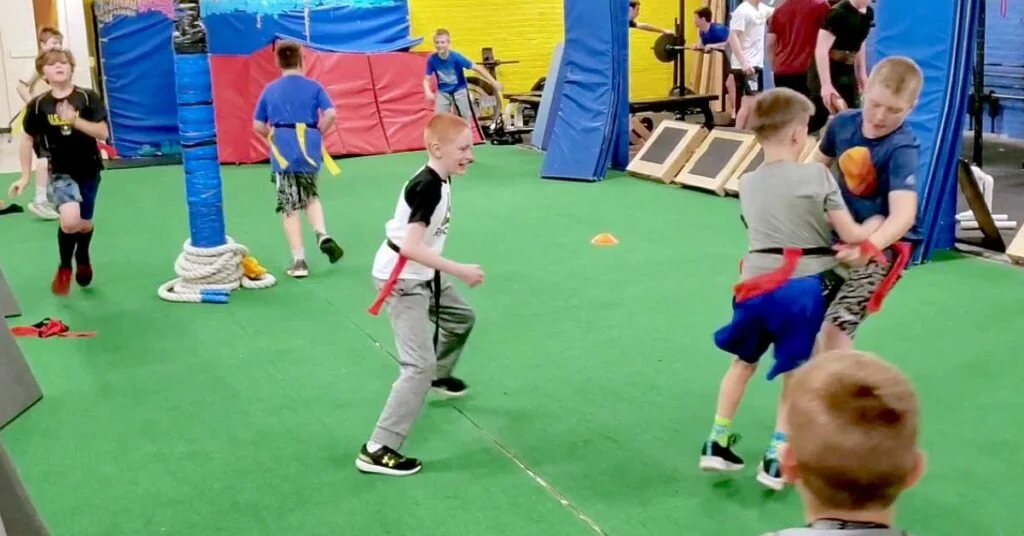
By incorporating American Football flags into the classic format, coaches can elevate the complexity. In "Flag Tag," every participant acts simultaneously as a pursuer and a target in a last-person-standing format. The objective is to strip opponents of their flags while protecting one’s own. Crucially, the game removes any need for indiscriminate physical contact, restricting the interaction to a specific anatomical target area: the hips. For football coaches, this directly reinforces proper tackling mechanics, as defenders must consistently orient themselves near an opponent’s hips during open-field engagements.

Team Relay Tag
Introducing time constraints to tag games instills a vital sense of urgency, mirroring the structural reality of competitive team sports. In Team Relay Tag, participants are divided into hunting and running squads within a confined square boundary. Every member of the hunting team takes a turn pursuing runners, while runners who are tagged remain in the game until all hunters have completed their turns. The stopwatch measures how quickly the hunting team captures its targets before roles are reversed. This format develops sharp directional changes, efficient movement in tight spaces, and rapid visual processing under pressure.
Power Ball
Drawing inspiration from classic televised competition shows, "Power Ball" challenges attacking players to deposit multiple balls into designated buckets within a strict thirty-second window, while defenders attempt to intercept them. The setup relies on a deliberate numerical imbalance, ensuring there is always one more target bucket than there are defenders. This forces defensive players into collaborative teamwork and pushes offensive players to read the field and exploit open space. The resulting skills—evasion, defensive footwork, visual perception, and split-second decision-making—transfer directly to a wide array of competitive sports.

Move the Mountain
Moving beyond traditional linear racing, "Move the Mountain" transforms standard track activities into an intense, multi-faceted relay obstacle course. By incorporating running, carrying objects, and navigating physical barriers alongside teammates of varying speed profiles, coaches create an environment where speed alone is not the sole determinant of success. This setup encourages cooperative problem-solving and exposes young athletes to diverse physical challenges.
Runners and Gunners
Often recognized by its traditional moniker "Pickle," "Runners and Gunners" utilizes soft balls and continuous movement to create a high-intensity cardiovascular workout disguised as play. Participants navigate back and forth across a designated corridor while throwers attempt to make contact. Because the velocity of a thrown ball far exceeds human running speed, the game naturally trains rapid acceleration, deceleration, and evasive reactions. Frisch notes that children routinely cover hundreds of yards during a single session without realizing they are completing rigorous endurance conditioning, entirely because their focus remains locked on the competitive excitement of the game.

Kings and Pawns
Blending elements of wrestling and football, "Kings and Pawns" introduces close-quarters physical engagement, pushing, pulling, and blocking. Teams are structured with kneeling pawns protecting a designated king, whose objective is to cross a contested zone without being tackled by opposing pawns. The activity provides a controlled, highly engaging environment for young athletes to grow comfortable with physical proximity, body contact, and balance maintenance, serving as an ideal introduction for contact sports.
Boulder Ball
Utilizing stability balls to simulate rolling obstacles, "Boulder Ball" engages younger athletes through two distinct variations focused on evasion and acceleration. In the escape variation, children maneuver around a central zone while coaches gently roll the stability ball, requiring quick reflexes, ducking, and diving. The alternative racing variation pits athletes against the rolling ball in a dash toward a safety mat, echoing cinematic pursuits and transforming abstract sprinting into an imaginative, high-energy activity.

Mountain Sprints
While traditional sprint training can occasionally feel monotonous to young participants, incorporating natural topography changes standard conditioning into an engaging challenge. Sprints up gentle hills naturally enforce proper forward lean during the acceleration phase, making poor running mechanics difficult to maintain. By turning hill sprints into paired races and ensuring adequate recovery intervals between efforts, coaches can effectively train speed and coordination without crossing into fatigue-inducing endurance work.
Tug-of-War
Classics like tug-of-war remain indispensable tools for total-body strength development. The activity demands maximal isometric tension across the hands, arms, shoulders, back, and lower body. Whether utilizing heavy ropes or smaller improvised grips, children engage in powerful physical exertion that builds functional strength while naturally fueling competitive enthusiasm. Integrating these challenges into broader movement circuits ensures a well-rounded approach to youth physical development.

The Long-Term Value of Play-Based Training
To ensure training translates effectively to real-world athletic competition, coaches must expose young participants to diverse movements and unpredictable environments. While structured drills have their place in refining specific mechanical actions, games introduce the chaotic, competitive variables inherent in actual sports. Frisch emphasizes that technical refinement should be reserved for later developmental stages, while the foundational years must prioritize holistic movement literacy. By preserving the element of fun, coaches can combat declining youth sports participation rates and instill a lifelong appreciation for physical activity.