
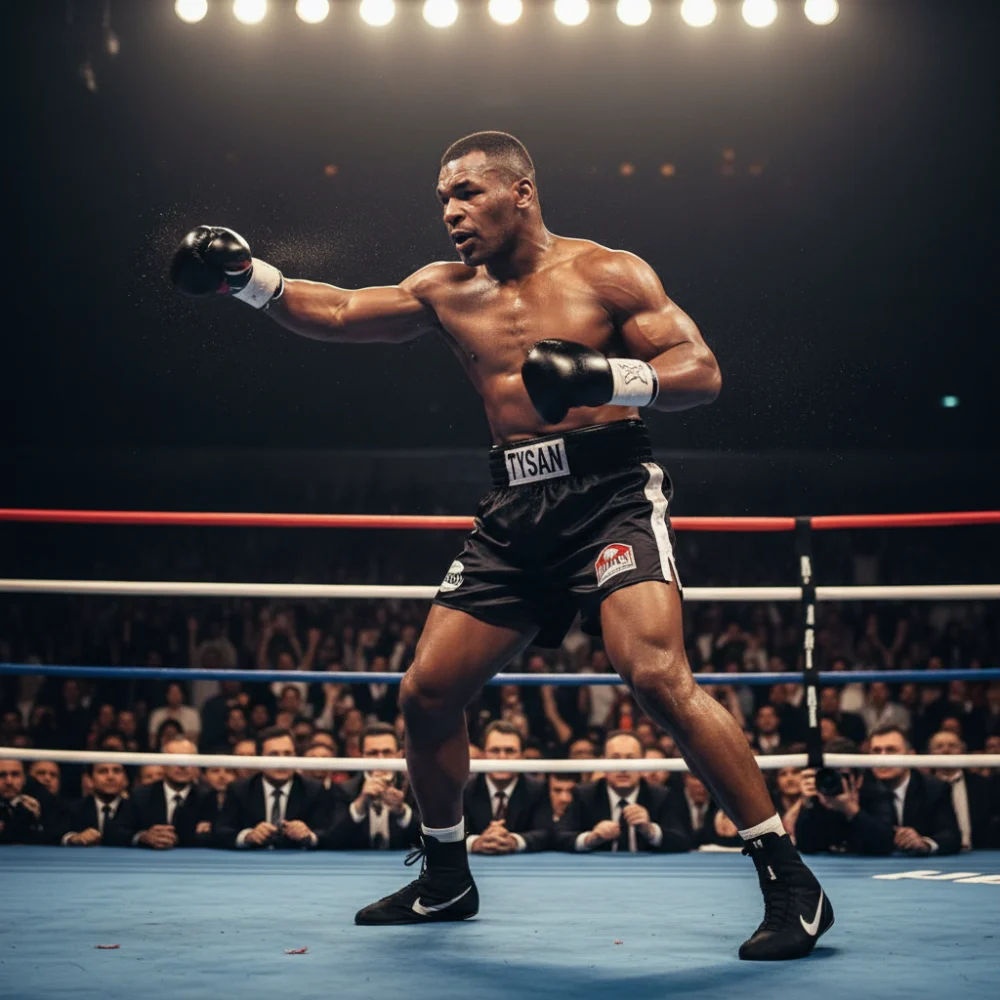
In the annals of combat sports, few names evoke as much visceral emotion as Mike Tyson. Known as “Iron Mike” and later “The Baddest Man on the Planet,” Tyson was not merely a boxer; he was a phenomenon of pure kinetic energy and intimidation. His rise from a troubled youth to the summit of the heavyweight division is a story of raw talent refined by obsessive discipline, resulting in one of the most terrifying primes the sport has ever witnessed.
The Hard Streets of Brownsville
The story of Mike Tyson begins in the gritty neighborhood of Brownsville, Brooklyn. Born into a high-crime environment, Tyson’s early life was defined by survival. By the age of 13, he had been arrested 38 times. However, this turbulent beginning forged a resilience that would later be channeled into the ring. It was during a stint at the Tryon School for Boys that his potential was discovered by Bobby Stewart, a juvenile detention center counselor and former boxer, who eventually introduced him to the legendary trainer Cus D’Amato.
Meeting D’Amato changed the trajectory of Tyson’s life forever. D’Amato didn’t just see a brawler; he saw a potential heavyweight champion of the world. He became Tyson’s legal guardian and moved him to Catskill, New York. There, inside a gym that prioritized discipline and psychological warfare, the transformation began. D’Amato instilled in Tyson a belief system that bordered on the spiritual, convincing the young fighter that he was destined for greatness.
Mastering the Peek-a-Boo Style
Physically, Tyson was an anomaly in the heavyweight division. Standing at just 5 feet 10 inches, he was significantly shorter than most of his opponents. To turn this perceived disadvantage into a weapon, D’Amato and trainer Kevin Rooney taught him the Peek-a-Boo style. This technique required continuous head movement, bobbing and weaving to slip punches while stepping inside the opponent’s guard to deliver devastating counter-punches.
The mechanics of Tyson’s style were brutal and efficient. He utilized his low center of gravity to generate immense leverage, exploding upward with hooks and uppercuts. His defensive movement was not passive; it was the setup for his offense. Key elements of his arsenal included:
- Elusive Head Movement: Constant motion making him nearly impossible to hit cleanly.
- Explosive Speed: Hand speed that rivaled welterweights, allowing him to land combinations before opponents could react.
- The Right Hook to the Body: A debilitating punch that often forced opponents to drop their guard, opening them up for a knockout blow to the head.
The Year of Kid Dynamite: 1985
Mike Tyson turned professional in March 1985, at the age of 18. What followed was one of the most active and destructive debut years in boxing history. Fighting frequently, sometimes twice in a single month, Tyson decimated the competition. He won his first 19 professional fights by knockout, 12 of them in the first round. The boxing world took notice of “Kid Dynamite,” a fighter who entered the ring without a robe, wearing simple black trunks, and possessing a stare that broke opponents before the bell rang.
His aura of invincibility grew with every bout. Tyson didn’t just defeat opponents; he dismantled them. The sound of his punches landing echoed differently, a thudding impact that signaled concussive power. By 1986, it was clear that Tyson was on a collision course with the heavyweight championship, and the media frenzy surrounding him was reaching a fever pitch.
Youngest Heavyweight Champion in History
On November 22, 1986, history was made in Las Vegas. Mike Tyson faced Trevor Berbick for the WBC Heavyweight title. The anticipation was palpable, but the fight itself was a showcase of total dominance. Tyson overwhelmed the champion, knocking him down repeatedly until the referee stopped the fight in the second round. At 20 years, 4 months, and 22 days old, Mike Tyson became the youngest heavyweight champion in history, a record that stands to this day.
This victory was the culmination of Cus D’Amato’s prophecy, though the legendary trainer had passed away a year prior. Tyson dedicated the win to the man who had been a father figure to him. With the WBC belt around his waist, Tyson set his sights on unifying the division, a feat that had become increasingly difficult in the era of fractured sanctioning bodies.
Unifying the Belts: The Road to Undisputed
Tyson’s hunger was not satiated by a single belt. He systematically targeted the other champions. He defeated James “Bonecrusher” Smith to add the WBA title and then Tony Tucker to capture the IBF title. In 1987, Mike Tyson became the undisputed heavyweight champion of the world. He was the first heavyweight to own all three major belts—WBA, WBC, and IBF—simultaneously.
Perhaps the zenith of his prime occurred on June 27, 1988, against Michael Spinks. Spinks, who was undefeated and held the lineal championship, was considered the only legitimate threat to Tyson’s reign. The fight lasted only 91 seconds. Tyson came out with a ferocity that was terrifying to behold, knocking Spinks out cold in the first round. This performance is widely regarded as the peak of Mike Tyson’s prowess.
The Psychology of Fear
Beyond his physical gifts, Tyson was a master of psychological intimidation. He understood that the fight began long before the first bell. His ring walk was devoid of music, replaced by a singular, ominous tone or simple silence. The lack of socks, the towel with the hole cut out for his head, and the black trunks were all calculated choices to project an image of an executioner rather than an athlete.
Tyson famously stated, “Everybody has a plan until they get punched in the mouth.” This quote perfectly encapsulated his approach. He overwhelmed opponents with pressure, forcing them to abandon their strategies and enter survival mode. Many fighters were defeated in the locker room, paralyzed by the reputation of the man waiting for them in the ring.
While his later career was marred by controversy, prison time, and personal struggles, the rise of Mike Tyson remains a unique chapter in sports history. Between 1985 and 1988, he was arguably the most dominant athlete on the planet. He bridged the gap between sports and pop culture, becoming a global icon recognized in every corner of the world.
Today, the legacy of Mike Tyson is viewed with a mixture of awe and complexity. He remains the standard against which punchers are measured. When boxing fans discuss knockout power, head movement, and intimidation, the conversation inevitably returns to Iron Mike. His rise from the streets to the stratosphere of boxing is a testament to the raw, transformative power of the sport.